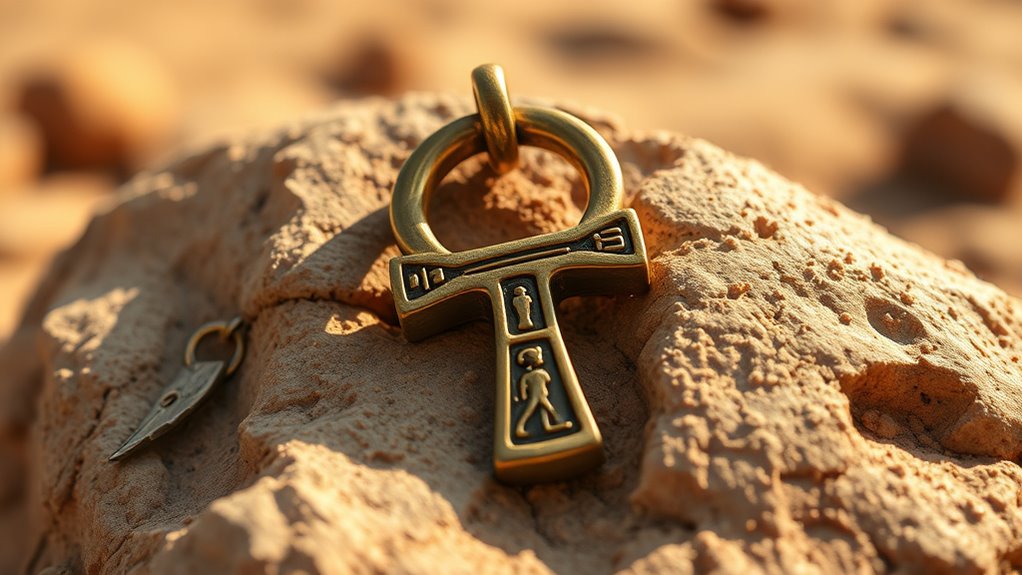

The ankh is an ancient Egyptian symbol that represents life and immortality. You’ll see it in art, jewelry, and hieroglyphs, often held by gods and pharaohs to symbolize divine authority and eternal life. Its loop at the top signifies the soul’s eternity, while the crossbar and stem connect physical and spiritual worlds. To uncover more about this powerful symbol’s meaning and history, keep exploring its fascinating significance.
Key Takeaways
- The Ankh resembles a cross with a loop at the top and symbolizes eternal life in ancient Egyptian culture.
- It is frequently depicted in Egyptian art held by gods, pharaohs, and mortals, representing divine authority and life.
- The shape’s loop signifies the eternal soul, while the crossbar and stem symbolize the union of physical and spiritual worlds.
- The Ankh embodies concepts of life, death, rebirth, and divine vitality, conveying hope for everlasting existence.
- It has cultural and linguistic significance, used in rituals and funerary objects to represent the soul’s journey and immortality.

Have you ever wondered why the ankh has remained a powerful symbol for thousands of years? Its enduring presence stems from its deep roots in ancient Egyptian art and spiritual symbolism. The ankh’s distinctive shape, resembling a cross with a loop at the top, is more than just a design—it embodies profound meanings that have resonated across millennia. In ancient Egyptian art, the ankh appears frequently in the hands of gods, pharaohs, and mortals alike, symbolizing their divine authority and connection to eternal life. Artists depicted the ankh not only as a decorative element but as a visual representation of the life force that sustains the universe, making it a central motif in tomb paintings, sculptures, and jewelry.
The ankh, a symbol of divine authority and eternal life, appears in Egyptian art as a powerful emblem of life’s enduring spirit.
The significance of the ankh goes beyond its aesthetic appeal. Its spiritual symbolism is woven into the very fabric of ancient Egyptian beliefs about life, death, and rebirth. Egyptians believed that life was a sacred gift bestowed by the gods, and the ankh served as a conduit for this divine vitality. When gods are shown holding an ankh, it’s a sign that they are bestowing life or offering protection. The symbol also represents the concept of eternal life, a core aspect of Egyptian religion. It’s often associated with the afterlife, where it signifies the hope for everlasting existence beyond physical death. This spiritual symbolism cemented the ankh as a powerful emblem of hope, renewal, and divine power.
You can see how the ankh’s design captures these ideas effortlessly. The loop at the top is thought to symbolize the eternal soul or the concept of eternity itself, while the crossbar and vertical stem embody the union of the physical and spiritual worlds. Its portrayal in ancient Egyptian art makes it clear that the symbol was not merely decorative but a visual shorthand for complex beliefs about life’s continuity. Whether held by deities or inscribed on funerary objects, the ankh acts as a reminder of the divine promise of immortality. Its presence in sacred rituals and artworks underscores its importance as a spiritual symbol, representing the soul’s journey and the everlasting nature of life itself.
Furthermore, the ankh’s shape is often linked to the Egyptian alphabet and hieroglyphic writing system, indicating its significance in conveying sacred concepts.
In essence, the ankh’s power endures because it encapsulates fundamental human questions about existence and eternity. Its rich history in ancient Egyptian art and spiritual symbolism offers a timeless reminder that life, in all its forms, is sacred and eternal. That’s why, even today, the ankh continues to inspire and symbolize life’s enduring spirit.
Frequently Asked Questions
What Materials Were Traditionally Used to Craft Ankh Symbols?
You’ll find that ancient artisans typically crafted ankh symbols from materials like gold, silver, and copper, using ancient crafting techniques. These metals held symbolic material significance, representing divine power, eternity, and life. You might also see ankh symbols made from stone or faience, chosen for their durability and spiritual meaning. By combining these materials with skilled craftsmanship, they created powerful objects that conveyed sacred beliefs and eternal life.
Did the Ankh Have Any Influence Outside Ancient Egypt?
You might find that the ankh’s influence spread far beyond Egypt, proving that what’s old often becomes new again. Its symbolism of life and immortality has permeated various cultures through trade and cultural diffusion, shaping modern symbolism in jewelry, art, and spiritual practices worldwide. The ankh’s timeless appeal shows that ideas can cross borders, proving that sometimes, history’s footprints leave a mark on contemporary society.
Are There Modern Interpretations or Uses of the Ankh Symbol?
You’ll find the ankh widely used today in modern jewelry, where it symbolizes life and spiritual connection. Artists incorporate it into contemporary art to evoke ancient wisdom and mysticism. People also wear it as a protective talisman or a fashion statement. Its powerful symbolism transcends cultures, making it popular in various spiritual practices and creative expressions, bridging ancient meaning with modern style seamlessly.
How Was the Ankh Worn or Displayed in Ancient Egyptian Society?
You often see the ankh worn as jewelry in ancient Egyptian society, where it served as a personal symbol of life and protection. People displayed it in temple decorations, emphasizing its sacred significance. You might have worn ankh jewelry yourself or seen it adorning statues and wall carvings in temples, highlighting its importance as a symbol of eternal life and divine power in daily life and spiritual practices.
Are There Specific Rituals Associated With the Ankh in Egyptian Religion?
During ancient Egyptian ceremonies, you’ll notice the ankh often plays a key role in religious symbolism. It’s used in rituals to invoke divine protection, health, and eternal life. Priests and pharaohs hold or display the ankh to connect with gods and affirm spiritual truths. Its presence in sacred acts underscores its importance in reinforcing the divine power and eternal life that ancient Egyptian religion venerates.
Conclusion
Now that you know the ankh symbolizes life and immortality, imagine holding one in your hand, feeling its ancient power. Did you know that over 1,500 years ago, ancient Egyptians used the ankh in daily rituals? It’s more than just a symbol—it’s a timeless reminder of life’s enduring strength. Next time you see it, picture the countless generations that believed in its magic, inspiring you to cherish every moment of your own life.