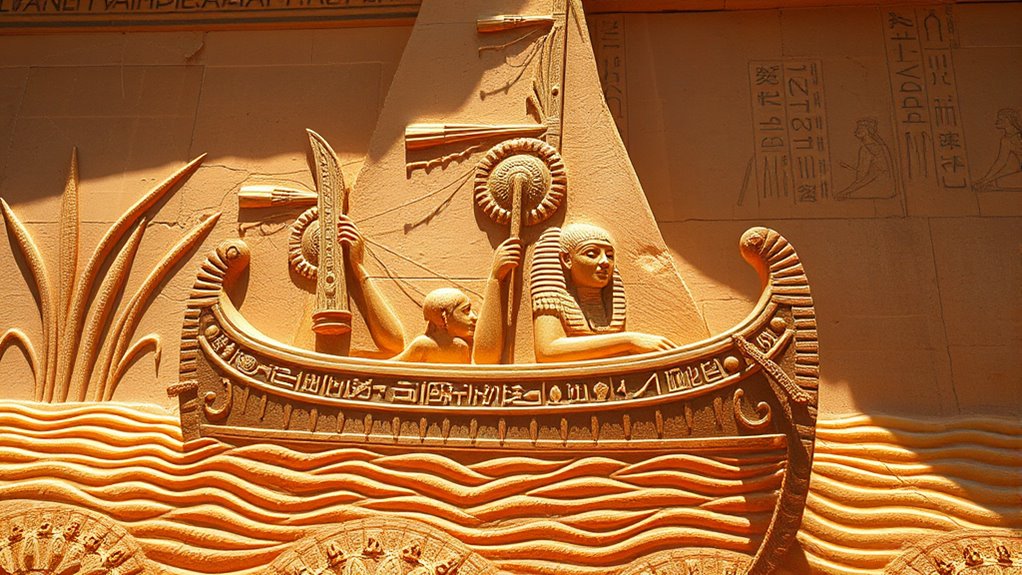
In Egyptian iconography, sacred boats symbolize divine guidance, spiritual passage, and the soul’s journey toward rebirth. They go beyond transportation, representing the connection between mortal life and the divine sphere. Often adorned with solar motifs, these boats reflect cosmic order and the sun god Ra’s journey through the sky. If you explore further, you’ll uncover how these vessels embody eternal life and the spiritual importance woven into Egyptian art and beliefs.
Key Takeaways
- Boats symbolize the soul’s journey, divine passage, and connection to the afterlife in Egyptian iconography.
- They represent divine guidance through the underworld and the transition from mortal life to eternal life.
- Often feature solar motifs, linking them to the sun god Ra’s celestial journey and cosmic order.
- Used in royal imagery to depict stability, protection, and the pharaoh’s mediating role between gods and humans.
- Incorporate drum-shaped elements symbolizing life’s cyclical nature and the ongoing process of rebirth.

Have you ever wondered why boats hold such a prominent place in Egyptian art and iconography? It’s because they symbolize more than just transportation—they represent the very essence of life, spiritual passage, and divine guidance. In ancient Egypt, the Nile was the lifeblood of the land, and river journeys along its waters weren’t just practical—they were deeply spiritual, embodying the journey of the soul and its connection to the divine. When you see images of boats in Egyptian art, you’re witnessing a reflection of this sacred voyage, a metaphor for crossing from the mortal world into the realm of gods and eternity.
Egyptian boats often appear in scenes of the afterlife, guiding the deceased through the Duat, the underworld. These vessels are not ordinary crafts; they symbolize the soul’s journey toward rebirth and eternal life. The boat becomes a vessel of divine guidance, a means by which the soul traverses the treacherous waters of the afterlife, seeking harmony with the gods. The imagery suggests that life itself is a continuous river journey, and death is merely a transition facilitated by divine aid. As you observe these depictions, you realize that boats serve as a bridge between worlds, helping souls navigate the complexities of existence and the afterlife.
Egyptian boats in the afterlife symbolize the soul’s journey toward rebirth and divine guidance.
The design of Egyptian boats further emphasizes their spiritual significance. They often feature solar motifs, with the sun god Ra believed to travel across the sky in a celestial boat. This connection underscores the idea that boats are not just physical objects but spiritual symbols of divine power and cosmic order. By associating boats with the sun’s journey, Egyptian artisans conveyed that divine navigation was integral to maintaining balance within the universe. When you look at these images, you see a divine blueprint for navigating life’s challenges, with the boat acting as a trusted guide through both the physical and spiritual realms.
In Egyptian iconography, the boat also served as a symbol of stability and protection. Pharaohs were often depicted riding in divine boats, emphasizing their role as mediators between gods and people. Their journey along the Nile or in the afterlife was a sacred duty, ensuring the harmony of the cosmos. These images reinforce the belief that divine guidance is central to order and stability. So, when you encounter Egyptian art featuring sacred boats, you’re witnessing a rich tapestry of symbolism—an enduring reminder that life’s true voyage is spiritual, guided by divine forces that help you navigate the waters of existence, both here and beyond. Additionally, the construction and design of these boats often incorporated drum-shaped elements, symbolizing the cyclical nature of life and rebirth in Egyptian belief systems.
Frequently Asked Questions
How Did Boat Symbolism Evolve Throughout Egyptian History?
You see that boat symbolism evolved from simple watercraft to profound mythological significance and royal symbolism. Early on, boats represented life’s journey, but over time, they became symbols of divine travel in the afterlife and the sun god’s daily journey. Royalty used sacred boats to emphasize their divine connection, showcasing their role as intermediaries between gods and people. This evolution highlights Egypt’s deep spiritual and political values.
What Materials Were Commonly Used to Craft Ancient Egyptian Boats?
You’ll find that materials like cedar, acacia, and papyrus were commonly used in crafting ancient Egyptian boats. These materials offered durability and buoyancy, crucial for navigation and ceremonial purposes. Skilled craftsmanship was essential, as artisans carefully assembled and decorated the vessels with intricate carvings and paint. The choice of materials and craftsmanship reflected both practical needs and spiritual symbolism, emphasizing the boats’ sacred significance in Egyptian culture.
Were Boats Used Exclusively for Religious Purposes or Also for Daily Life?
Imagine thinking ancient Egyptian boats only served divine purposes—how boring! In reality, you’d find them bustling with everyday life, ferrying people across the Nile for secular reasons and daily transportation. These boats weren’t just sacred relics; they were practical, essential tools for survival. You could hop on a boat to visit friends, trade goods, or escape the heat—proving that in Egypt, even the divine had a busy schedule.
How Did Egyptian Boat Design Influence Later Maritime Cultures?
Egyptian boat design greatly influenced later maritime cultures through innovations in pharaonic navigation and Nile transit. You can see this impact in the use of lightweight, streamlined hulls and sail systems that allowed easier movement across water. These designs inspired Mediterranean and Middle Eastern boat builders, who adopted Egyptian techniques for trade and exploration. By mastering Nile transit, Egyptians set foundational principles that shaped subsequent seafaring and riverine vessel development.
Are There Any Surviving Ancient Egyptian Boats or Models Today?
Did you know that over 50 ancient Egyptian boat models have been discovered? Yes, you can see authentic ancient ship models in museums, and many modern boat replicas are inspired by these. While fully preserved ancient Egyptian boats are rare, some well-preserved fragments and models still exist today, allowing you to appreciate their craftsmanship. These remnants connect you to Egypt’s maritime history and show how their designs continue to influence boat construction.
Conclusion
As you sail through Egypt’s ancient waters, the boats become more than vessels—they’re ladders to the divine, ripples of eternity in stone and paint. Each stroke and curve whispers stories of rebirth, protection, and connection to the gods. Let these sacred boats carry your imagination across timeless currents, where life and afterlife intertwine like the flowing Nile. In their silent voyage, they invite you to feel the eternal heartbeat of Egypt’s spiritual soul.