Before DNA was discovered, the double helix symbolized life’s interconnectedness, growth, and renewal. Cultures worldwide used spiral imagery in art and sacred symbols to represent life’s cyclic nature and continuity across generations. The shape suggested resilience, inheritance, and the repeating patterns that underlie biological diversity. It embodied the idea that nature’s blueprint is woven into a spiraling form, symbolizing the hidden order of life itself. To understand how this imagery influenced scientific thought, keep exploring.
Key Takeaways
- The double helix symbolized life’s interconnectedness, growth, and the cycle of renewal long before its scientific discovery.
- Spiral imagery in ancient cultures represented continuity, evolution, and the recurring patterns of life across civilizations.
- Early perceptions linked the spiral shape to genetic inheritance, variation, and the elegant blueprint of life.
- The double helix served as a metaphor for biological development, emphasizing unity, complexity, and natural progression.
- Its symbolism influenced early ideas about genetic forces, underlying order in nature, and the interconnected fabric of life.
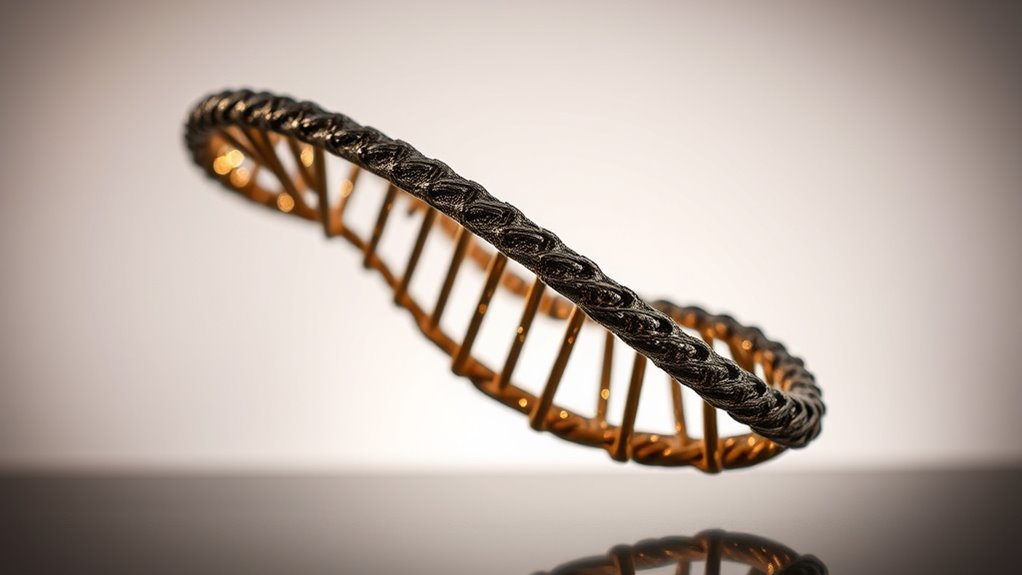
The double helix has become a powerful symbol representing life, growth, and the interconnectedness of all living things. Even before scientists uncovered the structure of DNA, people instinctively associated the spiral form with nature’s endless cycle of renewal. This spiral imagery, evident in everything from galaxies to seashells, became a natural metaphor for genetic symbolism — the idea that life’s blueprint is woven into a repeating, spiraling pattern. Long before the molecular details of DNA were known, the double helix represented the fundamental code of life, a visual shorthand for the complex interweaving of genetic information.
The double helix symbolizes life’s interconnectedness, growth, and the endless cycle of renewal woven into nature’s spiraling patterns.
In many ancient cultures, spirals signified growth, evolution, and the continuity of life. They appeared in petroglyphs, pottery, and sacred symbols, embodying the idea that life unfurls in recursive patterns. These early representations laid the groundwork for understanding the spiral as a symbol of biological and spiritual interconnectedness. When people looked at the spiral imagery, they saw a reflection of life’s ongoing cycle—birth, growth, death, and rebirth—all encoded within a continuous, flowing line. This universal symbol hinted at an underlying order, a hidden structure that connects all living beings across time and space.
Even without scientific knowledge of DNA, the double helix was already revered as a representation of genetic symbolism. The twisting, winding shape suggested a blueprint that was both elegant and resilient. It implied that life’s diversity springs from a simple, repeating pattern—one that could be passed from generation to generation. The spiral imagery, then, offered a visual cue for understanding inheritance, variation, and the continuity of life. It was as if the shape itself contained the secret of life’s complexity, a symbol of how genetic information is stored, transmitted, and expressed through a looping, intertwined structure.
Furthermore, the spiral shape is often linked to concepts of growth and evolution, reinforcing its connection to biological development and change over time. Before the discovery of DNA, scientists and thinkers saw the double helix as more than just a scientific model; it was a symbol of life’s inherent unity and complexity. They recognized that the spiral form carried deep meaning—an emblem of growth and interconnectedness at every level. This perception helped shape the way people thought about heredity and biological continuity, long before the molecular details were uncovered. The double helix, with its spiral imagery, stood as a visual metaphor for the unseen genetic forces shaping every living thing, symbolizing the blueprint of life woven into the fabric of nature itself.

NORLSO Gold Spiral Bracelet for Women Vintage Spiral Link Bracelet Adjustable Helix Charm Bracelet Boho Jewelry Gifts (Gold)
Unique Design: This vintage spiral link Bracelet comes in two colors, gold and silver, allowing you to freely…
As an affiliate, we earn on qualifying purchases.
As an affiliate, we earn on qualifying purchases.
Frequently Asked Questions
How Was the Double Helix Symbol Used in Ancient Cultures?
You might find that the double helix symbol isn’t directly linked to ancient cultures, but similar patterns appear in ancient symbolism and cultural motifs. For example, spirals and intertwined designs represented concepts like eternity, life cycles, or spiritual growth. These motifs often symbolize interconnectedness and harmony, echoing the double helix’s themes of unity. While not identical, they reveal how ancient cultures used complex structures to convey profound ideas about life and the universe.
Did Any Other Scientific Symbols Resemble the Double Helix Before DNA?
You wonder if any scientific symbols resembled the double helix before DNA. While molecular motifs often mirror nature’s nuances, few symbolic structures explicitly echo the double helix’s twist. Some scientists drew inspiration from spiral and helical shapes, but these weren’t widely recognized as symbolic structures representing genetic material. The double helix’s distinctive design became uniquely iconic, setting it apart from other scientific symbols that share similar swirling or spiral characteristics.
What Philosophical Meanings Were Associated With the Double Helix Before DNA?
You might find that the double helix symbol was often linked to mystical spiral and cosmic symbolism before DNA’s discovery. People saw it as representing life’s endless cycles, universal harmony, and the interconnectedness of all things. Its twisting form reflected spiritual growth and the universe’s mysteries, giving it a deep philosophical meaning. This symbolism suggested that life and cosmos are intertwined, emphasizing the idea of continuous evolution and divine order.
Were There Artistic Representations of the Double Helix Prior to DNA Discovery?
You might wonder if there were artistic interpretations of the double helix before DNA’s discovery. While direct representations are rare, some mythical motifs and abstract designs evoke the spiral and twisting forms resembling the helix. Artists often drew inspiration from nature’s patterns, which could resemble the double helix’s shape. These artistic interpretations reflect an innate fascination with spirals, but concrete depictions specifically of the double helix appeared only after its scientific significance became clear.
How Did the Double Helix Influence Early Theories of Genetics?
You might find it fascinating how the double helix shaped early genetics theories, almost by chance. The molecular structure revealed how genetic information is stored and passed down, inspiring scientists to explore genetic coding deeper. This elegant design suggested a mechanism for replication, fueling ideas about heredity. Its discovery marked a turning point, helping scientists understand DNA’s role in inheritance, and shaping modern genetics with a visual blueprint of life’s code.

HMANE DNA Models Double Helix Model Components Science Educational Teaching Instrument Toy
√Principle: In a double-stranded DNA molecule, A=T, G=C. That is: A + G = T + C or…
As an affiliate, we earn on qualifying purchases.
As an affiliate, we earn on qualifying purchases.
Conclusion
Imagine the double helix as a secret staircase woven into the fabric of life itself, guiding you through the unseen depths of nature’s design. Before DNA was uncovered, this symbol whispered that life’s true blueprint is a delicate dance of intertwining paths, each twist revealing a new mystery. Embrace the double helix as your compass, reminding you that understanding life’s complexity begins with trusting the elegant, spiraling journey of discovery.

LZAOA Fibonacci Spiral Metal Wall Art, Math Art Fibonacci Spiral Gold Wall Decor, Metal Wall Decor for Living Room, Office, Outdoor, Indoor (12 * 12 In)
Geometric Metal Wall Decoration: Our 12 × 12 In Fibonacci Spiral Metal Wall Art is made of 100%…
As an affiliate, we earn on qualifying purchases.
As an affiliate, we earn on qualifying purchases.

4-Pack Copper Spiral Goddess Charms, Divine Feminine Symbols with Double-Sided Design for Spiritual Jewelry
AUTHENTIC TIERRACAST SACRED DESIGN: Originally designed by renowned TierraCast and now crafted by passionfashion in Greece, these spiral…
As an affiliate, we earn on qualifying purchases.
As an affiliate, we earn on qualifying purchases.