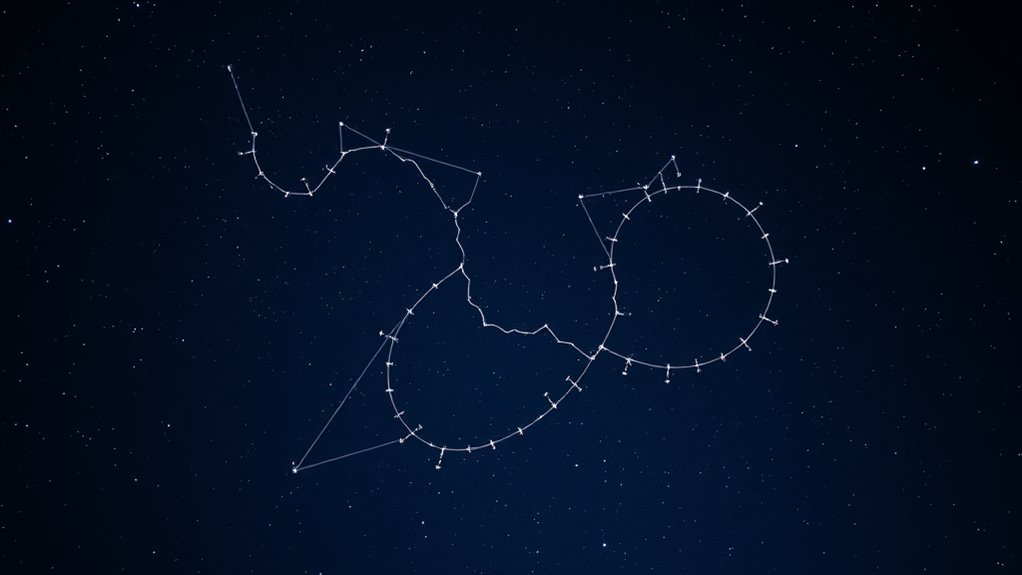

The Draco constellation is steeped in myth, famously linked to Ladon, the dragon guarding golden apples in Greek stories, symbolizing protection and vigilance. Its winding shape resembles a celestial serpent, serving as a navigational marker near the North Celestial Pole. Across cultures, Draco embodies themes from chaos to wisdom, often seen as a guardian of the sky. Exploring its stories and alignments reveals how ancient societies interpreted the stars—and there’s more to discover about its cultural and navigational significance.
Key Takeaways
- Draco is linked to Ladon, the Greek dragon guarding golden apples, symbolizing protection and vigilance in mythology.
- Its shape resembles a winding dragon, reinforcing its role as a celestial guardian across various cultures.
- Positioned near the North Celestial Pole, Draco serves as a key navigational reference in the night sky.
- In Chinese astronomy, Draco symbolizes the celestial dragon representing power and good fortune.
- The constellation’s myth and geometric alignment reflect humanity’s desire to interpret the cosmos through stories and science.
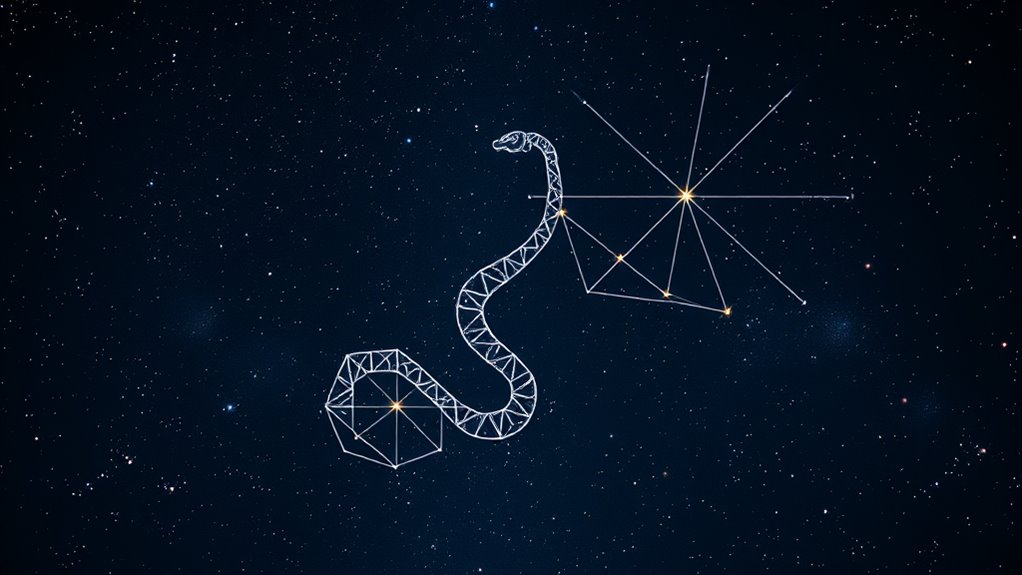
Have you ever wondered about the tales behind the Draco constellation? This striking pattern of stars has fascinated humanity for centuries, and its mythological origins reveal a rich tapestry of legends. In various cultures, Draco has symbolized different themes, from danger and chaos to protection and wisdom. Understanding its mythological roots helps you appreciate why this constellation holds such significance across civilizations. For the ancient Greeks, Draco was associated with the myth of Ladon, the dragon who guarded the golden apples in the Garden of the Hesperides. This mythological origin positions Draco as a symbol of guarding sacred treasures, emphasizing strength and vigilance. Meanwhile, in other traditions, Draco represented a celestial serpent or dragon, embodying primal chaos or transformative power. These cultural symbols reflect how ancient societies viewed the cosmos as a mirror of their values, fears, and hopes.
As you explore the constellation’s mythological origins, notice how its shape resembles a dragon winding through the sky. This visual connection reinforces its role as a guardian or a symbol of protection in many cultures. In Chinese astronomy, Draco is linked to the celestial dragon, embodying power and auspiciousness. The dragon’s cultural symbolism in this context highlights its importance as a protector of the heavens and a bringer of good fortune. Similarly, in Western traditions, Draco’s serpent-like form often symbolizes danger or chaos, yet also the cycle of renewal and transformation. The mythological stories woven around Draco reflect humanity’s desire to understand and interpret the sky’s patterns, imbuing the stars with meaning that transcends mere light points.
Beyond the myths themselves, the geometric alignments of Draco also intrigue astronomers and stargazers alike. Its position near the North Celestial Pole makes it a navigational reference point, symbolizing stability amid the chaos of the night sky. The constellation’s winding shape and its proximity to other prominent stars create a natural framework for celestial navigation and storytelling. These geometric alignments serve as a bridge between myth and science, illustrating how ancient cultures used the stars not only for myth-making but also for practical purposes like navigation and calendar systems. When you look up at Draco, you’re witnessing a celestial pattern that embodies centuries of myth and symbolism, connecting you to the cultural stories that have shaped human understanding of the universe. This blend of mythological origins and geometric alignments enriches Draco’s role as both a symbol and a navigational guide in the night sky.
Top picks for "draco constellation myth"
Open Amazon search results for this keyword.
As an affiliate, we earn on qualifying purchases.
Frequently Asked Questions
Are There Any Recent Discoveries Related to Draco’s Stars?
Recent stellar research and astronomical observations have uncovered intriguing details about Draco’s stars. You’ll find that astronomers have recently identified new exoplanets orbiting stars within Draco and studied stellar evolution patterns more closely. These discoveries help deepen our understanding of the galaxy’s structure and star formation processes. Staying updated on these findings allows you to appreciate the ongoing efforts to explore Draco’s stellar landscape and its role in the broader universe.
How Does Draco’s Position Vary Over Earth’s History?
They say, “what goes up must come down,” but celestial movement shows otherwise. Over Earth’s history, Draco’s position has shifted due to precession and orbital changes, causing historical shifts in its location in the night sky. You can see how its apparent position varies over time, tracing a slow dance across the celestial sphere. These shifts remind us that even the stars have a story of change, spanning ages and epochs.
Are There Any Hidden Symbols in Draco’s Shape?
You might wonder if Draco’s shape holds hidden symbols. While some believe its form hints at celestial symbolism or mythological interpretations, there’s no concrete evidence of intentional symbols. Many see the constellation as a dragon from ancient stories, but its pattern primarily reflects its mythological role. So, although intriguing, Draco’s shape doesn’t reveal secret symbols, just a fascinating connection to celestial mythology.
What Is the Significance of Draco in Different Cultures?
Think of Draco as a timeless dragon weaving through the night sky, embodying power and mystery. In different cultures, its mythological significance varies—sometimes as a guardian, other times as a symbol of protection or chaos. Its cultural symbolism reflects deep-rooted stories and beliefs, making Draco a celestial emblem that connects humanity’s collective imagination across civilizations. You see, its significance is a mirror of our universal fascination with the divine and the unknown.
Can Draco Be Seen From the Southern Hemisphere?
You can see Draco from the southern hemisphere, but it’s quite high in the northern sky, making it less visible than from the north. This affects celestial navigation, as navigators rely on prominent constellations like Draco for orientation. Its mythological symbolism, often linked to dragons, adds cultural meaning regardless of your location. So, while it’s harder to spot from the south, Draco still holds significance in celestial observations worldwide.
Conclusion
As you gaze upon Draco’s winding form, you gently uncover the stories woven into its stars. These myths whisper softly of ancient fears and celestial guardians, guiding your curiosity through timeless patterns. The constellation’s silent dance hints at secrets best left unspoken, inviting you to appreciate the quiet harmony above. In the end, Draco’s gentle presence reminds you that some mysteries are meant to be appreciated, softly guiding your wonder without unsealing every secret.