
The Golden Ratio, approximately 1.618, is a unique mathematical proportion that shapes our perception of beauty and harmony. You’ll notice it in nature, art, and architecture, creating compositions that feel balanced and natural. This ratio subconsciously guides the eye and evokes a sense of order and aesthetic appeal. Understanding these principles helps you craft designs that resonate with universal beauty—continue exploring to discover how this hidden code influences visual harmony.
Key Takeaways
- The golden ratio (~1.618) is a mathematical proportion that appears naturally in art, architecture, and nature.
- It creates balanced and harmonious compositions that are aesthetically pleasing to the human eye.
- Famous structures and artworks, like the Parthenon and da Vinci’s “Vitruvian Man,” incorporate the golden ratio.
- Designers use the ratio to achieve natural visual flow and subconscious appeal in various creative fields.
- Understanding the golden ratio links mathematical principles with universal concepts of beauty and harmony.
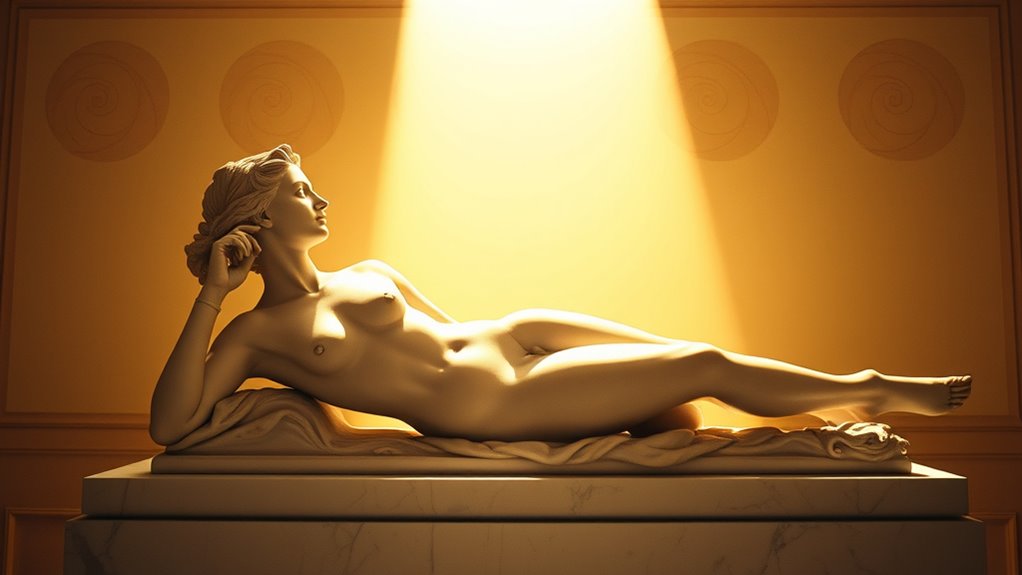
Have you ever wondered what makes certain designs and artworks feel naturally pleasing to the eye? The answer often lies in the concept of the golden ratio, a fascinating mathematical proportion that has captivated artists, architects, and designers for centuries. When you look at a visually appealing composition, chances are it embodies principles of mathematical proportions that create a sense of aesthetic harmony. This ratio, approximately 1.618, appears repeatedly in nature, architecture, and art, suggesting a universal blueprint for beauty.
The golden ratio creates naturally pleasing, harmonious designs found in art, nature, and architecture.
The essence of the golden ratio is its ability to divide a line or space into parts that maintain a specific proportional relationship, where the whole relates to the larger part just as the larger part relates to the smaller part. When you apply this proportion to your work, it results in compositions that feel balanced and harmonious without any element overpowering the others. This is because the human eye instinctively recognizes and appreciates these proportions, which evoke a sense of order and natural beauty. The golden ratio isn’t just a mathematical curiosity; it’s a tool that helps you craft designs that resonate on a subconscious level.
In art and architecture, you’ll notice how buildings, paintings, and sculptures often incorporate golden ratio divisions to enhance their visual appeal. For instance, in the Parthenon or Leonardo da Vinci’s famous “Vitruvian Man,” the application of these proportions results in a sense of perfection. When you understand the underlying logic, you can intentionally embed these proportions into your own work to achieve similar effects of aesthetic harmony. It’s like giving your creation a secret code that the human mind recognizes as pleasing, even if we don’t consciously realize it.
Using mathematical proportions like the golden ratio isn’t about strict rules; it’s about understanding the underlying principles that make a design feel right. When you integrate these proportions seamlessly, your work embodies a natural balance that draws viewers in and keeps their attention. Additionally, recognizing how these ratios appear in nature can inspire you to incorporate biological patterns into your creative processes, making your designs feel even more organic and appealing. Whether you’re designing a logo, composing a photograph, or creating a sculpture, applying the golden ratio can elevate your work by aligning it with the subconscious cues our minds associate with beauty. Ultimately, understanding this relationship between mathematics and aesthetic harmony empowers you to craft artworks that are not only visually appealing but also deeply resonant with those who experience them.
Frequently Asked Questions
How Is the Golden Ratio Calculated Mathematically?
To calculate the golden ratio mathematically, you use the ratio calculation where a line is divided into two parts, a longer one (a) and a shorter one (b). The formula is (a + b) / a = a / b, which equals approximately 1.618. You can solve for the ratio by setting up this mathematical formula, then find the value that satisfies this proportion for your specific lengths.
Are There Visual Examples of the Golden Ratio in Nature?
Yes, you can see visual examples of the golden ratio in nature. Look at flower patterns where petals often follow this ratio, creating balanced and appealing arrangements. Animal proportions also display it; for instance, the spiral shells of certain mollusks or the proportions of a human face align with the golden ratio. These natural examples highlight how the golden ratio contributes to the symmetry and harmony you observe in the world around you.
Does the Golden Ratio Apply to Modern Design?
Like a compass guiding sailors, the golden ratio steers modern design. You’ll see it in logos, architecture, and layout compositions, proving its timeless appeal. Its historical applications highlight cultural significance, symbolizing harmony and balance. Designers use it to create visually pleasing, intuitive experiences. So, yes, the golden ratio still influences contemporary aesthetics, connecting past principles with today’s innovative creations.
Can the Golden Ratio Be Used in Architecture Today?
Yes, you can use the golden ratio in architecture today. It’s applied in both historical architecture and contemporary applications to create harmony and balance. You might incorporate it into building layouts, facades, or interior designs to enhance aesthetic appeal. Architects often rely on this ratio to guide proportions, ensuring structures feel naturally pleasing. Using the golden ratio helps you achieve timeless beauty and visual coherence in modern architectural projects.
Is the Golden Ratio Related to the Fibonacci Sequence?
Yes, the golden ratio is related to the Fibonacci sequence through a fascinating mathematical connection. As you progress along the Fibonacci sequence, the ratio of consecutive numbers approaches the golden ratio, creating a clear sequence relationship. This connection highlights how the golden ratio naturally emerges from simple recursive patterns, making it a fundamental concept in understanding patterns in nature, art, and architecture.
Conclusion
So, isn’t it fascinating how the golden ratio appears in both art and nature, almost as if it’s a hidden code shaping our perception of beauty? It’s like the universe subtly aligns itself, whispering that harmony isn’t just a coincidence but a universal truth. Maybe, in some strange way, you’ve always been drawn to these perfect proportions because they resonate with the very fabric of existence. After all, beauty might just be math’s quiet masterpiece.