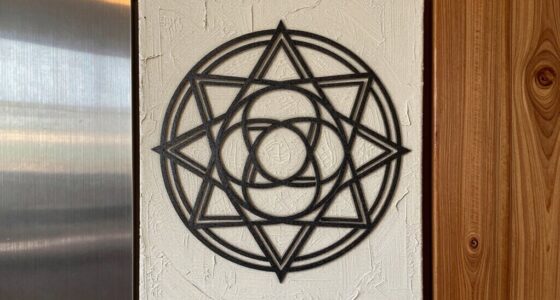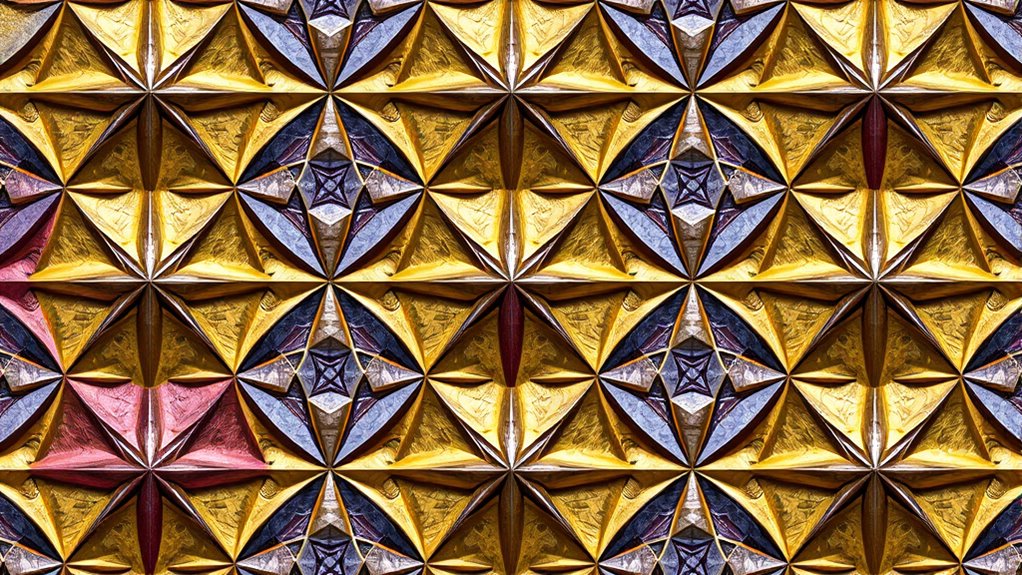

Penrose tiling reveals a mesmerizing pattern that fills a plane without repeating, showcasing non-periodic order. This intricate design reflects a deeper cosmic harmony, suggesting that beauty and structure can exist beyond symmetry and repetition. It challenges traditional ideas of pattern and chaos, hinting at a universal organization rooted in mathematical principles. Exploring this fascinating structure will open your eyes to how complex patterns mirror the universe’s mysterious, elegant order.
Key Takeaways
- Penrose tiling demonstrates aperiodic patterns that never exactly repeat but maintain a harmonious, ordered structure.
- It embodies quasicrystal properties, revealing complex arrangements that challenge traditional symmetry notions.
- Such patterns mirror cosmic order, suggesting that beauty and structure can emerge from irregular yet mathematically governed arrangements.
- Penrose tilings bridge art and science, illustrating how intricate, non-repetitive patterns reflect the universe’s underlying organization.
- They symbolize that infinite complexity can produce elegant, non-repeating structures, offering insights into cosmic and mathematical harmony.
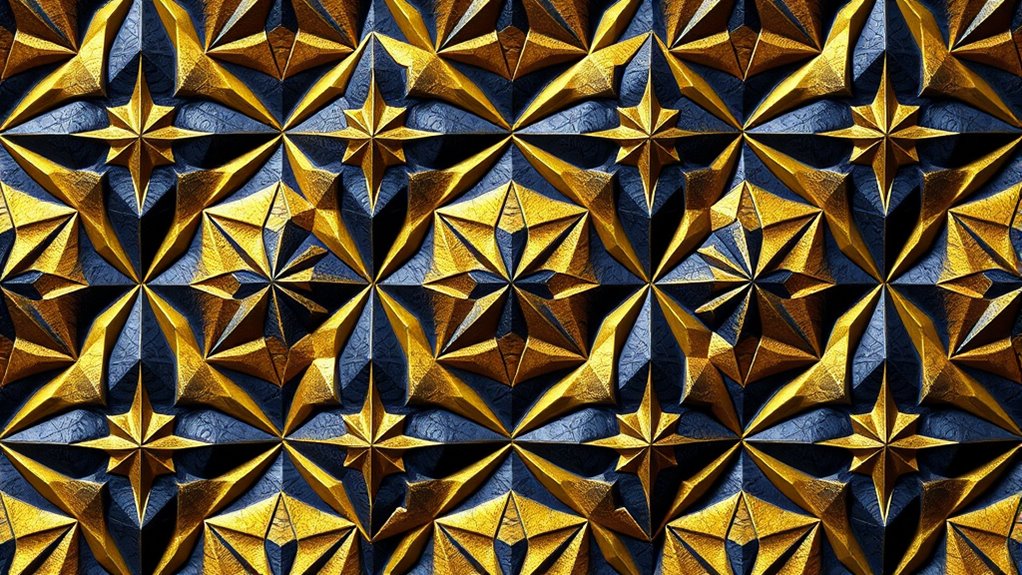
Have you ever wondered how certain patterns can fill a plane without repeating? With Penrose tiling, you discover a mesmerizing example of this phenomenon. Unlike traditional tilings that repeat periodically, Penrose patterns cover a plane in a way that never repeats exactly, yet they maintain a harmonious and ordered structure. This intriguing quality arises from the unique properties of its quasicrystal structure, which challenges conventional notions of symmetry and periodicity. As you explore it, you’ll see that Penrose tiling embodies a kind of mathematical aesthetics—beauty rooted in complexity and non-repetition, yet possessing a deep sense of order.
The quasicrystal structure at the heart of Penrose tiling reveals a fascinating intersection of mathematics and art. These structures, once thought impossible, display symmetries that are aperiodic—meaning they never repeat exactly but still follow strict mathematical rules. This creates a pattern that appears both random and perfectly ordered. When you study the tiling, you notice how the shapes, such as kites and darts or thin and thick rhombuses, fit together in a way that defies the regular grids seen in traditional tilings. This non-repeating arrangement is what makes Penrose tiling so captivating. It’s as if the pattern whispers a cosmic secret: order can exist without repetition. This insight has profound implications beyond mathematics, influencing fields like physics, where quasicrystals are observed in nature, and in art, where the aesthetic appeal of non-periodic tilings continues to inspire.
You’ll find that Penrose tiling’s mathematical aesthetics go beyond mere visual appeal. It embodies a sense of harmony that resonates on a deeper level, suggesting that beauty can be found in complexity and irregularity. The pattern’s non-repeating nature mirrors the structure of the universe itself, hinting at underlying cosmic order. As you examine the pattern, you realize it’s a visual manifestation of mathematical principles that govern quasicrystals, materials with a similar aperiodic order. This connection reveals how mathematical concepts shape the physical world, bridging the gap between abstract theory and tangible reality. Engaging with Penrose tiling, you experience a sense of wonder—an appreciation for how intricate patterns can evoke both chaos and harmony simultaneously. It becomes a symbol of how the universe’s complexity can be both unpredictable and beautifully ordered.
In essence, Penrose tiling invites you into a universe where patterns defy the ordinary rules of symmetry. Its quasicrystal structure showcases the elegance of non-periodic arrangements, illustrating that beauty isn’t always about repetition. Instead, it’s about discovering the hidden order woven into complexity. This pattern exemplifies mathematical aesthetics at its finest, blending art, science, and cosmic mystery into a unified whole. As you explore its intricacies, you realize that Penrose tiling offers more than visual delight — it’s a window into a deeper understanding of how the universe organizes itself, beautifully and endlessly, in patterns that challenge and inspire. Additionally, the non-repeating patterns serve as a reminder of the infinite possibilities within mathematical structures.
Penrose tiling puzzle kit
As an affiliate, we earn on qualifying purchases.
As an affiliate, we earn on qualifying purchases.
Frequently Asked Questions
How Can Penrose Tiling Be Applied to Modern Architecture?
You can apply Penrose tiling to modern architecture by integrating its non-repeating patterns into adaptive facades, creating dynamic, eye-catching exteriors. These patterns also lend themselves well to decorative mosaics, adding visual complexity and cultural depth. By using Penrose tiling, you make structures more engaging and unique, while also exploring new aesthetic possibilities that blend mathematical elegance with functional design.
What Is the Mathematical Basis Behind Penrose Patterns?
You wonder what lies beneath the mesmerizing patterns. The mathematical foundations reveal a fascinating blend of geometric constructions and irrational numbers. These patterns arise from aperiodic tilings, where shapes fit together without repeating, yet follow strict mathematical rules. It’s a delicate balance of symmetry and complexity, rooted in golden ratios and projection methods, creating a tapestry that’s both unpredictable and perfectly ordered—an intricate dance of mathematics and art that defies simple explanation.
Are There Natural Examples of Penrose Tiling in Biology?
You might find natural examples of Penrose tiling in biology through molecular arrangements and cellular structures. Some biological patterns, like the arrangement of certain proteins or the structure of viral capsids, display non-repeating, quasi-periodic features similar to Penrose patterns. These arrangements help enhance stability and functionality, demonstrating how nature employs complex, non-repetitive designs that mirror the mathematical beauty of Penrose tiling in the natural world.
How Does Penrose Tiling Relate to Quasicrystals?
Imagine quasicrystal structures as intricate mosaics, where aperiodic order creates stunning patterns. You see, these structures don’t repeat like regular crystals but follow Penrose tiling principles. This non-repeating pattern results in unique, symmetrical arrangements that mirror Penrose tiling’s non-periodic design. Quasicrystals embody aperiodic order, linking directly to Penrose tiling, revealing how complex, non-repetitive patterns can exist naturally, defying traditional crystal symmetry.
Can Penrose Patterns Be Generated Using Computer Algorithms?
You can definitely generate Penrose patterns using computer algorithms. By employing algorithmic generation and computational modeling, you create these intricate non-repeating patterns efficiently. These methods allow you to explore various tiling arrangements, ensuring accuracy and complexity. Computational tools help you simulate the precise rules needed to produce Penrose tilings, making it easier to study their mathematical properties and applications in quasicrystals and other fields.

Adult Coloring Book for Women Relaxation, 24 Pages Mindfulness Coloring Books for Adult – Anxiety Relief, Stress Relief & Relaxing Gifts for Women Include Mandala Wildlife Plant Cultural Motifs
[24 Non-repeating Design] Each of the 24 exclusive designs masterfully interweaves sacred mandala geometries with enchanting wildlife, botanical…
As an affiliate, we earn on qualifying purchases.
As an affiliate, we earn on qualifying purchases.
Conclusion
So, next time you marvel at those seemingly random patterns, remember, Penrose tiling proves there’s a cosmic order hiding in chaos—kind of like your cluttered desk revealing a secret universe. Instead of boring repeats, you get endless, non-repeating beauty that’s basically the universe’s way of saying, “I don’t do predictable.” So go ahead, embrace the chaos—after all, it’s just the universe’s art project, and you’re lucky enough to be part of the gallery.
quasicrystal model kit
As an affiliate, we earn on qualifying purchases.
As an affiliate, we earn on qualifying purchases.

Classroom Poster for Classical Physics Charts, Mathematical Formulasr Room Aesthetic Posters Canvas Wall Art 16x20inch(40x50cm) Unframe-style-2
Modern Canvas Texture:Premium matte-finish canvas with subtle linen texture, designed to resist glare and fingerprints. No cheap paper…
As an affiliate, we earn on qualifying purchases.
As an affiliate, we earn on qualifying purchases.