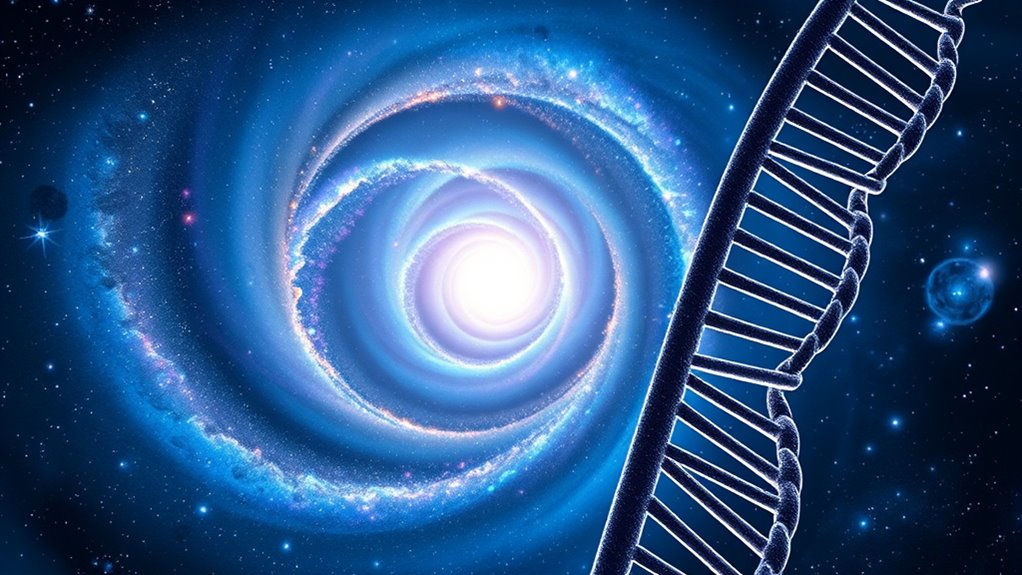

Spirals appear everywhere in nature, from massive galaxies to tiny DNA strands, symbolizing growth, expansion, and interconnectedness. As you explore, you’ll notice how cosmic spirals organize stars and matter, representing universe’s ongoing expansion. In biology, DNA’s double helix encodes life’s information through elegant twists, reflecting evolution and continuity. These patterns showcase nature’s universal language of expansion and complexity. Keep discovering, and you’ll uncover how spirals unify the fabric of our universe and life itself.
Key Takeaways
- Spirals are common in nature, appearing in galaxies and DNA, symbolizing growth, expansion, and interconnectedness across scales.
- Galaxy spiral arms organize matter and facilitate star formation, representing cosmic expansion and dynamic movement.
- DNA’s double helix encodes genetic information efficiently, exemplifying biological growth and the transfer of complex data.
- Spiral patterns serve as universal symbols of development, evolution, and the ongoing expansion of natural systems.
- Recognizing spirals highlights their role as fundamental symbols of natural growth, stability, and the interconnected fabric of the universe.
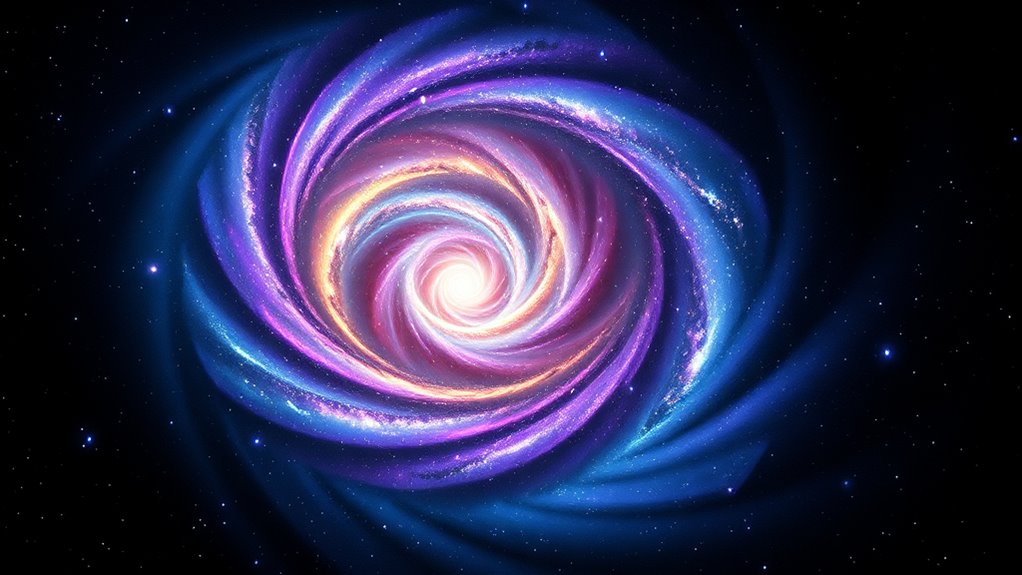
Spiral shapes are everywhere in nature, from the majestic arms of galaxies to the intricate double helix of DNA. These patterns aren’t just visually captivating—they embody fundamental principles of growth, expansion, and interconnectedness. When you look up at the night sky, you see galaxies swirling in elegant spirals, their cosmic patterns revealing the universe’s dynamic and expansive nature. On a microscopic level, you observe similar spirals within biological structures, notably in DNA, where the double helix exemplifies how life’s blueprint is encoded through elegant, repeating twists. Both cosmic patterns and biological structures highlight the universal language of spirals, illustrating how nature employs this shape to optimize form, function, and movement.
Spirals in galaxies and DNA symbolize growth, expansion, and universal interconnectedness across scales.
In galaxies, the spiral arms act as cosmic highways, funneling gas and stars toward the core while simultaneously stretching outward. This pattern isn’t random; it’s a result of gravitational forces and density waves that organize matter into these sweeping arms. The spiral’s design allows galaxies to sustain star formation over billions of years, demonstrating how the shape fosters growth and stability on a grand scale. When you observe a galaxy’s spiral, you’re witnessing a visual representation of expansion—an ongoing process of matter dispersing and organizing itself in a harmonious pattern that balances chaos and order.
Similarly, within biological structures, the double helix of DNA reveals a different kind of expansion—one that encodes genetic information essential for life. This spiral isn’t just aesthetically pleasing; it’s an efficient way to store and replicate genetic material. The twisting strands enable the molecule to pack vast amounts of information into a compact space, while also facilitating precise replication during cell division. The spiral in DNA symbolizes not only growth at the cellular level but also the continuity of life, illustrating how biological systems use spirals as symbols of expansion, evolution, and interconnectedness. Understanding these patterns can help us appreciate the universal significance of spirals in nature and science.
Both in the cosmos and within living organisms, spirals serve as powerful symbols of ongoing development. They represent the universe’s relentless tendency toward expansion and complexity, echoing the natural inclination of systems to evolve and adapt. As you consider these patterns, it becomes clear that spirals aren’t merely shapes; they are universal symbols of growth, transformation, and interconnectedness at every scale. Whether in galaxies or in the tiniest biological structures, the spiral embodies the fundamental rhythm of expansion woven into the fabric of existence.

Spirals in the Universe: Peeking into the secret of the magic art of the universe
As an affiliate, we earn on qualifying purchases.
As an affiliate, we earn on qualifying purchases.
Frequently Asked Questions
How Did the Spiral Shape Originate in Nature?
You might wonder how the spiral shape formed in nature. It originates through natural formation processes driven by growth patterns and physical forces, like the way shells and galaxies develop. Spirals offer evolutionary advantages, such as efficient packing and movement. You can see this in the way plants grow or galaxies expand, showing that the spiral shape is a clever solution that nature repeatedly uses for ideal design and survival.
Are All Spirals Purely Mathematical or Do They Have Symbolic Meanings?
You might wonder if all spirals are just mathematical symbolism or if they carry spiritual significance. Many cultures see spirals as more than patterns—they symbolize growth, transformation, and life’s journey. While mathematically precise, spirals also hold deep spiritual meaning, representing eternity and the universe’s expansion. So, it’s a blend: some are purely mathematical, but many are rich with symbolic and spiritual significance, resonating across diverse traditions.
Can the Spiral Be Used in Modern Technology or Design?
Did you know that 85% of new technological designs incorporate spiral or fractal patterns? You can see this in modern technology and design, where spirals inspire innovative applications like antennas, art, and architecture. These patterns optimize space and efficiency, making your designs more dynamic and functional. By using spirals, you tap into nature’s blueprint for growth and expansion, creating visually appealing and highly effective solutions.
How Does the Spiral Relate to Concepts of Infinity?
You see, the spiral symbolizes infinity because it resembles an endless loop that keeps expanding without end. This shape embodies boundless growth, showing how something can continuously evolve and reach outward forever. When you observe a spiral, you’re reminded of endless possibilities and the infinite nature of the universe. It’s a powerful symbol that captures the idea of limitless expansion and the never-ending journey of discovery.
Are There Cultural Differences in Interpreting the Spiral Symbol?
Remember, beauty is in the eye of the beholder. You’ll find that cultural symbolism shapes how people interpret the spiral, with some viewing it as a symbol of growth, eternity, or spiritual journey. Interpretative differences vary widely across cultures, reflecting unique beliefs and histories. So, what the spiral means to you might differ from someone else’s understanding, highlighting the rich diversity in cultural symbolism worldwide.

DNA Double Helix Model
DNA Double Helix Structure Model
As an affiliate, we earn on qualifying purchases.
As an affiliate, we earn on qualifying purchases.
Conclusion
As you reflect on the elegant dance of spirals in galaxies and DNA, realize they’re subtle whispers of nature’s endless embrace. These patterns hint at a gentle expansion, a graceful unfolding of life’s mysteries. Embrace this delicate symbolism, and let it inspire you to see beyond the surface—where growth and discovery quietly flourish. Sometimes, the most profound truths are woven into the quiet curves of the universe, guiding you toward wonder in every twist and turn.

Artery8 Space Map Milky Way Galaxy Spiral Stars Solar System Extra Large XL Wall Art Poster Print
Size: This unframed wall art print measures 24 x 32 inches (61 x 81 cm) and is printed…
As an affiliate, we earn on qualifying purchases.
As an affiliate, we earn on qualifying purchases.
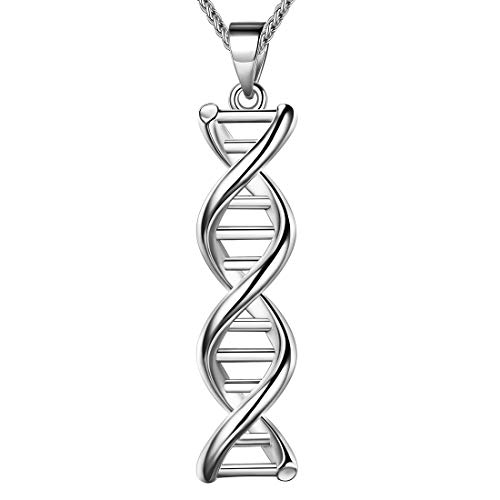
beautlace DNA Double Helix Chemistry Science Molecule Biology Necklace Silver Plated DNA Pendant Jewelry for Women KP0049W
❤MATERIALS❤: Silver/18K Gold/Black Gun Plated will ensure a very long lasting brilliant finish, high resistance to rust and…
As an affiliate, we earn on qualifying purchases.
As an affiliate, we earn on qualifying purchases.