The Rosetta Stone revealed the mystery of the ancient Egyptian language by showing how hieroglyphic symbols and phonetic signs work together within their grammar. It allowed scholars to compare hieroglyphs with known Greek words, revealing how symbols represented sounds and meanings. This breakthrough made decoding inscriptions possible, opening a window into Egypt’s history and culture. If you keep exploring, you’ll uncover even more about how this remarkable discovery transformed our understanding of the past.
Key Takeaways
- The Rosetta Stone features the same text in Greek, Demotic, and hieroglyphic scripts, enabling comparative analysis.
- Scholars used Greek, a known language, to identify hieroglyphic phonetic signs and grammar rules.
- Jean-François Champollion deciphered hieroglyphics by recognizing phonetic symbols, unlocking the language’s structure.
- Decoding the hieroglyphic script revealed Egypt’s history, culture, and religious texts.
- The Rosetta Stone’s breakthrough transformed Egyptology by providing the key to understanding ancient Egyptian language and civilization.
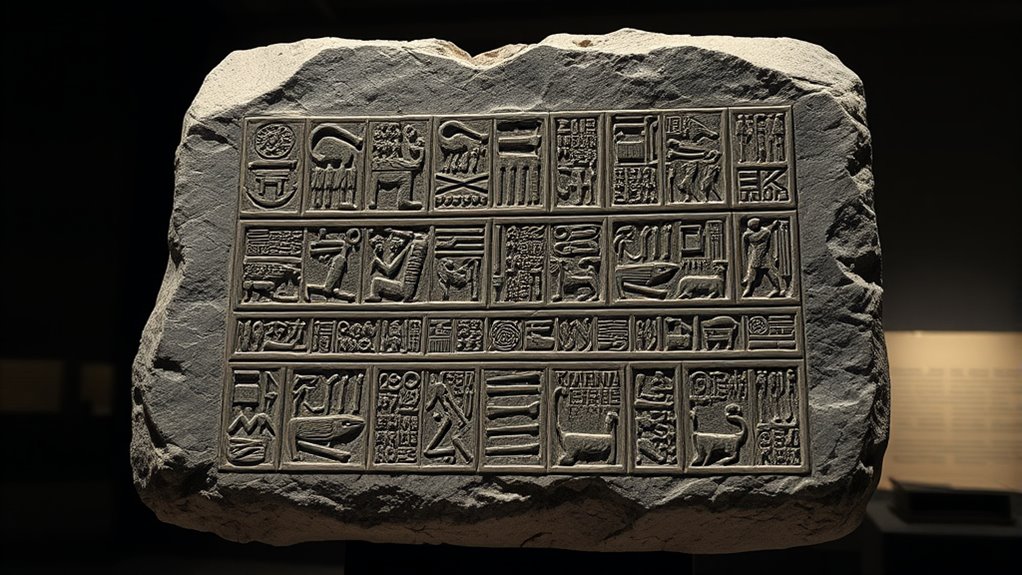
Deciphering the mysteries of the ancient Egyptian language has revolutionized our understanding of one of history’s most fascinating civilizations. Central to this breakthrough is the understanding of hieroglyphic grammar and phonetic symbols. When you study ancient Egyptian writing, you realize that hieroglyphic script isn’t just a collection of pictures; it’s a complex system combining visual symbols with phonetic cues to convey meaning. Hieroglyphic grammar provides the rules for how these symbols interact, determining sentence structure, verb forms, and tense. Recognizing these rules allows you to interpret texts accurately and appreciate the sophistication of Egyptian communication.
Deciphering hieroglyphic grammar unlocks Egypt’s rich history and culture through complex symbols and phonetics.
Phonetic symbols play a vital role in this decoding process. Unlike purely symbolic hieroglyphs, phonetic symbols represent sounds, much like letters in modern alphabets. They often appear alongside ideograms—symbols that depict objects or ideas—to clarify pronunciation or provide grammatical context. When you analyze inscriptions, you see that phonetic symbols enable the Egyptians to write words that might not have specific hieroglyphic images, especially foreign terms or abstract concepts. This blending of ideograms and phonetics made the script versatile and efficient, but also challenging to interpret without a key.
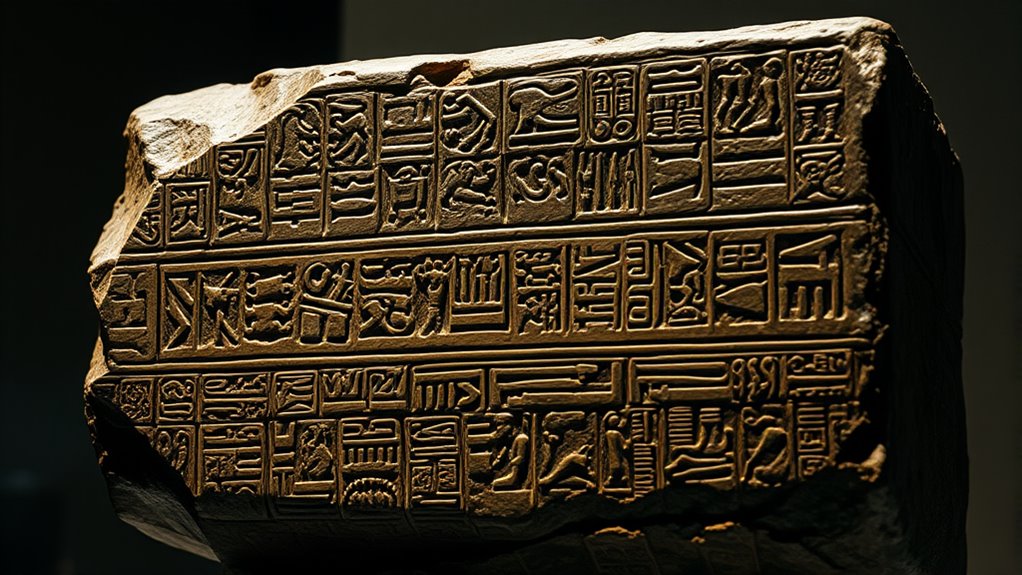
The discovery of the Rosetta Stone was pivotal because it featured the same text inscribed in Greek, Demotic, and hieroglyphic scripts. This allowed scholars to compare known Greek words with the hieroglyphic symbols, ultimately revealing the phonetic values of many signs. You can imagine how exciting it was when Jean-François Champollion cracked the code, recognizing that some hieroglyphs served as phonetic symbols rather than mere pictures. This breakthrough unblocked the ability to read and understand countless inscriptions, Tomb walls, temples, and papyri.
As you explore further, you learn that hieroglyphic grammar isn’t just about individual symbols but also about their placement and interaction within sentences. The order of symbols, the use of determinatives (which clarify meaning), and the positioning of phonetic signs all follow specific rules. Understanding these grammatical structures helps you comprehend the nuances of Egyptian religious texts, royal inscriptions, and everyday writings alike. It’s this intricate system of hieroglyphic grammar and phonetic symbolism that makes deciphering ancient Egyptian possible, transforming a long-lost language into a vibrant window into the past.
In essence, your ability to decode hieroglyphic grammar and identify phonetic symbols is what transformed the study of Egyptology. The Rosetta Stone didn’t just open words; it opened up a civilization’s history, beliefs, and culture, all encoded in a language that once baffled scholars for centuries.

Lulu Jr. Illustory Book Making Kit, Multicolor
- Product Name: Lulu Jr. Illustory Book Making Kit
- Award Recognition: 2017 Mom's Choice Gold Award
- Includes Writing Guide: Just Imagine..A Guide to Writing and Illustrating
As an affiliate, we earn on qualifying purchases.
As an affiliate, we earn on qualifying purchases.
Frequently Asked Questions
How Long Did It Take to Fully Decode the Egyptian Hieroglyphs?
It took about 20 years for scholars to fully decode Egyptian hieroglyphs after the Rosetta Stone was discovered. You face numerous linguistic challenges, like understanding symbols and grammar. Through scholarly collaborations, especially between French and British experts, they gradually unraveled the language’s mysteries. Their combined efforts, persistent research, and new insights finally unlocked the hieroglyphs’ secrets, transforming our understanding of ancient Egypt’s history and culture.
Are There Still Undeciphered Symbols on the Rosetta Stone?
You might be surprised to learn that about 20% of the hieroglyphic mysteries on the Rosetta Stone remain untranslated. While most symbols have been deciphered, some untranslated symbols still puzzle scholars today. These unresolved symbols are part of the ongoing quest to fully understand ancient Egyptian language, showing that even with the Rosetta Stone’s breakthroughs, mysteries linger, inspiring continued exploration into the depths of Egypt’s ancient script.
How Has Decoding Impacted Our Understanding of Ancient Egyptian Culture?
Decoding the Egyptian language through the Rosetta Stone gives you valuable cultural insights and historical revelations. You can now understand ancient texts, beliefs, and daily life stories that were previously lost. This breakthrough helps you appreciate how Egyptians viewed their gods, rulers, and society. It unveils a deeper connection to history, allowing you to see their world more clearly and gain a richer understanding of ancient Egyptian culture.
Did the Rosetta Stone Influence Other Decipherment Efforts?
Imagine you’re in a modern lab, marveling at a 19th-century breakthrough—like the Rosetta Stone’s influence on linguistic breakthroughs. It definitely inspired other decipherment efforts, sparking archaeological discoveries worldwide. Its success showed how comparing known and unknown scripts could unseal ancient languages, encouraging scholars to decode scripts from Mesopotamia to the Americas. So, yes, the Rosetta Stone’s impact extended far beyond Egypt, shaping modern archaeology and linguistic research.
What Modern Technologies Are Aiding in Deciphering Ancient Scripts?
You leverage modern technologies like machine learning and digital imaging to decode ancient scripts more efficiently. Machine learning algorithms analyze patterns in symbols, helping identify language structures, while digital imaging enhances the clarity of worn or damaged inscriptions. These tools accelerate decipherment, allowing you to uncover historical insights faster and more accurately, ultimately deepening your understanding of ancient civilizations and preserving their heritage for future generations.
Conclusion
Now that you’ve uncovered the secrets of the Rosetta Stone, you’ve truly opened a window into the past. Decoding ancient Egyptian language isn’t just about words—it’s about connecting with a civilization that still captivates us today. Remember, understanding history is like holding a key to the past; it helps us uncover the mysteries that shape our world. So, keep exploring, because there’s always more beneath the surface waiting to be revealed.