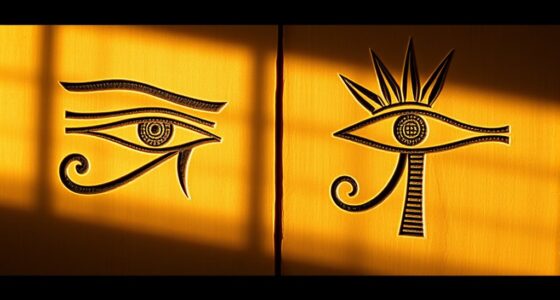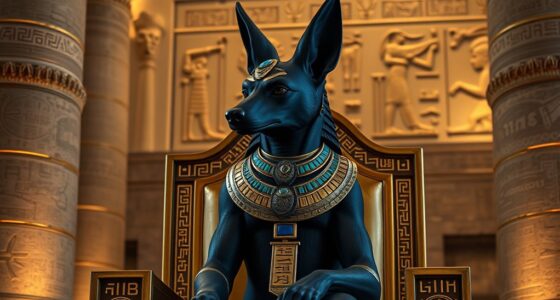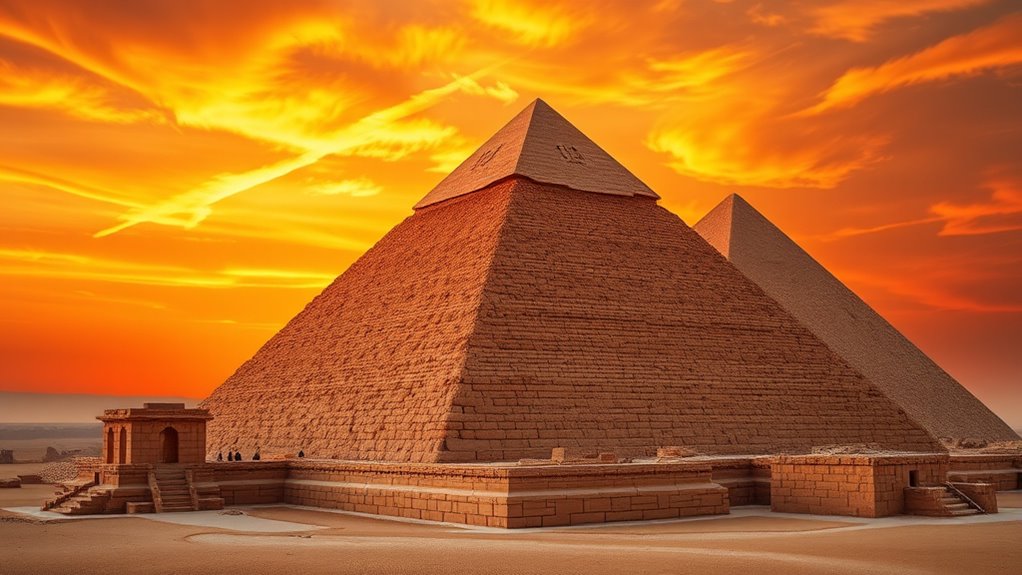

Pyramids serve as powerful symbols of human achievement and spiritual aspirations, blending precise architecture with deep symbolism. Their design reflects a journey from earthly life to divine eternity, with alignment to celestial events emphasizing their cosmic connection. Built as tombs and spiritual gateways, they exhibit engineering skill and cultural significance. Their purpose goes beyond mere structure, embodying beliefs about life, death, and the universe. To discover more about their hidden meanings and functions, continue exploring their fascinating history.

Get art and craft supplies delivered free — and shop member deals
- Fast, free delivery on millions of items
- Access to Prime Big Deal Days deals on October 6–7
- Prime Video, Amazon Music and more included
Key Takeaways
- Pyramids symbolize human achievement, spiritual ascent, and serve as gateways to the divine for the soul’s journey.
- Their precise architecture and celestial alignments reflect advanced engineering and astronomical knowledge.
- Designed as tombs, they protect and honor the deceased, facilitating their transition to the afterlife.
- The pyramids embody cultural beliefs, cosmology, and social hierarchy, reinforcing divine authority of rulers.
- They function as monumental expressions of power, spirituality, and cosmic understanding, connecting the mortal and divine realms.
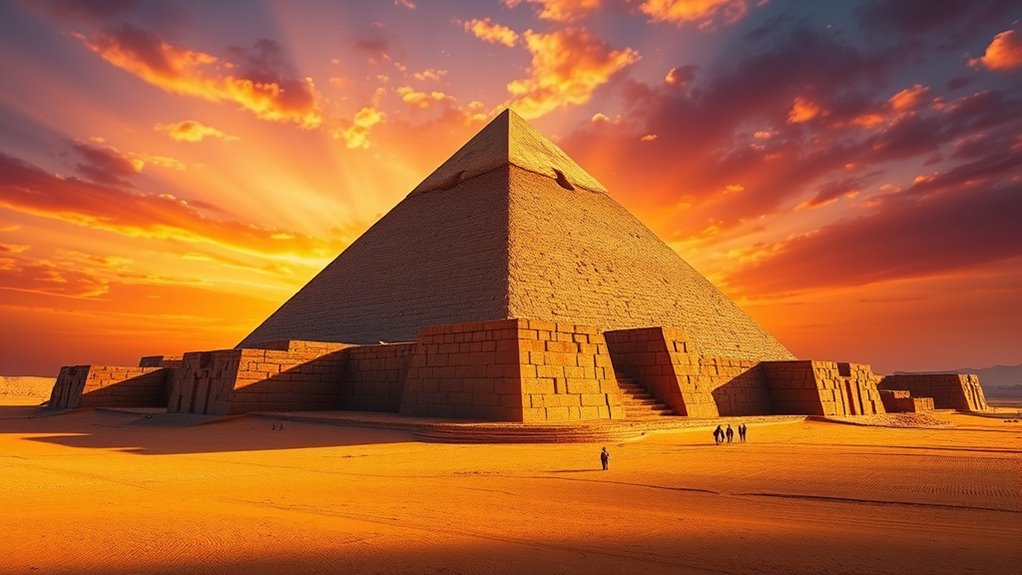
Pyramids have long stood as powerful symbols of human achievement and spiritual significance. When you examine these impressive structures, you can’t help but feel a sense of awe at their enduring presence. Their design isn’t just about impressing viewers; it’s deeply rooted in ancient symbolism that reflects spiritual beliefs, cosmology, and the social order of the civilization that built them. The pyramid’s shape itself, with its broad base narrowing to a point, symbolizes the journey from the earthly domain to the divine, guiding the soul toward eternity. This symbolic meaning is woven into every aspect of their construction, revealing a sophisticated understanding of the cosmos and the afterlife. Additionally, the precise construction and astronomical alignments of pyramids demonstrate their importance in ancient astronomical knowledge, emphasizing their role in connecting the mortal world with the divine realm.
You’ll notice that the architectural significance of pyramids isn’t just in their size but in their precise construction. These structures were engineered with remarkable skill, using massive limestone blocks that fit together with incredible accuracy. Their design was carefully planned to withstand centuries of weathering, emphasizing their importance as lasting monuments. The sloping sides are aligned with precision to the cardinal points, reflecting sophisticated knowledge of astronomy. This alignment wasn’t accidental; it had spiritual importance, connecting the pyramid to celestial events and reinforcing its role as a conduit between the mortal world and the divine.
The precise construction and astronomical alignment of pyramids reveal their spiritual and enduring architectural mastery.
As you explore the purpose behind their design, you realize that pyramids served both practical and symbolic functions. They acted as tombs for pharaohs and high-ranking officials, ensuring their transition to the afterlife. The internal chambers and passageways were designed to protect the body and sacred items, emphasizing the importance of the afterlife journey. But beyond their function as burial sites, pyramids also acted as monumental expressions of power and religious devotion. Their grand scale and strategic location demonstrated the pharaoh’s divine status and reinforced the central role religion played in everyday life.
In essence, pyramids are much more than impressive feats of architecture. They are embodiments of ancient symbolism, meticulously crafted to serve spiritual and societal purposes. Their architectural significance lies in their durability, alignment, and symbolic form, all of which reflect a civilization’s complex understanding of life, death, and the cosmos. When you stand before a pyramid, you’re not just witnessing an ancient monument; you’re experiencing a tangible connection to the beliefs and ingenuity of a remarkable civilization that sought to transcend mortality and reach the divine.
ancient Egyptian pyramid replica
As an affiliate, we earn on qualifying purchases.
As an affiliate, we earn on qualifying purchases.
Frequently Asked Questions
How Did Ancient Builders Achieve Precise Pyramid Alignments?
You can understand that ancient builders achieved precise pyramid alignments by carefully observing solar alignments and star positioning. They used simple tools like sighting rods and water levels to establish true north, matching celestial events with the pyramid’s orientation. By tracking the movements of stars and the sun during key times of the year, they ensured their structures aligned accurately with these celestial patterns, reflecting their advanced astronomical knowledge.
Are There Lesser-Known Pyramids With Unique Symbolic Meanings?
Yes, you can explore hidden pyramids with unique symbolic meanings, often overlooked. These lesser-known pyramids, scattered across regions like Mesoamerica and Sudan, hold regional symbolic meanings that reflect local beliefs, gods, or historical events. You might discover that their designs and locations were intentionally chosen to convey specific messages or spiritual connections, offering a deeper understanding of the diverse cultural significance behind these mysterious structures.
What Materials Were Used to Construct Ancient Pyramids?
You’ll find that ancient pyramids were built mostly with massive limestone blocks, with some using granite for inner chambers. Around 2.3 million blocks were used for the Great Pyramid alone. Construction techniques involved precise material sourcing, transport, and placement, often using ramps and levers. These materials were carefully selected for durability and symbolism, showcasing advanced engineering skills and resourcefulness in sourcing, which allowed these monumental structures to stand the test of time.
How Did Pyramids Influence Later Architectural Designs?
You can see how pyramid influence shaped later architectural designs by inspiring the use of stepped structures, grand facades, and geometric precision. The architectural legacy of pyramids is evident in modern landmarks like ziggurats and monumental buildings, emphasizing strength and stability. Their innovative design techniques continue to inspire architects today, highlighting how the enduring pyramid influence has left a lasting mark on architecture worldwide.
Were Pyramids Ever Used for Purposes Beyond Burial and Symbolism?
You might be surprised to learn that pyramids served more than just burial and symbolic purposes. They had alternative uses and ritual functions, such as serving as temples or sites for religious ceremonies. In some cases, pyramids were used for astronomical observations or as places for offerings and rituals to honor gods. These multifaceted roles show that pyramids played an active part in ancient spiritual and community life beyond their iconic symbolism.
Conclusion
As you step back and look at pyramids, it’s like gazing at giant stone dreams reaching for the sky. These monuments aren’t just tombs; they’re echoes of beliefs, power, and eternity carved in time. Their purpose is woven into every block, whispering stories of ancient civilizations. By understanding their symbolic design, you see how they stand as timeless guardians of history—monuments that, like silent sentinels, continue to inspire wonder across the ages.
Halloween Picks
halloween
As an affiliate, we earn on qualifying purchases.