
TL;DR

Get art and craft supplies delivered free with Prime
- Fast, free delivery on millions of items
- Prime Video, Amazon Music and more included
- Member-only deals all year
Furniture maker and artist Aspen Golann has created carved wooden vessels and a five-foot-four cabinet inspired by 17th-century embroidery. The cabinet will be shown in Pattern Recognition: Superhouse at Five in New York from November 6 to December 19, 2026.
Artist and furniture maker Aspen Golann has translated motifs from early American embroidery into carved wooden vessels and a five-foot-four cabinet, bringing a little-displayed craft tradition into sculptural furniture. Her “Crewel Cabinet” is scheduled to appear in the group exhibition Pattern Recognition: Superhouse at Five, opening November 6 at Superhouse in New York City.
The wooden vessels grew out of Golann’s research into early needlework, an activity pursued almost exclusively by women, according to Colossal’s report. She began the series during the Metropolitan Museum of Art and Vacheron Constantin Artisan Residency, an 18-month program focused on preserving and reinterpreting traditional craft techniques. Ceramicist Ibrahim Said and jeweler Joy Harvey also took part in the residency.
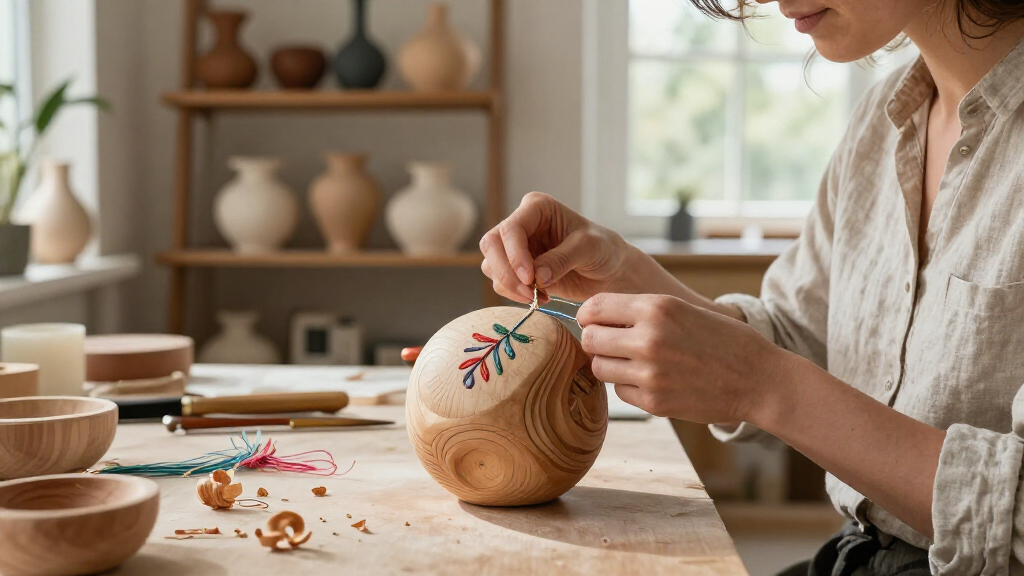
In works including “Pouring Vessel”, Golann applies needlework-inspired motifs to solid wood using a technique described as strapworking. Her “Strap-Carved Vessel” is unusually flat in profile but remains hollow, retaining the basic structure of a vessel while putting its carved pattern forward. The pieces explore the boundary between practical objects and decorative forms.
“Crewel Cabinet,” completed during the residency, stands five feet, four inches tall. It is built from 37 narrow wooden staves joined edge to edge into a rounded form. Each stave comprises 14 colored layers; Golann carved plants and animals, including rabbits and dogs, through those layers to create patterns that recall the colored threads of colonial-era crewel embroidery. The cabinet is due to be shown at Superhouse from November 6 through December 19.
Turning Needlework Into Carved Furniture
Golann’s work gives scale and permanence to embroidery that was often made for domestic use and could be stored away. She told Colossal that early embroidery by young women is under-researched and under-displayed, and described it as fragile and rare. Translating its imagery into a large cabinet changes how the work can be encountered: its motifs become part of a substantial object presented in an exhibition setting.
The project also links two forms of making that are often discussed separately: woodworking and needlework. Rather than reproduce embroidery literally, Golann uses layered wood and carving to evoke its colored threads and compositions. The result raises questions about whose craft traditions receive attention in museums and how historical forms can be reinterpreted without losing sight of the people who made them.
Popular right now

Vitamix 5200 Professional-Grade Blender, 64 oz. Container, Black

TCL T7 Series 85-Inch 4K 144Hz QLED Smart Google TV

Breville Bambino Espresso Machine, Brushed Stainless Steel (BES450BSS)
As an affiliate, we earn on qualifying purchases.
From Boston Chairs to Embroidery Motifs
Colossal places Golann’s project within a broader interest in early American furniture. In the second half of the 17th century, colonial makers drew on English motifs and techniques. Golann has made contemporary responses to the high-backed Windsor chair associated with Boston, including “Meeting Bench,” made with chairmaker Peter Galbert, and “Union Settee.” Those works consider furniture as both a designed object and a place where people gather.
Her embroidery research shifts the focus from furniture forms to domestic needlework. Golann has said that some of the stitched pieces were dowry objects made under restrictive expectations for women, while also containing evidence of their makers’ interests and imagination. The carved cabinet is her attempt to bring that expressive dimension into a larger, more visible form.
““[The embroidery] is under-researched and under-displayed, and it’s fragile, rare, and stowable. I wanted to make some version of this thing that couldn’t be put away.””
— Aspen Golann, as quoted by Colossal
Exhibition Details and Commission Scope
The source report does not list the full lineup of works that will appear at Superhouse, say whether Golann’s vessels will be shown alongside “Crewel Cabinet,” or provide ticketing and visitor information. It also does not specify the exact completion or installation date for the U.S. Treasury commission. Golann’s comments describe its planned materials and inspiration, but further details about its final form are not provided.
The report says Golann is working toward a solo exhibition at the Fuller Craft Museum, slated to open next November. It does not provide an exact opening date or further information about the exhibition’s contents.
New York Showing and Future Work
“Crewel Cabinet” is scheduled to be part of Pattern Recognition: Superhouse at Five at Superhouse in New York, running November 6–December 19, 2026. The show offers the next public presentation of the work described in the report; the available material does not confirm which other Golann pieces will be included.
Golann is also developing a furniture piece for the U.S. Treasury, which the report says commissions a work for its collection every 50 years. She plans to use different tones of precious metals and reflective surfaces in an abstract landscape inspired by early American embroidery. A solo exhibition at the Fuller Craft Museum is slated for next November, though its precise date and scope have not been announced in the source material.
Key Questions
What is Aspen Golann showing in New York?
Her “Crewel Cabinet” is scheduled for the group exhibition Pattern Recognition: Superhouse at Five at Superhouse. The source does not confirm whether her other vessels will also be included.
When and where is the exhibition?
The exhibition is scheduled for November 6 through December 19, 2026, at Superhouse in New York City.
How is the cabinet made?
The cabinet is made from 37 wooden staves, each built from 14 colored layers. Golann carved plants and animals through the layers to evoke the color and imagery of early American crewel embroidery.
What is the cabinet inspired by?
It draws on early American embroidery, including needlework made by girls and women. Golann has described the pieces as domestic objects shaped by restrictive expectations but also expressive of their makers’ inner lives.
What is Golann working on next?
She is developing a furniture commission for the U.S. Treasury inspired by early American embroidery and is working toward a solo exhibition at the Fuller Craft Museum, slated to open next November. The source gives no exact date for that museum show.
Source: thisiscolossal.com