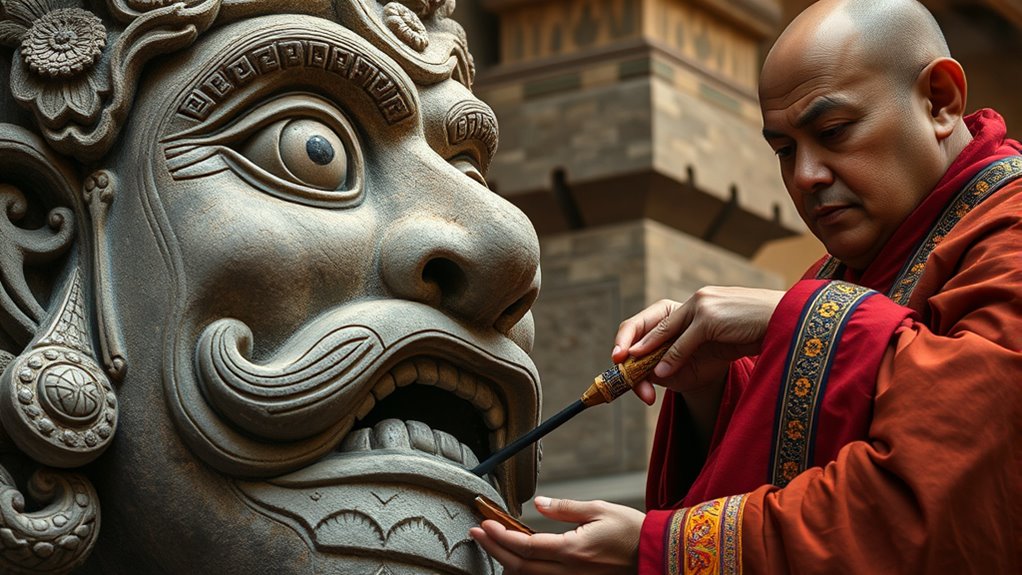

The Opening of the Mouth ritual is an ancient Egyptian ceremony that brings statues and mummies to life, allowing them to see, speak, hear, and breathe. Priests use tools like an adze or chisel to perform specific gestures and recite spells inscribed on tombs, symbolizing the awakening of the deceased’s senses. This powerful act signifies spiritual rebirth and the progression into eternal life, offering insights into Egypt’s beliefs about death and rebirth if you continue exploring further.
Key Takeaways
- The ritual symbolically revives the deceased’s senses, enabling interaction with the living and afterlife.
- Priests used tools like adzes or chisels to perform the ritual on statues or mummies.
- Recited spells and inscriptions invoked divine power to ensure spiritual awakening and protection.
- Opening the mouth signified awakening senses such as sight, speech, hearing, and breathing.
- The ritual reflects Egyptian beliefs that death is a transition to eternal life and spiritual rebirth.

Have you ever wondered how ancient Egyptians prepared their dead for the afterlife? One of their most fascinating rituals was the Opening of the Mouth ceremony, a essential part of funeral ceremonies designed to breathe life into statues and representations of the deceased. This ritual was more than just a symbolic act; it was believed to revive the spirit within the statue, allowing the deceased to interact with the world of the living and the afterlife. As you explore ancient Egyptian burial practices, you’ll notice that symbolism played a central role, with every gesture and word carrying profound meaning rooted in their complex religious beliefs.
During the funeral ceremonies, priests would perform the Opening of the Mouth ritual using specific tools, often including an adze or a chisel, which symbolized the act of opening the senses of the deceased. This act was carefully performed on statues or mummies, which represented the individual in the tomb. The ceremony was thought to restore the deceased’s ability to see, speak, hear, breathe, and eat—fundamental faculties necessary for a successful journey into the afterlife. The process was imbued with ancient symbolism; for example, the act of opening the mouth signified awakening the senses that had been dormant since death, guaranteeing the soul’s continued existence and interaction with the physical world. Symbolism in rituals played a crucial role in ensuring the spiritual significance of this act.
The ritual’s significance extended beyond mere functionality—it was believed that through this act, the ka (spirit) could recognize and communicate with the living, making the statue or mummy a vessel for the deceased’s continued presence. The priests recited specific spells, often inscribed on tomb walls or included in funerary texts, to invoke divine power and safeguard the process. These spells served to reinforce the ancient symbolism that connected the physical act of opening the mouth with spiritual awakening and eternal life. The symbolism is evident in the careful craftsmanship of the ritual tools and the detailed inscriptions, which all aimed to guarantee the deceased’s rebirth and protection in the afterlife.
You can see that the Opening of the Mouth ritual was more than a simple ceremony; it was a essential act rooted in their deep understanding of life, death, and rebirth. Every step was steeped in symbolism, emphasizing that the physical act was also a spiritual one—an act that granted the dead the ability to breathe, perceive, and communicate again. This ritual highlights how the ancient Egyptians viewed death not as an end but as a transition, where symbolic gestures helped secure a safe passage into eternity.
Oduduwa Small Tools – Spiritual Set for Rituals, with Coffin Box and Divine Symbols, Oddua
Comprehensive Ritual Set: Includes essential elements like a coffin box, hand-holding stick, moon, sun, and more, each representing…
As an affiliate, we earn on qualifying purchases.
As an affiliate, we earn on qualifying purchases.
Frequently Asked Questions
How Did the Ritual Originate in Ancient Egypt?
You might wonder how this ritual started in ancient Egypt. It likely evolved from funeral ceremonies emphasizing spiritual symbolism, ensuring the deceased’s soul could recognize and return to their body. By performing this ritual, priests believed they restored life and consciousness, making statues more than mere representations. This act symbolized rebirth, helping the soul navigate the afterlife, and became a crucial part of Egyptian burial practices to secure eternal life.
Were Similar Rituals Practiced in Other Cultures?
You might notice that other cultures also practiced rituals similar to the Egyptian opening of the mouth, especially in funeral practices. These rituals often involve spiritual symbolism, symbolizing the rebirth or awakening of the deceased’s spirit. For example, in ancient Greece and China, ceremonies aimed to guarantee safe passage to the afterlife, reflecting a universal desire across civilizations to honor the dead and connect with spiritual domains through meaningful rituals.
What Materials Were Used in the Ritual Process?
You discover that the ritual process involved specific materials that held deep artistic symbolism. You use ritual tools like wooden sticks, metal chisels, and precious substances such as incense or oils. These materials aren’t just functional but represent spiritual power and life. As you perform the ritual, you realize each tool and material amplifies the symbolic act of awakening the statue’s spirit, making the process both artistic and sacred.
How Did the Ritual Evolve Over Different Dynasties?
Imagine the ritual as a river that flows through China’s dynastic changes, adapting to each era’s beliefs and power structures. Over time, its symbolism deepened, reflecting evolving religious and political ideas. During different dynasties, the ceremony incorporated new elements, emphasizing spiritual authority and connection to the divine. You see this evolution in how the ritual’s form and meaning shifted, echoing the ongoing dialogue between tradition and innovation.
Are There Modern Equivalents or Adaptations of This Ritual?
You might notice modern spiritual renewal practices that adapt ritual symbolism from ancient traditions. For instance, some cultures incorporate symbolic gestures or ceremonies to rejuvenate the soul, similar to the Opening of the Mouth ritual. These adaptations aim to reconnect individuals with their spirituality, emphasizing renewal and life-force. While not identical, they carry forward the core idea of ritual symbolism as a means of renewing spiritual energy in contemporary contexts.

Pamonrueer 19 Pcs Egyptian Figurines Set Resin Ancient Egypt Decor Hand-Painted Small Ancient Egyptian Pyramid Mummy Pharaoh Anubis Statue Egyptian Gods for Table Home Decoration
Resin material: Figurines are made of resin, with rich details that capture the essence of ancient Egyptian art…
As an affiliate, we earn on qualifying purchases.
As an affiliate, we earn on qualifying purchases.
Conclusion
As you witness the Opening of the Mouth Ritual, you realize it’s like breathing life into stone, transforming silent statues into vessels of vitality. This ancient ceremony isn’t just about restoring function; it’s a powerful act of awakening spirits and honoring the divine. When you understand its significance, you see how art and spirituality dance together, turning cold materials into living stories that continue to speak across time. It’s a timeless bridge between the mortal and the divine.
opening of the mouth ritual replica kit
As an affiliate, we earn on qualifying purchases.
As an affiliate, we earn on qualifying purchases.

The Funerary Texts and Spells of Ancient Egypt: The History of the Pyramid Texts, Coffin Texts, and Book of the Dead
As an affiliate, we earn on qualifying purchases.
As an affiliate, we earn on qualifying purchases.