TL;DR

Get art and craft supplies delivered free with Prime
- Fast, free delivery on millions of items
- Prime Video, Amazon Music and more included
- Member-only deals all year
Handmade ceramic pottery sets are coordinated collections of individually formed dishes, so expect small differences in shape, glaze, and color. Before buying, check the exact pieces and dimensions, ask whether the glaze is suitable for food, and get the maker’s care instructions. Choose a set size and weight that work for your cupboards and everyday meals.
A handmade dinner plate can make a Tuesday-night pasta supper feel like a small occasion. Its rim may wobble just enough to catch the light, and the glaze might pool into a blue-green edge that no factory mold could repeat.
Handmade ceramic pottery sets bring that character to everyday tableware, but a lovely photograph won’t tell you whether the bowls stack neatly or the glaze is meant for food. Here’s how to weigh the look against the practical details, from set size to care instructions, before you buy.
Check the exact set contents and dimensions; “four-piece set” can mean very different combinations of dishes.
Expect small changes in color, form, and glaze because handmade pieces are shaped and fired individually.
Ask the maker whether the glaze and finish are intended for food contact, and follow their care instructions.
Measure your cupboard space and think about weight, stackability, and replacement pieces before ordering.
If you want a larger, more consistent group, buying pieces from the same batch can help, though exact uniformity is unlikely.
What You Get When You Buy Handmade Pottery
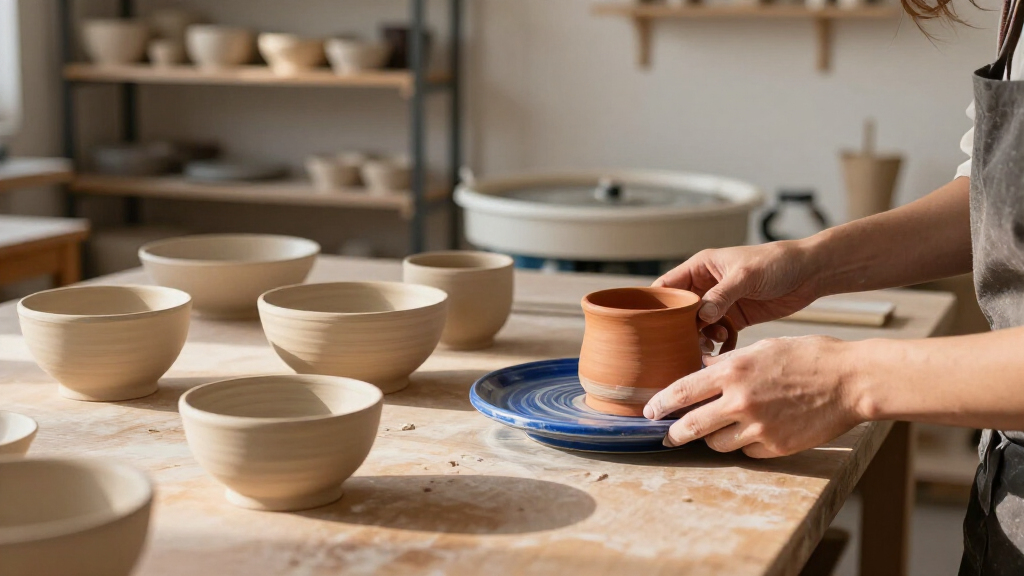
Handmade ceramic pottery sets are coordinated groups of dishes shaped and finished by hand, often with small differences from piece to piece. A set might include dinner plates, bowls, and mugs, while another may add serving platters or offer just a few matching forms. Check the listing for exact quantities, sizes, and intended uses. [1]
Those differences are part of the appeal, but they also affect how a set looks and works as a group. One bowl may have a slightly fuller curve; another may show a soft stripe where the glaze settled during firing. Imagine setting out four bowls for soup: they look like siblings, not photocopies. That variation can make a table feel collected and personal, though it may bother you if you want every place setting to look identical in a formal arrangement.
“Handmade” can describe work made start to finish by one potter, a small batch shaped with tools, or a mix of hand processes and equipment. Ask the seller who made the pieces and which steps were done by hand. The answer helps you understand what the price reflects and how much variation to expect. A potter who throws every bowl individually may produce more visible differences than a maker who uses a mold and hand-finishes each piece. Clear answers tell you more than a label alone. [1]
Think coordination, not perfect matching: handmade pieces often share a palette and shape while keeping individual marks.
Choose a Set That Fits Your Table and Cupboards
Handmade ceramic pottery sets work best when the piece count, dimensions, and weight suit your routine. Count the people you usually serve, then decide whether you want a spare setting for guests or a replacement after an accident. A set for two can be a better buy than a grand service for eight if you eat in a small kitchen: fewer unused dishes mean less storage pressure and a lower upfront cost, while a larger set can make hosting simpler and help keep a table coordinated. [1]
Before ordering, compare a plate’s diameter with your cupboard shelves and dishwasher rack. A broad, shallow bowl may be beautiful but awkward to stack; a thick mug can feel reassuring in your hands and heavy after a long coffee. These details matter most when you use the pieces often: a dish that barely fits a shelf can make putting dinner away a daily nuisance. For instance, measure the shelf where your current dinner plates sit, then compare that number with the maker’s listed dimensions.
- Count place settings: Start with your usual household and add extras only if you host often. If you entertain occasionally, a few extra plates may be more useful than buying a full additional set.
- Check dimensions: Look for plate diameter, bowl capacity, and mug volume, not just a piece count. Capacity helps you tell whether a bowl suits cereal, soup, or a larger meal.
- Consider storage: Ask whether pieces stack safely and how much cupboard space a full set needs. A shape that nests well saves room, but tightly stacked rims may need protection from scratches or chips.
- Ask about replacements: Find out whether the maker sells individual pieces or future batches. This matters if a favorite mug breaks or you later want to add place settings.
If you buy gradually, ask whether later batches are likely to have similar colors and forms. Kiln conditions and glaze application can shift the result, so a new bowl may coordinate beautifully without being an exact twin. Buying the larger order from one batch can improve consistency, but it also means committing to the quantity and cost at once. [1]
Compare the Look, Care, and Cost Before You Choose
Handmade ceramic pottery sets vary in surface, upkeep, and price, so compare what matters to your home before falling for a glaze. The table below gives you useful questions to ask each maker; the answers can differ even between pieces that look similar online. A finish you love may need more careful handling, while a simpler surface may fit a busy kitchen better. [1]
| What to compare | What to ask | Why it matters |
|---|---|---|
| Finish and color | Will pieces vary within the set? | Sets usually coordinate without matching exactly. |
| Food use | Is this glaze and finish intended for food contact? | “Natural” or “handmade” alone doesn’t establish food suitability. |
| Care | Can I use the dishwasher or microwave? | Advice depends on the piece and the maker’s process. |
| Price | What does the set include, and how is it made? | Hands-on labor, materials, firing, and small batches all affect cost. |
Food-contact suitability depends on the clay, glaze, firing, and intended use. Ask directly whether the pieces are made for serving food, especially if the finish is unusual or highly decorative. A glossy surface or earthy color is not proof of suitability; the maker should provide clear use guidance. This answer matters because a set’s appearance cannot tell you how it was made or what uses the maker intended. [1]
Price often reflects skilled labor, materials, kiln time, and the smaller number of pieces made at once. That can make handmade tableware more expensive than mass-produced dishes, but you may also be paying for a maker’s design and finishing time. Consider the cost alongside what you’ll actually use: a carefully thrown mug you reach for daily may feel worth more than a larger set with pieces that sit in a cupboard. For example, a pair of carefully thrown mugs may cost more than a boxed set from a chain store, yet give you forms and surfaces you’ll enjoy reaching for each morning. [1]
Make Handmade Dishes Part of Everyday Meals
Handmade ceramic pottery sets can serve everyday meals when the maker intends them for regular use and gives care guidance for the pieces. Ceramic durability varies with construction and firing, and even a sturdy plate can chip after a hard knock or crack after a sudden temperature change. That means “suitable for everyday use” still calls for ordinary care; it doesn’t promise that a piece can tolerate every impact or heating method. Treat each item as usable tableware, not as indestructible cookware. [1]
Ask about dishwasher and microwave use rather than guessing. Some pieces can handle either; others call for hand-washing or should stay out of the microwave. The tradeoff is convenience versus the maker’s recommended care: hand-washing adds a small task to every meal, but may be necessary for a delicate finish or construction. If the answer is hand-wash only, decide whether that fits your week before you bring home six dinner plates and six bowls.
A simple habit helps protect your set: avoid moving a cold dish straight into intense heat, and don’t stack plates so roughly that their rims scrape. The clink-clink of dishes in a crowded sink can turn into a chipped edge if you rush. Small chips can also make a piece less pleasant to handle, so gentle washing and storage help preserve both its appearance and usefulness. Follow the maker’s instructions for washing, heating, and storage. [1]
- Ask for use guidance before purchase, including food contact, dishwasher, and microwave instructions.
- Use gentle handling around rims and handles, where knocks can chip or crack a piece.
- Store with care: If pieces nest, ask whether the maker recommends a cloth or other protection between them.
For example, if you want bowls for oatmeal each morning, ask whether they suit hot food and routine washing. If a particular piece is intended mostly for display, the maker’s guidance should say so. The same set can mix daily workhorses with serving pieces you bring out for Sunday lunch, as long as you know how each one is meant to be used. Thinking about your routine this way helps you choose pieces for the jobs they can handle, rather than discovering after purchase that the care requirements don’t fit your habits.
Find a Maker Whose Work You’ll Love Living With
Handmade ceramic pottery sets feel more meaningful when you know who made them and how they were produced. Look for a seller who describes the studio, forming method, clay, glaze, and firing in plain language. These details help you judge whether the maker’s approach suits your priorities: a particular forming method may create a shape you prefer, while a specific finish may influence care needs and variation. Studio shops, craft markets, and online storefronts can all help you learn about a maker’s work; ask questions if the listing leaves gaps. [1]
Photos of a set beside a hand or common household object can help you judge scale, while close-ups reveal glaze texture and rim shape. Still, photos can’t settle every practical question. If you are choosing between a smooth pale glaze and a speckled one, ask whether the surface is easy to clean and whether the color varies between pieces. Seeing how the work looks is only one part of the decision: scale, cleaning, and repeatability determine whether it fits your everyday table.
Some potters offer personalized sets with a choice of glaze, shape, or quantity. That can make it easier to create a table that suits your home, though made-to-order work may take longer and may not be repeatable exactly. The benefit is a closer fit to your taste or needs; the tradeoff is a longer wait and less certainty that a future replacement will match. If you want a set that grows over time, ask how future pieces may compare with the original batch. [1]
A good seller makes the details easy to understand: what’s included, where the work comes from, how the pieces are made, and how to care for them. That information lets you weigh the pleasure of a particular form or glaze against the space and maintenance it requires. When you can picture the bowls stacked beside your plates and the mugs warming your hands on a cold morning, you’ve moved beyond shopping by thumbnail. You’re choosing the objects that will share your meals.
Frequently Asked Questions
What pieces are usually included in a handmade pottery set?
It depends on the maker. Sets may include dinner plates, bowls, mugs, or serving pieces, so check the listing for exact quantities and dimensions before ordering. [1]
Are handmade ceramic dishes safe to eat from?
Ask the maker whether the pieces are intended for food use and whether their glaze and finish are suitable for that purpose. “Handmade” or “natural” by itself doesn’t establish food suitability. [1]
Can handmade pottery go in the dishwasher or microwave?
Some pieces can, while others need hand-washing or should stay out of the microwave. Follow the maker’s guidance for the specific set rather than assuming all ceramics have the same care needs. [1]
Why do pieces in the same set look slightly different?
Each piece is formed and finished individually, and glaze application and kiln conditions affect the final surface and color. The pieces may coordinate without matching exactly; buying from one batch can improve consistency. [1]
Can I buy replacement pieces later?
Ask the maker whether they sell individual replacements or expect to make similar pieces in a future batch. Later work may coordinate with your original set while differing in shade, shape, or size. [1]
Conclusion
Choose a set you’ll enjoy using on an ordinary weekday, then check the dimensions, food-use guidance, and care notes before you buy. Handmade pottery earns its place at your table one meal at a time: a warm bowl in your hands, a softly uneven rim, and a glaze that catches the window light.
Fall Picks
fall essentials
As an affiliate, we earn on qualifying purchases.