TL;DR

Get art and craft supplies delivered free with Prime
- Fast, free delivery on millions of items
- Prime Video, Amazon Music and more included
- Member-only deals all year
Radiant Geometries: Vectors of Knowledge from the Indigenous Americas is on view at Rice University’s Moody Center for the Arts in Houston through December 19, 2026. Curated by Noor Alé, the exhibition brings together contemporary Indigenous artists whose work engages with ancestral and technological knowledge across the Americas. The source does not provide an opening date or a full artist and artwork list.
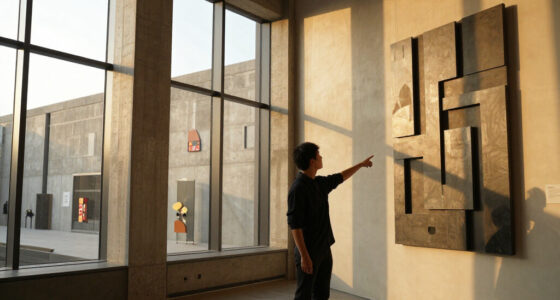
Rice University’s Moody Center for the Arts is presenting Radiant Geometries: Vectors of Knowledge from the Indigenous Americas, an exhibition of contemporary Indigenous art examining relationships among mathematics, science, architecture and cultural knowledge. Curated by Noor Alé, the Houston exhibition spans South, Central and North America and is scheduled to run through December 19, according to a report by Colossal.
The exhibition brings together painting, sculpture, textiles, video and sound, among other forms. Its artists draw on ancestral knowledge and contemporary technologies while exploring mathematical, metaphysical, social and environmental ideas. The works reflect distinct cultural backgrounds and heritages rather than presenting a single Indigenous perspective, the report says.
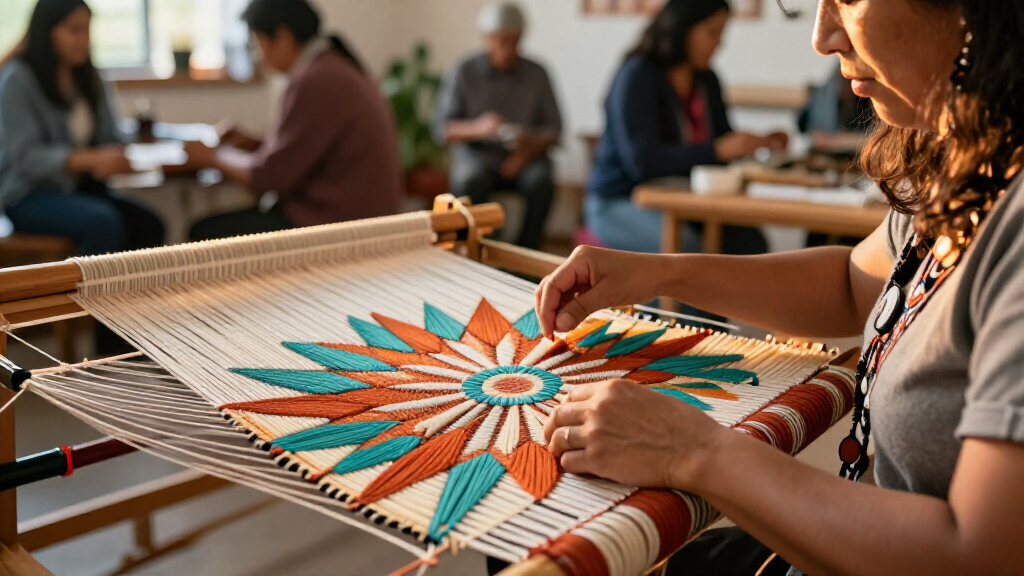
Among the featured artists is Melissa Cody (Navajo/Diné), who combines knowledge passed down through three generations of makers with both a vertical Navajo loom and a mechanized Jacquard machine. Her 2025 textile Sunrise Rainbows is made with Jacquard weaving and aniline-dyed wool fringe. The exhibition frames such practices as continuing and adapting, rather than separating traditional techniques from contemporary design and messages.
Eamon Ore-Giron contributes large geometric abstractions that refer to Indigenous motifs and symbols, including Native American medicine wheels and tapestries from the Amazon Basin, while also drawing on the visual language of 20th-century hard-edge painting. Nearby, Aymara artist Natalia Montoya Lecaros presents Tótems de emergencia (2021): four upright, modular mixed-media sculptures arranged in a circle. The series draws on Aymara clothing traditions, which the source describes as combining Indigenous practices with elements introduced by Spanish colonizers.
The artists named in the report also include Patricia Domínguez, Jordan Ann Craig, Nanibah Chacon, Patrick Martinez and Caroline Monnet. Chacon’s Where Two Rivers Meet (2026) is described as a mixed-media and sound installation. Monnet’s A Quiet Place (2021) is a print. The source gives no complete checklist of works or participating artists.
Indigenous Knowledge in Contemporary Art
The exhibition puts Indigenous knowledge systems at the center of a presentation about art, technology and the natural world. Its examples show how cultural practices can persist through changing materials and methods: Cody uses a mechanized Jacquard machine alongside a vertical loom, while Ore-Giron places Indigenous references in conversation with modern geometric abstraction. These descriptions come from the exhibition report; they do not establish that all participating artists approach technology or tradition in the same way.
Alé describes the show as focused on how Indigenous ways of knowing shape relationships to territories, waterways and interspecies care. That emphasis gives the exhibition relevance beyond formal questions of pattern or design: it connects artistic work with ways of understanding land and relationships among living things. The report does not make claims about the exhibition’s public reception or its measurable impact, so its significance is best understood through the themes and works documented.
As an affiliate, we earn on qualifying purchases.
From Looms to Digital Machinery
The exhibition’s framing draws on long-standing practices cited in the source. Diné weavers have made patterned blankets and rugs on upright looms using their bodies to operate them. The report also notes that Diné people have herded Navajo-Churro sheep since the breed was introduced by the Spanish in the 16th century. These details help situate Cody’s textile work in a history of making and material use without reducing her contemporary practice to historical reference alone.
The report also points to Maya ceramics made more than a millennium ago in Mesoamerica, including objects decorated with natural motifs such as birds. One of Ore-Giron’s 2026 paintings is titled Talking Shit with Object 17 (Pre-Columbian ceramic plate with avian designs, 300–900 CE), linking a contemporary geometric work to a named ceramic reference. More broadly, the exhibition’s stated scope across the Americas brings together artists with different histories and cultural ties; the report does not suggest that those histories are interchangeable.
The exhibition is one of the programs at the Moody Center for the Arts, Rice University’s arts venue in Houston. The center is also scheduled to host a large-scale vinyl installation by Sharmistha Ray, opening October 22 and remaining on view through January 29, according to the report. That installation is a separate exhibition, not part of Radiant Geometries.
“At its core, Radiant Geometries centers Indigenous ways of knowing that continue to shape relationships to territories, waterways, and interspecies care.”
— Noor Alé, curator of Radiant Geometries
Exhibition Details Still Unspecified
The source says the exhibition runs through December 19 in Houston but does not identify its opening date, visiting hours, admission arrangements or any public programs. Readers should consult the Moody Center’s current listings for practical visit information. The report also does not provide a complete artist list, full checklist, or detailed account of how the works are organized across the galleries.
Descriptions of individual works and their cultural references are based on the report and its captions. The material does not include responses from every artist or additional curatorial commentary about the interpretation of particular objects. It is also unclear whether the exhibition’s closing date or associated programming could change; the source gives December 19 as the scheduled end date.
Houston Exhibition Runs Through December
Radiant Geometries is scheduled to remain on view at the Moody Center for the Arts through December 19, 2026. Visitors seeking current hours, access information or event details can check the center’s exhibition listings. The report does not identify a closing event or any further dates connected to this show.
Separately, the Moody Center is scheduled to open Sharmistha Ray’s large-scale vinyl installation on October 22, with that work on view through January 29, according to Colossal. The source does not provide a year for the January end date, so readers should verify the current schedule with the venue.
Key Questions
Where is Radiant Geometries on view?
It is at Rice University’s Moody Center for the Arts in Houston. The source does not provide hours or admission details.
When does the exhibition close?
The report lists December 19, 2026 as the final day. Check the Moody Center’s current listings for any schedule changes.
What does the exhibition explore?
It examines Indigenous approaches to mathematics, science and architecture, as well as connections among cultural knowledge, technology, nature and social life across the Americas.
Which artists are featured?
The report names Melissa Cody, Eamon Ore-Giron, Natalia Montoya Lecaros, Patricia Domínguez, Jordan Ann Craig, Nanibah Chacon, Patrick Martinez and Caroline Monnet, among others. It does not provide a full artist list.
Source: rss
Fall Picks
fall essentials
As an affiliate, we earn on qualifying purchases.