
TL;DR
The fourth Toronto Biennial of Art, titled “Things Fall Apart,” brings together more than 30 artists and collectives in an exhibition curated by Allison Glenn. Its focus on rupture, water, borders and memory extends beyond Toronto for the first time, while the Hyperallergic review finds the show powerful in its treatment of history but raises questions about its emphasis on rupture.
The fourth Toronto Biennial of Art, titled “Things Fall Apart,” brings more than 30 artists and collectives to venues in Toronto and, for the first time, sites beyond the city, including Anchorage and New York’s Times Square. Curated by Allison Glenn, the exhibition examines rupture through histories of water, borders, movement and memory; a Hyperallergic review praises several works while questioning what it means to organize the show around rupture.

Get art and craft supplies delivered free with Prime
- Fast, free delivery on millions of items
- Prime Video, Amazon Music and more included
- Member-only deals all year
The Biennial takes the Great Lakes as a point of departure, extending an ongoing focus on water into questions about how people and histories move across borders. In its review, Hyperallergic describes the exhibition as a discursive exploration of artists’ responses to the present, while noting that rupture can be a compelling frame and a source of unresolved questions.
At the Art Gallery of Ontario, Dawoud Bey’s “Material Histories, Living Landscapes” brings landscape photographs into conversation with a two-channel video and objects from the museum’s collection with roots in Nigeria, Ghana and the Kingdom of Kongo. The review reads the installation as a visual and sonic response to the Middle Passage and the continuing effects of slavery. At the University of Toronto Art Centre, Antonio Obá’s “Jardim” uses rows of brass bells that sound as visitors pass through, leading to a painting that reimagines the treatment of Dorothy Counts, a Black teenager who integrated a Charlotte, North Carolina, high school in 1957.
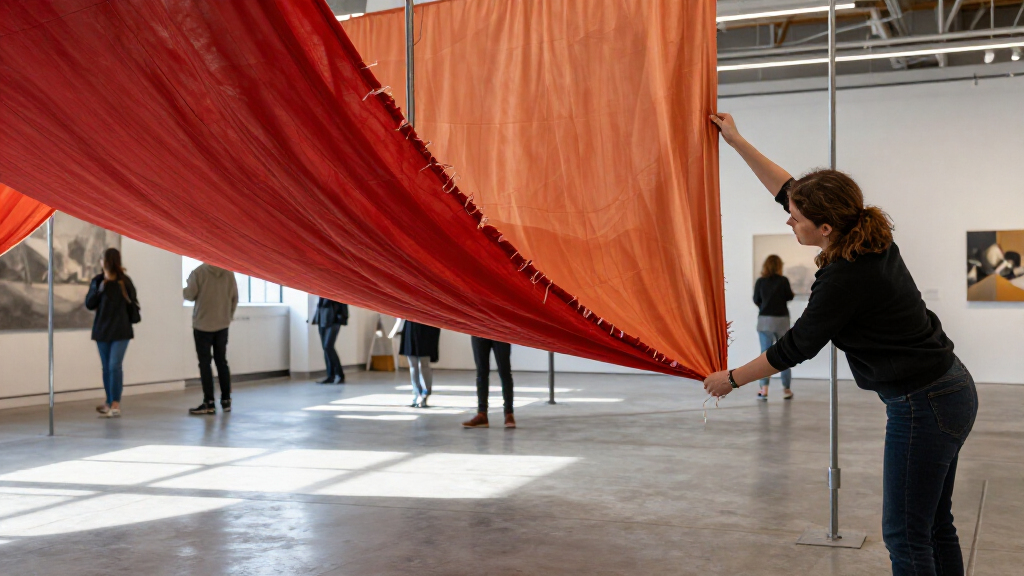
Other works connect personal and collective knowledge to material and place. Wen Liu’s sculpture incorporates herbal medicines prescribed after her father’s death; Taqralik Partridge’s installation recalls her grandmother’s family crossing the Hudson Strait by boat. At the Royal Ontario Museum, Raphaël Barontini’s textile installation links Caribbean imagery and Harriet Tubman to the Underground Railroad. In Scarborough, Nirbhai (nep) Singh Sidhu’s permanent structure at a gurdwara uses earth from Sirhind, Punjab, and draws on the Sikh practice of simran.
The exhibition’s reach beyond Toronto makes its attention to waterways and borders more than a local theme. Its works approach historical rupture through different forms: archival and museum material, remembered journeys, ritual, sound and imagined alternatives to documented violence. Together, they ask audiences to consider how the past remains present in landscapes, institutions and family knowledge.
The review’s reservations also matter to how the show is received. “Rupture” can connect distinct histories of displacement and change, but it can risk flattening their differences if treated as a single condition. Hyperallergic’s assessment is that the exhibition is provocative and affecting, while its central framing invites scrutiny rather than settling that question.
Popular right now

Dyson Cyclone V10 Origin Cordless Vacuum
Philips 5500 Series Fully Automatic Espresso Machine with LatteGo Milk System

iRobot Roomba Plus 405 Combo Robot Vacuum and Mop with AutoWash Dock
As an affiliate, we earn on qualifying purchases.
From Great Lakes to Other Sites
The Biennial has an established interest in water; this edition uses the Great Lakes to connect its themes to movement and borders. The curator, Allison Glenn, grew up in Detroit and crossed into Canada through Windsor, a personal geography that the review notes alongside the exhibition’s cross-border focus.
The show’s title and framing draw on Canadian Prime Minister Mark Carney’s Davos statement that the world is “in the midst of a rupture, not a transition.” The line appears in the Biennial catalogue. The review places that language against strained Canada–United States relations, but the exhibition’s artists address a wider range of histories, including slavery, Indigenous knowledge, migration and ecological damage.
““It’s a provocative and discursive exploration of how artists respond to our late-capitalist epoch, but its focus on ‘rupture’ raises questions.””
— Hyperallergic review
Questions Around the Rupture Frame
The source review does not provide the Biennial’s exact opening and closing dates, full venue list, attendance figures or responses from the curator and participating artists to its critique. It also ends mid-discussion, so its assessment of the exhibition is incomplete in the supplied material.
It remains a matter of interpretation whether rupture functions as a useful connection among the works or risks placing distinct histories into one broad frame. The review identifies that tension but does not resolve it; no audience or institutional response is included.
Exhibition Continues Across Venues
The Biennial is presented across locations in Toronto and at sites in Anchorage and Times Square. The supplied report does not state the exhibition’s schedule or identify a next public program, so readers should consult the Biennial’s official channels for current venue details and dates.
Further reporting could establish how the curator and artists respond to the questions raised about rupture, and how visitors encounter works displayed across such different settings. For now, the confirmed development is the multi-site exhibition and its shared focus on histories of movement, memory and separation.
Key Questions
What is the Toronto Biennial showing?
The fourth Toronto Biennial of Art presents “Things Fall Apart,” an exhibition of more than 30 artists and collectives exploring rupture, water, borders, memory and movement.
Who curated this Biennial?
Allison Glenn curated the fourth edition.
Where is the exhibition taking place?
It is presented at venues across Toronto, with sites beyond the city in Anchorage, Alaska, and Times Square, New York.
What does the review say about the exhibition?
Hyperallergic calls it a provocative exploration of artists’ responses to the present and highlights works that engage history through landscape, ritual, memory and material. The review also questions the Biennial’s emphasis on rupture.
When does the Biennial run?
The source material identifies the edition as the 2026 Biennial but does not provide opening or closing dates. Check the Biennial’s official information for the current schedule.
Source: rss