
TL;DR

Get art and craft supplies delivered free with Prime
- Fast, free delivery on millions of items
- Prime Video, Amazon Music and more included
- Member-only deals all year
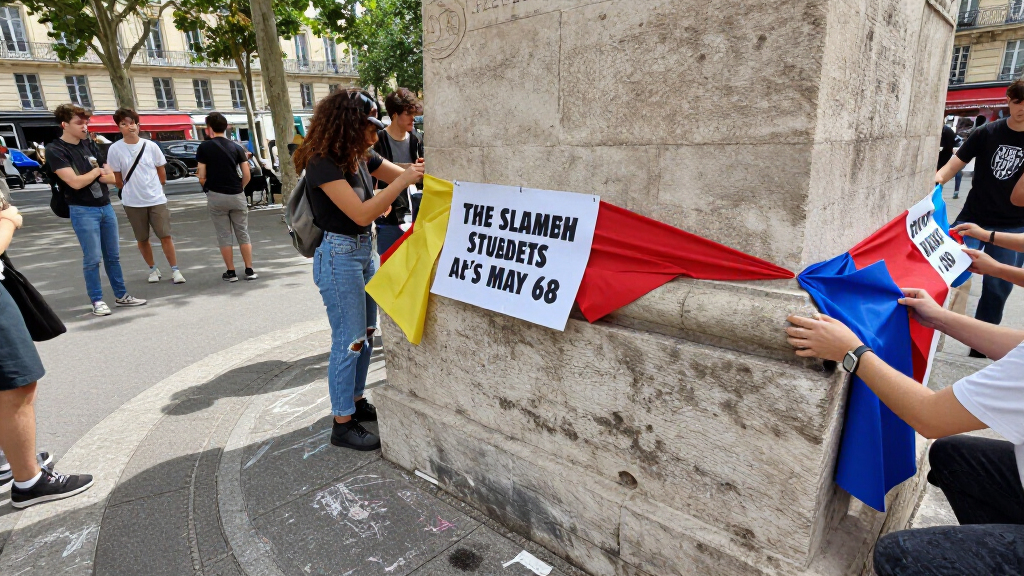
French student protesters have draped garments and messages over monuments, occupied culturally significant sites and altered statues as part of demonstrations over school conditions, police violence and living costs. The actions echo tactics used during May 1968, though the scale of the current protests and details of several incidents remain unclear.
French student demonstrators have draped slogans over monuments, blocked the Louvre’s entrance and altered public statues to protest school conditions, police violence and the cost-of-living crisis, according to a report by Hyperallergic. The actions draw on a protest tradition associated with May 1968, when students similarly made statues and historic sites part of their demonstrations.
Earlier in October, protesters dressed the Monument à la République in Paris in a white garment carrying the words “Neglected high schools, youth sacrificed.” The display denounced working conditions in education, including staff shortages and long hours, Hyperallergic reported. The monument depicts Marianne, the personification of the French Republic.
On October 19, dozens of students from the École du Louvre blocked the Louvre Museum’s main entrance. In Marseille, a separate group entered city hall and knocked a bust of Marianne to the floor, the report said. The account does not provide details about arrests, injuries or the duration of either action.
Other interventions have directly addressed policing. On October 17, protesters placed a yellow vest on Marianne bearing the message, “2026: The police are mutilating high school students.” The garment referenced the gilets jaunes movement, which protested fuel prices and what participants saw as government neglect from 2018 to 2020. The slogan makes an accusation about police conduct; the report also cites rights groups and lawyers who have accused officers of causing severe injuries to teenagers during the protests.
Monuments Become Protest Platforms
The actions make public landmarks more than backdrops: they turn familiar symbols of national identity and republican values into sites where protesters contest how those values are being upheld. At Place de la République, demonstrators marked the eyes of allegorical figures representing Liberty, Equality and Fraternity with black streaks resembling tears. Hyperallergic described the gesture as suggesting that France had turned away from principles associated with its revolution.
That visual approach can draw attention beyond the immediate demonstration, but it can also prompt disagreement over who may use monuments and for what purpose. After protesters placed a Palestinian flag and a yellow vest on a statue of Joan of Arc in Toulouse, authorities removed them. The intervention sparked online debate: some viewed it as an affront to national identity, while others interpreted the flag as connecting different human-rights struggles, according to the report.
As an affiliate, we earn on qualifying purchases.
Echoes of May 1968
The comparison with May 1968 rests on a shared tactic as well as overlapping complaints about education. During that period, students challenged the education system and the Gaullist government. At the Sorbonne, protesters displayed portraits of revolutionary figures on the university’s facade and placed red flags on statues of Louis Pasteur and Victor Hugo. On May 13, demonstrators climbed Léopold Morice’s Monument à la République as a gathering point during a nationwide general strike.
The current actions also draw on more recent protest imagery. The yellow vest on Marianne recalls demonstrations over fuel prices and the cost of living. Hyperallergic places the use of monuments within a wider history of political protest, including the defacing or removal of statues during Black Lives Matter demonstrations and the draping of a black cloth over a statue of French colonial commander Joseph Gallieni in 2020. These comparisons describe visual parallels; they do not establish that the movements have the same aims or scale.
““2026: The police are mutilating high school students.””
— Message displayed by protesters on Marianne at the Monument à la République
Scale and Police Allegations
The report does not establish the overall size or geographic spread of the current demonstrations, nor does it detail how long the Louvre blockade or Marseille city hall incident lasted. It also does not give a complete account of arrests, property damage or official responses to those events.
Claims about police violence remain attributed allegations. Hyperallergic reports that French rights groups and lawyers have accused police of inflicting severe injuries on teenagers, and describes cases involving a 14-year-old injured by a tear-gas grenade and other students allegedly beaten with batons. The available account does not provide police responses or a full set of independently verified figures on injuries and arrests.
Protests and Responses Ahead
Further developments will depend on whether students continue actions at schools, museums and public monuments, and on how authorities respond. The report gives no announced next protest date or formal negotiation timetable. Any new demonstrations, police statements or decisions about the monuments and sites involved may clarify the movement’s reach and the official response.
Key Questions
What are French student protesters demonstrating against?
The actions described in the report address underfunded schools, poor working conditions, staff shortages, long hours, police violence and living costs. The specific demands may vary between groups and locations.
Which monuments or landmarks have been involved?
Reported actions include displays on the Monument à la République in Paris, interventions at the Louvre and Marseille city hall, and a yellow vest and Palestinian flag placed on a statue of Joan of Arc in Toulouse.
How do the actions relate to May 1968?
Students in 1968 also used public statues and culturally significant sites during protests over education and government. The current demonstrations echo that tactic, but the comparison does not mean the two movements are identical.
Are the allegations of police violence confirmed?
The report attributes allegations of severe injuries to rights groups and lawyers and cites specific cases. It does not provide police responses or enough information to independently verify every allegation.
Source: rss
Halloween Picks
halloween
As an affiliate, we earn on qualifying purchases.