
TL;DR

Get art and craft supplies delivered free with Prime
- Fast, free delivery on millions of items
- Prime Video, Amazon Music and more included
- Member-only deals all year
Tang Shuo’s first solo exhibition in New York, “Borrowed History,” is on view at Plato Gallery from October 8 to November 7, 2026. Its oil paintings use fictional versions of the artist as figures from imagined ancestral lives, while the work also connects to his ongoing documentation of Dashishan Village, where the report says the population has fallen from more than 200 people to about a dozen.
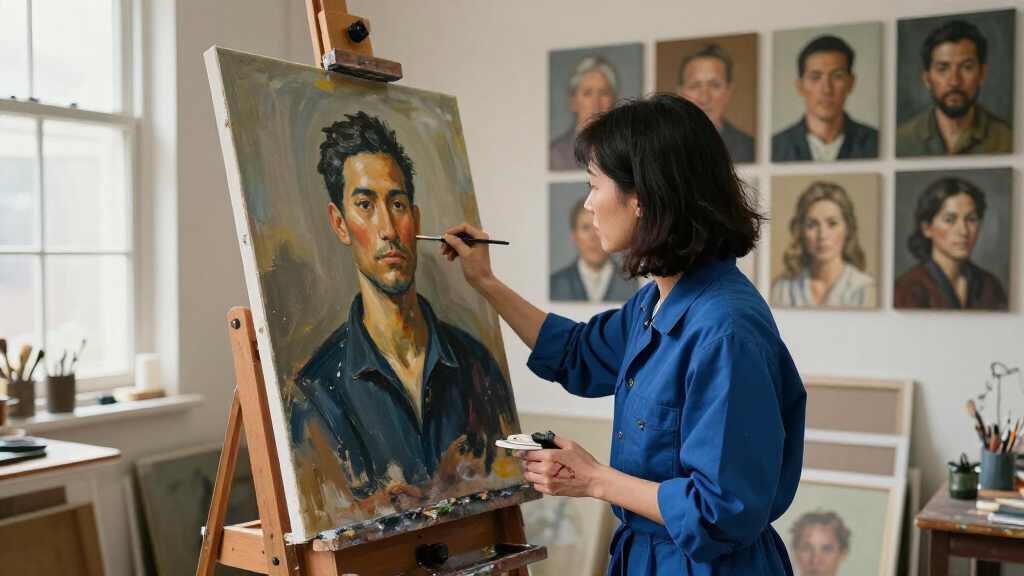
Tang Shuo’s first solo exhibition in New York, “Borrowed History,” opened at Plato Gallery on October 8 and is scheduled to run through November 7, 2026. The oil paintings use fictional versions of the artist as figures from imagined ancestral lives, drawing on his family’s connection to Dashishan Village in southern China and asking how inheritance and place shape identity.
In the exhibition, Tang works from photographs of himself but places his likeness in scenes associated with different imagined roles. “The Migrant” shows a figure carrying a small sack; “The Settler” depicts one lifting a tree trunk, with tools and bones scattered nearby. Both are 2026 oil paintings on linen, each measuring 100 by 80 centimeters, according to the report by Colossal. Other works listed include “The Tree Hollow I,” “Waiting” and “Vessel.”
The scenes are fictional rather than documentary reconstructions of particular ancestors. Colossal describes the paintings as tinged with magical realism and reports that Tang cites Gabriel García Márquez’s novel “One Hundred Years of Solitude” as an influence. Forests and brightly colored clouds recur in the images; the report says Tang uses the natural surroundings to connect different eras and generations.
The exhibition is linked to Tang’s continuing interest in his family history and the village where he grew up. Colossal reports that he continues to document Dashishan’s residents and stories and intends to publish a book recording the village’s history. The report says Tang describes that planned book as his “own bible.”
Painting Ancestry Through Place
The paintings bring family memory and landscape together without presenting invented scenes as verified history. Tang’s approach gives viewers a way to consider how ties to a particular place can inform ideas of ancestry, even when the lives of earlier generations cannot be reconstructed in detail.
The project also has a documentary dimension beyond the canvases. Colossal reports that Dashishan’s population has declined from more than 200 residents when Tang was a child to only about a dozen today. His planned village-history book and ongoing documentation may preserve accounts of a community undergoing major change, though the source does not provide a publication date or further details about the research.
Popular right now

Shark Rocket Pet Plus Corded Stick Vacuum, Bordeaux, HV322

iRobot Roomba Max 715 Pet Robot Vacuum with AutoEmpty Dock

Samsung 42-Inch Class OLED S90F 4K Smart TV (2025)
As an affiliate, we earn on qualifying purchases.
From Dashishan to Plato Gallery
Tang grew up in Dashishan, where several generations of his family lived in a small community and farmed, tending crops and sheep. Colossal recounts that he was afraid of snakes as a child; one painting revisits that fear through an imagined image of the artist holding a black serpent beside its shed skin. The work connects a personal memory to the exhibition’s broader interest in family, land and inherited stories.
“Borrowed History” extends Tang’s earlier engagement with his ancestry and his home territory, according to Colossal. Its New York presentation is the artist’s first solo exhibition in the city. The reported gallery dates are October 8 through November 7, 2026; further information about the exhibition’s format or public programming is not included in the source material.
““own bible””
— Tang Shuo, as quoted in the Colossal report
Limits of the Imagined Record
The paintings’ ancestral scenes are deliberately fictional; the source does not identify them as depictions of specific relatives or as evidence of particular historical events. It is also not clear how much of the imagery comes from family testimony, village records or Tang’s own invention beyond the report’s description of the work.
The reported population figures for Dashishan are not accompanied by a date for the current count or details about how it was gathered. The planned history book has no stated release schedule, publisher or confirmed scope in the source material. Those details remain unreported.
Exhibition and Village History
“Borrowed History” is scheduled to remain on view at Plato Gallery through November 7, 2026. The next development described in the source is Tang’s planned book about Dashishan, but no publication date has been announced in the report. Until further details emerge, the exhibition offers the available account of how he combines imagined ancestral figures with his continuing attention to the village and its residents.
Key Questions
What is “Borrowed History”?
It is Tang Shuo’s first solo exhibition in New York, featuring paintings that imagine ancestral lives through fictional versions of the artist.
When and where is the exhibition on view?
The exhibition is scheduled at Plato Gallery from October 8 to November 7, 2026.
Are the figures portraits of Tang’s actual ancestors?
The scenes are described as fictional. Tang uses photographs of himself as a basis for imagined roles, but the report does not identify the figures as literal portraits of specific ancestors.
What is Tang’s connection to Dashishan?
Tang grew up in Dashishan Village in southern China, where his family farmed and several generations lived together. He continues to document the village’s residents and stories, according to Colossal.
Is Tang publishing a book about the village?
The report says Tang intends to publish a book recording Dashishan’s history, but gives no release date or other publication details.
Source: rss