
Egyptian creation myths focus on how divine beings like the Ennead and Ogdoad shape the universe from chaos into order. The Ennead, centered in Heliopolis, includes gods like Ra and Shu, who work together to create land, sky, and humans. The Ogdoad from Hermopolis symbolizes primordial chaos and darkness, transforming through divine action. These myths reveal how cosmic forces and gods sustain the world’s balance. Continuing to explore these stories uncovers deeper insights into ancient Egyptian beliefs.
Key Takeaways
- The Ennead myth centers around nine gods from Heliopolis, depicting creation from chaotic waters (Nun) to order through gods like Ra.
- The Ogdoad myth features four pairs of primordial gods representing chaos, darkness, and water, symbolizing potential before creation.
- Ennead gods, including Ra, Shu, and Tefnut, work together to shape the land, sky, and human existence.
- Both myths illustrate the transformation of chaos into order through divine action and cooperation of divine beings.
- Divine beings in these myths symbolize fundamental forces that sustain the universe and reflect ancient Egyptian cosmic understanding.
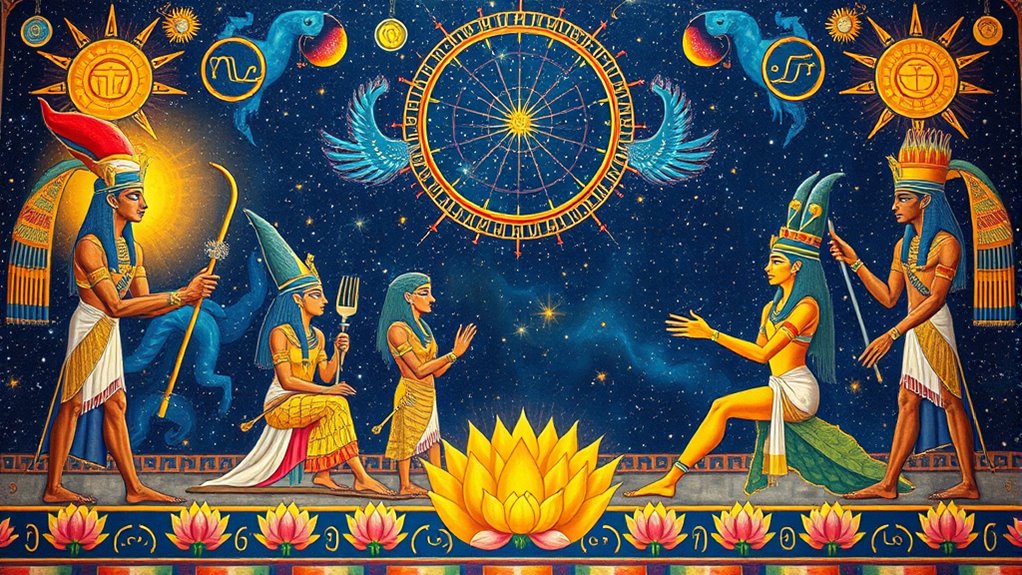
Egyptian creation myths explain how the world and the gods came into existence, shaping ancient Egypt’s worldview. These stories reveal the cosmic origins of everything, emphasizing the role of divine beings in shaping reality. The myths differ between regions, but they all focus on how primordial chaos gave way to order through the actions of powerful gods. You’ll find that these divine beings are not just creators but also symbols of the fundamental forces that govern life and the universe. Understanding their stories provides insight into how the ancient Egyptians saw the world and their place within it.
Egyptian myths reveal how chaos transformed into order through divine creation.
One of the most influential myth cycles involves the Ennead, a group of nine gods centered around the city of Heliopolis. In this narrative, the universe begins with Nun, the chaotic waters of primeval chaos from which all life emerges. From Nun, the sun god Ra rises, bringing light and order to the cosmos. Ra then creates other divine beings, including Shu (air) and Tefnut (moisture), who give form to the world. These gods embody essential elements that sustain life and establish the structure of the universe. As part of this myth, the divine beings work together to shape the land, sky, and humans, illustrating the interconnectedness of cosmic origins and divine action. The Ennead emphasizes that the universe’s stability depends on these divine beings maintaining order amid chaos.
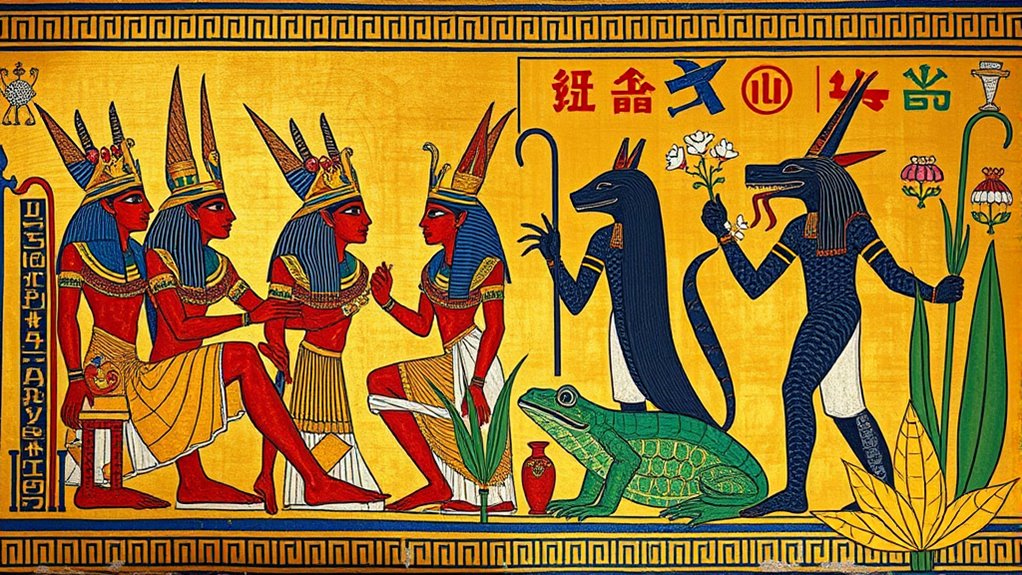
In contrast, the Ogdoad myth focuses on a different set of divine beings from Hermopolis. These are four pairs of primordial gods representing concepts like darkness, water, infinity, and chaos—such as Nun and Naunet, the male and female counterparts of the primordial waters. These divine beings embody the chaotic, unformed state before creation, highlighting the importance of balance between chaos and order. According to this myth, the Ogdoad gods exist in a state of potential, waiting for the moment when they give rise to the sun god, Atum, who then initiates creation. This story emphasizes the cosmic origins rooted in chaos, with divine beings playing a critical role in transforming disorder into the ordered universe. It reflects the Egyptians’ understanding that creation involved both chaos and divine intervention, with divine beings acting as catalysts for cosmic emergence.
Both myths underscore that divine beings are central to the universe’s origin. They serve as creators, maintainers, and symbols of fundamental forces. As you explore these stories, you see how they reflect ancient Egyptians’ beliefs in a universe born from chaos, shaped by divine agency, and sustained through divine order. These myths aren’t just stories; they’re a window into how the Egyptians understood their cosmic origins and the divine beings that brought and upheld the world.
Top picks for "egyptian creation myth"
Open Amazon search results for this keyword.
As an affiliate, we earn on qualifying purchases.
Frequently Asked Questions
How Did the Ennead and Ogdoad Interact in Creation Stories?
You see the Ennead and Ogdoad as representing cosmic duality and divine hierarchy in Egyptian creation stories. The Ogdoad embodies chaos and primordial elements, while the Ennead introduces order through gods like Ra and Osiris. They interact by shifting from primal chaos to structured divine domains, with the Ogdoad laying the groundwork and the Ennead establishing the divine hierarchy that sustains creation. This interplay highlights their foundational roles in Egyptian mythology.
What Symbols Represent the Gods in These Myths?
You see that gods in these myths are represented by symbolic attributes that reveal their divine nature. For example, Atum is often depicted with a serpent or a double crown, symbolizing kingship and creation. Similarly, the Ogdoad gods are shown with features like frogs or serpents, representing fertility and chaos. These divine representations help you understand each god’s unique role and power within the creation stories.
Are These Myths Linked to Specific Geographic Regions?
You can’t judge a book by its cover, and Egyptian myths are no different—these stories are closely tied to regional variations and geographic influences. The Ennead and Ogdoad myths often developed in specific areas like Heliopolis and Hermopolis, reflecting local beliefs and landscapes. These regional differences helped shape the gods’ roles and symbols, creating a rich tapestry of stories that vary depending on where you are in ancient Egypt.
How Did These Myths Influence Later Egyptian Religion?
You see how these myths shaped later Egyptian religion through cosmic symbolism and mythological evolution. They provided a foundational understanding of creation, gods, and the universe that influenced religious practices, rituals, and beliefs. By embedding cosmic symbolism into their worldview, Egyptians saw their gods as central to explaining life and the cosmos. This mythological evolution guaranteed these stories remained essential, guiding religious thought and inspiring new deities and traditions over centuries.
Were There Any Variations of These Myths Across Different Periods?
You’ll find myth variations across different periods and regions, reflecting local beliefs and cultural influences. Regional differences shaped how the Ennead and Ogdoad myths were told, with some communities emphasizing certain gods or stories more than others. Over time, these variations blended or evolved, creating diverse versions of the same myths. This dynamic storytelling helped keep Egyptian religion vibrant and adaptable throughout history.
Conclusion
As you explore the Egyptian creation myths, you’ll realize these stories are more than ancient tales—they’re like the original user manuals for understanding life. The Ennead and Ogdoad reveal how the Egyptians viewed the universe’s birth, blending myth with their worldview. Just as you might consult a modern guidebook, they turned to these gods for answers. These myths remind us that even in old stories, there’s a timeless quest for meaning—proof that some questions never go out of style.