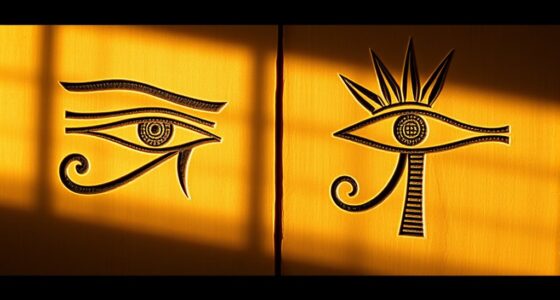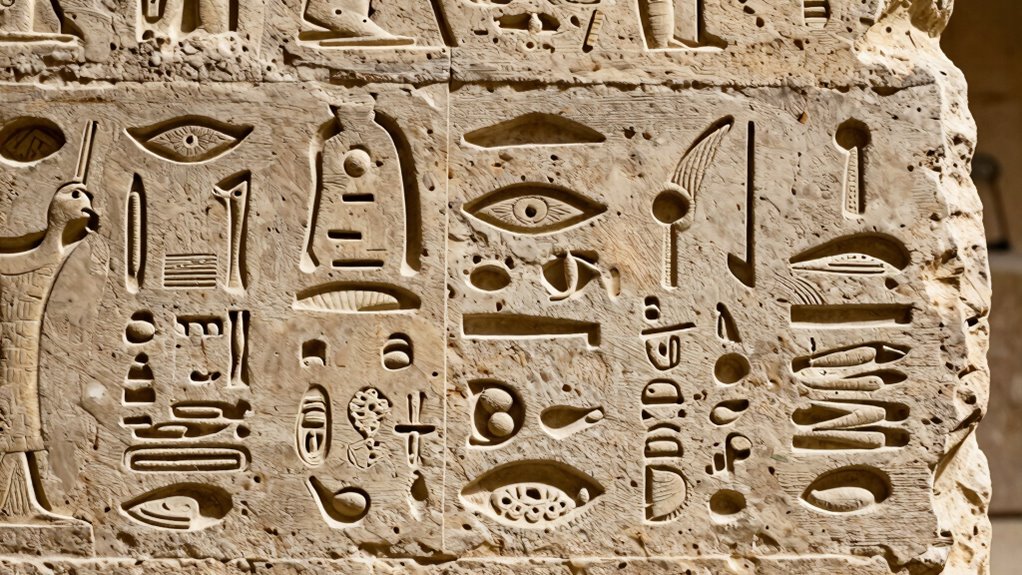

Hieroglyphs work as both a language and a symbol system. They combine images that represent sounds, like birds for “a,” with symbols carrying cultural and religious meanings, such as the lotus or the ankh. This dual function allows you to interpret literal messages while also understanding deeper spiritual or social messages. Their structured arrangement enhances clarity and emphasizes certain ideas. Keep exploring, and you’ll discover how this sophisticated system reflects the rich worldview of ancient Egypt.

Get art and craft supplies delivered free with Prime
- Fast, free delivery on millions of items
- Prime Video, Amazon Music and more included
- Member-only deals all year
Key Takeaways
- Hieroglyphs combined images with sounds, functioning as a phonetic alphabet for spelling words.
- Symbols conveyed layered cultural and spiritual meanings beyond their phonetic value.
- Arrangement and layout of hieroglyphs enhanced clarity and emphasized important messages.
- Hieroglyphs served both artistic and practical purposes, reflecting Egyptian worldview and beliefs.
- The interconnected use of symbols and sounds allowed for nuanced, sophisticated written communication.
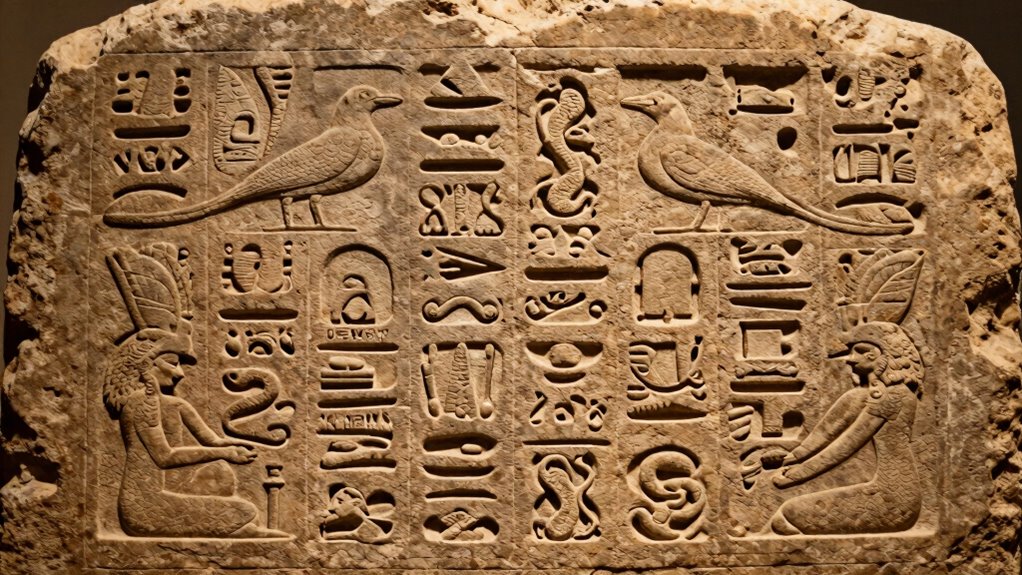
Have you ever wondered how ancient Egyptians communicated complex ideas through symbols? Their hieroglyphic system masterfully combines both language and symbolism, allowing them to record history, religious beliefs, and daily life. At the heart of this system lies hieroglyphic phonetics, a clever method that transforms pictures into sounds, much like an alphabet. Instead of relying solely on images to represent ideas, hieroglyphic phonetics let scribes spell out words by combining symbols that represent specific sounds. For example, a picture of a bird might stand for the sound “a” or “bird,” depending on its context. This dual function creates a flexible writing system that captures speech and preserves cultural meanings simultaneously. The phonetic components of hieroglyphs enable a nuanced and adaptable way to convey complex messages. Additionally, understanding the structural features of hieroglyphs reveals how their arrangement contributed to clarity and emphasis in inscriptions. But hieroglyphs aren’t just phonetic tools—they’re also imbued with cultural symbolism. Each symbol holds layers of significance, revealing beliefs, social values, and religious concepts. A lotus flower, for instance, symbolizes rebirth and purity in Egyptian culture; it isn’t just a plant. The ankh, resembling a cross with a loop at the top, isn’t only a sign of life but also a powerful emblem of eternal existence. When you look at hieroglyphs, you’re not only deciphering words but also engaging with symbols that carry spiritual and cultural weight. This integration of meaning makes hieroglyphic writing a rich tapestry of language and symbolism. The way hieroglyphs work as both language and symbols means that understanding one aspect enhances your grasp of the other. When you recognize a symbol’s cultural importance, you gain insight into the message’s deeper significance. Conversely, knowing the phonetic value of a hieroglyph helps you decode the literal message, which then opens the door to appreciating its symbolic layers. This interconnectedness is what makes hieroglyphs so sophisticated and enduring. They weren’t just a means of communication but a reflection of the worldview of the ancient Egyptians—where language and symbolism served to preserve knowledge, express beliefs, and connect the physical with the spiritual. Recognizing the symbolic significance of hieroglyphs enriches our understanding of their complex communication system. Additionally, the writing system’s ability to combine phonetics and symbolism demonstrates a high level of sophistication that influenced later cultures’ communication methods. This blend of visual and linguistic elements highlights how hieroglyphs served as both artistic expressions and practical tools for communication.
Egyptian hieroglyphs learning kit
As an affiliate, we earn on qualifying purchases.
As an affiliate, we earn on qualifying purchases.
Frequently Asked Questions
How Did Hieroglyphs Evolve Over Different Egyptian Periods?
You see hieroglyphs evolved considerably across Egyptian periods, reflecting changes in art and culture. During early times, their artistic evolution made symbols more detailed and expressive, often emphasizing religious symbolism importance. As periods progressed, hieroglyphs became more stylized and standardized, balancing aesthetic beauty with clarity. This shift allowed them to serve both as a refined form of communication and as powerful religious symbols, reinforcing spiritual beliefs and societal hierarchy.
Were Hieroglyphs Used in Everyday Communication or Only for Formal Inscriptions?
Did you know only about 5% of hieroglyphs are ceremonial, while the rest appeared in daily life? You’d find hieroglyphs as graffiti on walls or carved into everyday objects, showing they weren’t just for formal inscriptions. Hieroglyphs in daily life helped Egyptians communicate, record transactions, or decorate their homes. So, they played an essential role beyond temples and tombs, making their script a part of everyday expression.
How Did Scribes Learn and Memorize Hieroglyphic Symbols?
You learn and memorize hieroglyphic symbols through extensive scribe training, which includes practicing with mnemonic techniques. Scribes spend years studying to recognize and reproduce the symbols accurately, often using memory aids like storytelling or visual associations to remember complex glyphs. This disciplined training guarantees they master the symbols’ meanings and forms, allowing them to write both formal inscriptions and everyday texts with precision.
Did Hieroglyphs Influence Other Writing Systems?
You might be surprised to learn that hieroglyphs influenced other writing systems through their rich symbolism and artistic interpretation. Their intricate symbolism sparked curiosity and inspired the development of decorative scripts and pictorial writing elsewhere. This influence hints at a deeper connection, revealing how ancient Egyptian artistry and symbolism shaped future writing styles. The legacy of hieroglyphic symbolism continues to echo, leaving an enduring mark on visual communication throughout history.
Are There Undeciphered Hieroglyphic Symbols Still Unknown Today?
You’ll find some undeciphered hieroglyphic symbols still pose modern decipherment challenges. While many symbols are understood as either symbolic or phonetic, others remain ambiguous, complicating full translation. These unknown symbols often blur the line between symbolic and phonetic hieroglyphs, making it harder to interpret ancient texts accurately. Researchers continue to analyze these mysteries, but some symbols still resist complete understanding, leaving gaps in our knowledge of ancient Egyptian language and culture.
Conclusion
Imagine hieroglyphs as a vibrant tapestry, weaving together language and symbols into a single, mesmerizing story. As you explore their dual nature, you realize they’re not just written words but gateways to revealing ancient worlds. By understanding hieroglyphs, you hold a bridge between the past and present, connecting you to the minds of those who carved these symbols long ago. They’re timeless whispers, waiting for you to listen and uncover their secret meanings.
Halloween Picks
halloween
As an affiliate, we earn on qualifying purchases.