Sacred geometry involves precise mathematical ratios and symbolic designs that reflect universal truths, harmony, and spiritual ideas across cultures. It’s used in religious symbols, temples, and meditation tools to symbolize interconnectedness and divine principles. Decorative patterns, on the other hand, focus mainly on visual appeal, ornamentation, and aesthetic enhancement without necessarily carrying deeper meaning. If you want to understand how these patterns connect to universal and spiritual concepts, there’s more to explore below.
Open a free Amazon Business account
Business pricing, bulk buying and tax-exempt orders.
As an affiliate, we earn on qualifying purchases.
Key Takeaways
- Sacred geometry involves precise mathematical ratios and universal principles, while decorative patterns focus on visual appeal without deeper symbolism.
- Sacred geometry symbolizes spiritual concepts like harmony and interconnectedness, whereas decorative patterns primarily serve aesthetic purposes.
- Sacred geometry is used in religious, spiritual, and architectural contexts, whereas decorative patterns are mainly ornamental.
- Sacred geometry often incorporates specific symbols like mandalas and pyramids, unlike generic decorative motifs.
- Recognizing the mathematical significance of sacred geometry enhances understanding of universal harmony beyond mere decoration.
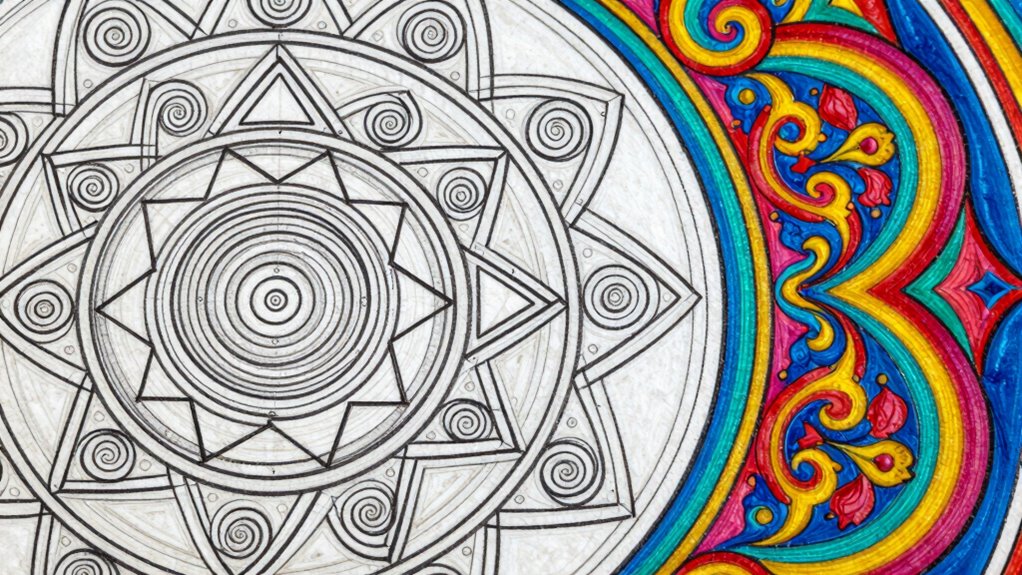
While both sacred geometry and decorative patterns involve intricate designs, they serve fundamentally different purposes. Sacred geometry is rooted in the belief that certain shapes and proportions reflect universal truths and divine principles. When you study sacred geometry, you find that its mathematical significance lies in precise ratios, such as the golden ratio, which appear repeatedly in nature and architecture. These patterns aren’t just visually appealing; they embody deeper truths about the universe’s structure. Many cultures have used sacred geometry to symbolize ideas like harmony, balance, and interconnectedness. For example, in ancient Egypt, the use of geometric proportions in pyramids was believed to connect the earthly domain with the divine. In Hindu and Buddhist traditions, mandalas utilize sacred geometric forms to represent spiritual journeys and cosmic order. These symbols serve as tools for meditation and reflection, emphasizing their cultural symbolism as much as their mathematical importance. Recognizing the role of proportions like the golden ratio enhances our understanding of how sacred geometry reflects universal harmony. Additionally, understanding the mathematical significance of these shapes helps us appreciate their role in both spiritual practices and natural patterns. These symbols serve as tools for meditation and reflection, emphasizing their cultural symbolism as much as their mathematical importance.
As an affiliate, we earn on qualifying purchases.
Frequently Asked Questions
How Do Sacred Geometry Symbols Influence Modern Architecture?
Sacred geometry symbols influence modern architecture by integrating mathematical principles that create harmonious and balanced structures. You’ll notice architects use these symbols as architectural symbolism to evoke spiritual or philosophical meanings, enhancing visual appeal and cultural significance. These principles guide the design of buildings, ensuring proportions and patterns resonate deeply, making spaces feel more unified and meaningful. Ultimately, sacred geometry helps you connect with the space on a deeper, subconscious level.
Can Decorative Patterns Have Spiritual Significance?
Yes, decorative patterns can hold spiritual significance. You might notice that certain symbols evoke feelings or memories, rooted in their symbolic meanings and cultural interpretations. These patterns often carry deeper messages, connecting you to traditions or beliefs. When you encounter them, their intricate designs can serve as silent reminders of spiritual truths, making your experience richer and more meaningful beyond mere aesthetics.
Are There Specific Cultures Associated With Sacred Geometry?
You’ll find sacred geometry closely linked to cultures like Ancient Egypt, Greece, and India, where it embodies spiritual and cultural symbolism. The historical origins of sacred geometry trace back thousands of years, revealing its importance in architecture, art, and religious practices. These cultures used geometric patterns to connect with the divine, representing harmony, creation, and universal truths, distinguishing sacred geometry from purely decorative patterns.
How Is Sacred Geometry Used in Meditation Practices?
You use sacred geometry in meditation to deepen your meditative focus and connect with spiritual symbolism. By visualizing geometric patterns like the Flower of Life or mandalas, you align your mind with universal principles, fostering inner harmony. These symbols serve as a spiritual language, helping you transcend everyday thoughts and access higher consciousness, making your meditation more meaningful and profound.
What Materials Are Commonly Used for Sacred Geometry Art?
You typically use materials like paper, canvas, or wood for sacred geometry art, allowing you to explore mathematical principles visually. You might also incorporate metal, glass, or stone for more durable, artistic interpretations. These materials help you express the intricate patterns and precise measurements that define sacred geometry, enabling a connection between mathematical harmony and aesthetic beauty. Your choice of medium influences the depth and spiritual resonance of your artwork.
Conclusion
While both sacred geometry and decorative patterns draw from intricate designs, their purposes differ sharply. Sacred geometry embodies universal truths and spiritual significance, guiding your understanding of the cosmos. Decorative patterns, on the other hand, serve primarily aesthetic purposes, enhancing beauty without deeper meaning. Think of sacred geometry as the language of the universe, and decorative patterns as the art that adorns it—each mesmerizing, yet fundamentally different in intent and significance.
NFL season / tailgating Picks
team gear
As an affiliate, we earn on qualifying purchases.