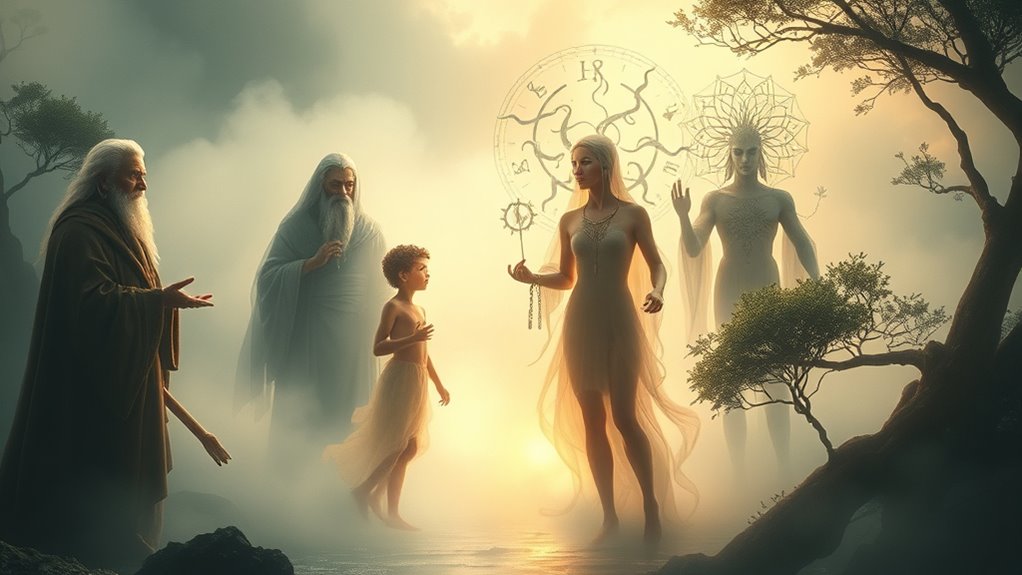

Spirit guides can be seen as external beings rooted in cultural traditions, providing guidance and reassurance, or as subconscious archetypes representing inner wisdom, depending on your perspective. While some believe these messages come from divine or spiritual sources, others see them as symbolic reflections of your mind working through emotions and conflicts. Understanding this comparison helps you interpret your experiences more clearly. If you explore further, you’ll discover how these views influence personal growth and perception.
Key Takeaways
- Spirit guides are culturally rooted entities offering external guidance, while subconscious archetypes are internal mental symbols representing inner wisdom.
- Cultural beliefs influence whether guides are perceived as literal supernatural beings or internal psychological constructs.
- Psychological perspectives, especially Jungian theory, interpret guides as archetypes arising from the collective unconscious.
- The perception of guides affects their role in personal growth, either as divine messengers or internal reflections.
- Recognizing guides as archetypes can empower introspection, whereas viewing them as external beings can strengthen spiritual reassurance.

Throughout history, many cultures have believed in spirit guides—ethereal beings that offer guidance and wisdom. These entities often appear in dreams, visions, or meditative states, and their roles vary widely depending on cultural interpretations. In some traditions, spirit guides are seen as ancestors or protective spirits, while others view them as messengers from divine spheres. These beliefs influence how individuals interpret personal experiences, shaping their understanding of life’s challenges and spiritual journeys. The cultural lens through which you view these guides shapes whether you see them as literal beings or symbolic representations of inner wisdom. For some, spirit guides serve as tangible sources of comfort and direction, reinforcing cultural narratives about the spiritual world. For others, the interpretation is more psychological—seeing these guides as manifestations of the subconscious mind working to process fears, hopes, and unresolved conflicts. Recognizing these guides as internal constructs aligns with the concept of archetypes embedded in the collective unconscious, as described by Carl Jung.
The psychological implications of believing in or experiencing spirit guides are significant. If you approach these experiences through a psychological lens, you might view them as archetypes from the collective unconscious—concepts introduced by Carl Jung to describe universal symbols embedded in all human minds. In this context, spirit guides are seen as subconscious archetypes that emerge during introspection or emotional upheaval, offering insights that help you navigate complex feelings or decisions. Recognizing these guides as internal constructs can empower you to harness your intuition without necessarily attributing them to external supernatural forces. Conversely, embracing a spiritual interpretation can deepen your sense of connection to something greater than yourself, fostering a feeling of guidance that transcends rational explanation. Some people find that believing in external spirit guides provides reassurance and a sense of purpose, especially during difficult times. Additionally, understanding the role of color and symbolism in how these guides are perceived can enhance personal interpretations and emotional responses.
Whether you see them as external beings rooted in cultural traditions or as internal archetypes of the mind, the core function remains similar: they serve as sources of guidance and insight. Your perception influences how you interpret their messages—whether as divine instructions or as symbolic reflections of your inner psyche. Recognizing the psychological implications can help you discern whether these experiences are empowering or potentially rooted in subconscious conflicts. Ultimately, the distinction might not matter as much as the effect they have on your personal growth and understanding. If your encounters with spirit guides inspire introspection and aid in resolving inner conflicts, they can be invaluable, regardless of whether you interpret them through cultural or psychological frameworks.

Spirit Guide Journal: Connect with Your Spirit Guides
As an affiliate, we earn on qualifying purchases.
As an affiliate, we earn on qualifying purchases.
Frequently Asked Questions
Can Spirit Guides Change Over a Person’s Lifetime?
Yes, spirit guides can change over your lifetime as part of your personal growth and spiritual evolution. As you gain new insights and face different challenges, your connection to various guides may shift, offering fresh guidance. This evolution reflects your inner development, helping you navigate life’s stages. Embracing these changes allows you to deepen your understanding of yourself and align more closely with your spiritual journey.
How Do Cultural Differences Influence Archetype Interpretations?
Cultural symbolism shapes how you interpret archetypes, creating diverse meanings across societies. While one culture sees a hero as brave, another might view the same figure as reckless. These interpretative frameworks influence your understanding deeply, highlighting that your perception isn’t universal. Your cultural background acts like a lens, coloring archetypes with unique significance, emphasizing that interpretations are fluid and shaped by societal context rather than fixed symbols.
Are There Scientific Methods to Distinguish Guides From Archetypes?
You wonder if scientific methods can distinguish guides from archetypes. While neuroscientific evidence can show brain activity patterns linked to spiritual experiences, it doesn’t definitively identify whether you’re interacting with a guide or archetype. Psychological assessments help analyze your perceptions and beliefs, but they can’t conclusively differentiate between the two. Ultimately, these methods provide insights, yet the subjective nature of your experience still plays a key role.
Can Anyone Develop a Relationship With Their Spirit Guide?
You can absolutely develop a relationship with your spirit guide—it’s a life-changing journey. Intuitive communication is the key; trust your instincts and stay open. With dedication, you’ll deepen your personal development and forge a bond that feels like having a secret superpower. Everyone has the potential; it just takes patience, practice, and belief to connect on a profound level. Your guide is waiting to help you thrive.
Do Archetypes Have Biological or Neurological Bases?
You wonder if archetypes have neuroscience origins or genetic influences. Research suggests archetypes may stem from our brain’s neural patterns, shaped by evolutionary processes. Genetic influences could also play a role by affecting how we interpret symbols and stories. While not fully understood, these ideas imply archetypes are rooted in biological and neurological mechanisms, helping explain why they resonate universally across cultures and individuals.
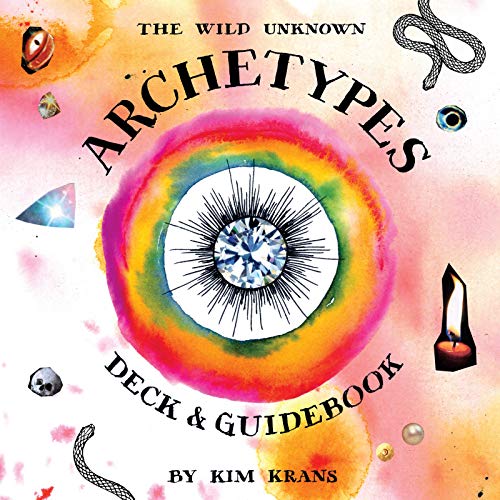
The Wild Unknown Archetypes Deck and Guidebook
As an affiliate, we earn on qualifying purchases.
As an affiliate, we earn on qualifying purchases.
Conclusion
Whether you see them as spirit guides or subconscious archetypes, remember they both serve as mirrors to your inner world. Some might argue that labeling them limits your growth, but embracing this dual perspective can deepen your understanding. Recognize that these symbols, whether external or internal, help you navigate life’s mysteries. Trust that by exploring both viewpoints, you release greater self-awareness and resilience, turning perceived obstacles into powerful opportunities for growth.

The Shaman's Dream Oracle: A 64-Card Deck and Guidebook
As an affiliate, we earn on qualifying purchases.
As an affiliate, we earn on qualifying purchases.

GZXINKE Cosmic Oracle Cards, Universe Message Oracle Cards for Beginners, Inner Strength, Spiritual Guidance Oracle Deck, Universal Wisdom for Daily Use, Readings, and Meditation
【Cosmic Oracle Cards】Trust in the Universe’s support and let these cards guide you through life’s uncertainties. Whether you're…
As an affiliate, we earn on qualifying purchases.
As an affiliate, we earn on qualifying purchases.