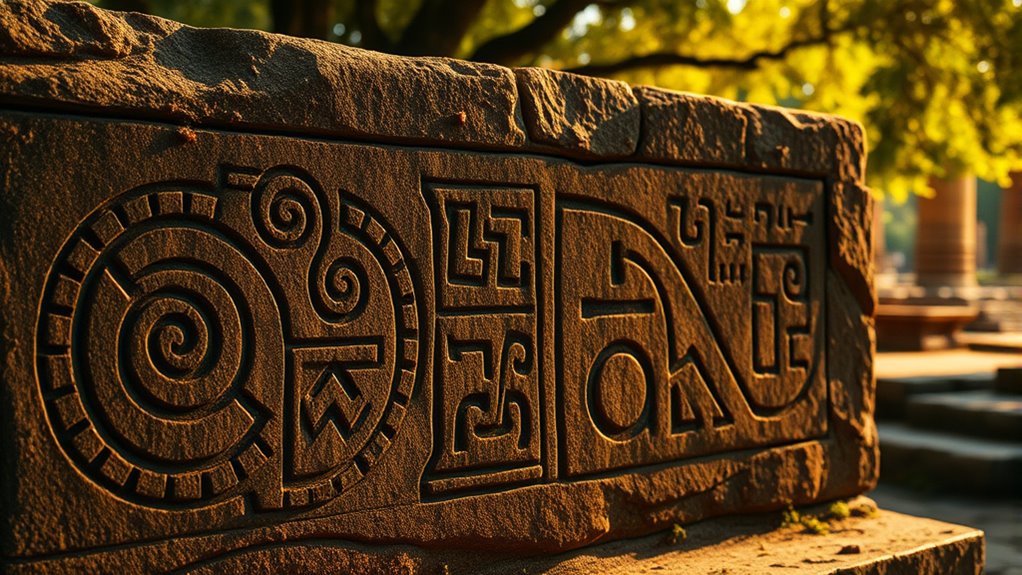

Symbols in ancient cultures are powerful visual tools that embody beliefs, reinforce social identities, and connect communities to their gods and ancestors. They carry deep meanings through carefully chosen lines, colors, and shapes, acting as bridges between the material and spiritual worlds. These symbols are used in rituals, art, and everyday objects to communicate complex ideas and preserve cultural identity across generations. Continue exploring, and you’ll discover how these symbols shaped societies and spiritual practices.
Key Takeaways
- Symbols served as visual representations of beliefs, power, and identity, connecting people to divine forces and ancestors.
- They held spiritual significance in rituals, facilitating communication with the divine and ensuring spiritual responses.
- Artisans incorporated symbols into everyday objects, embedding cultural values and mythologies into visual narratives.
- Symbols functioned as a visual language, preserving cultural identity and transmitting knowledge across generations.
- Sacred symbols reinforced social hierarchies and were controlled by elites to maintain spiritual and political authority.
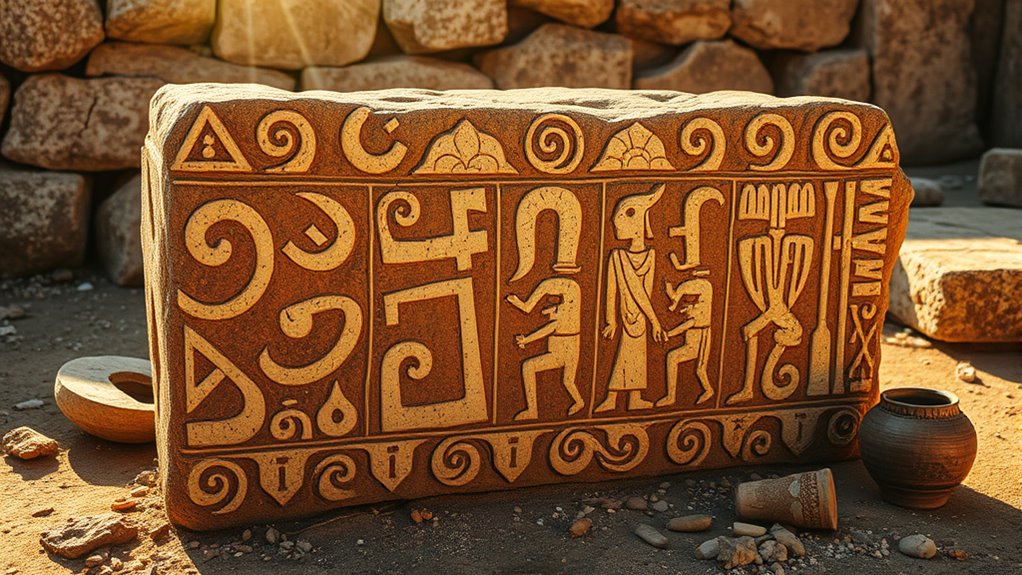
Symbols have played a vital role in ancient cultures, serving as visual representations of beliefs, power, and identity. You might find that these symbols weren’t just decorative; they carried deep meanings that connected people to their gods, ancestors, and the natural world. In many societies, symbols held ritual significance, acting as focal points during ceremonies and spiritual practices. For example, a particular motif might be used exclusively in religious rites, believed to invoke divine favor or communicate sacred truths. These ritual symbols often served as a bridge between the material and spiritual domains, reinforcing communal bonds and shared beliefs. Their use in rituals wasn’t arbitrary—every line, color, and shape was carefully chosen to evoke specific spiritual responses, ensuring that the symbols resonated with participants on a subconscious level.
You’ll notice that these symbols also appear prominently in artistic representations across many ancient cultures. Artisans and craftsmen incorporated symbols into pottery, textiles, carvings, and murals, embedding layers of meaning into everyday objects. These artistic representations weren’t merely decorative; they functioned as visual narratives that expressed cultural values, mythologies, and societal hierarchies. For instance, deities might be depicted with symbolic attributes that highlight their powers or roles within the pantheon. Similarly, animals, plants, and geometric figures often carried symbolic weight, representing concepts like fertility, protection, or eternity. When you examine ancient art, you see a visual language that communicated complex ideas without words, relying on symbols to convey messages across generations. Additionally, the use of symbols was often tightly controlled by religious or ruling elites to preserve their sacred significance and authority.
Furthermore, these artistic representations helped preserve cultural identity and continuity. They served as a form of visual storytelling, passing knowledge and tradition from one generation to the next. In some cases, symbols became sacred emblems that only initiates or specific groups could interpret, adding an element of exclusivity and spiritual authority. Over time, the meaning of certain symbols might evolve, but their core significance often remained rooted in shared history and belief systems. By understanding the symbolic content embedded in ancient art, you gain insight into the values and worldview of the culture that created it. Whether used in ritual contexts or displayed in everyday objects, symbols in ancient cultures functioned as powerful tools for communication, uniting communities through shared spiritual and artistic expression.
Frequently Asked Questions
How Do Symbols Evolve Over Time in Ancient Societies?
You see symbols evolve over time through symbol transformation, influenced by cultural shifts and new interpretations. As societies change, symbols often gain or lose ritual significance, adapting to different religious, social, or political contexts. This process helps maintain their relevance and power, ensuring they continue to communicate core values or beliefs. Over generations, these symbols become layered with new meanings, reflecting the dynamic nature of ancient societies and their ongoing cultural development.
What Role Do Symbols Play in Cultural Identity?
Symbols play a pivotal role in your cultural identity by embodying ritual significance that connects you to your heritage. They serve as visual or meaningful representations that strengthen societal cohesion, reminding you of shared values and traditions. When you recognize and uphold these symbols, you actively participate in maintaining your community’s sense of belonging and continuity, reinforcing your cultural roots and fostering collective pride.
Are There Universal Symbols Across Different Ancient Cultures?
You’ll find some universal symbols across ancient cultures, like shared motifs and mythological icons, that reveal common human themes. For example, the circle often represents eternity or wholeness, while serpents symbolize rebirth. These symbols appear independently in diverse societies, showing how humans across time and space use visual cues to express fundamental ideas. Recognizing these shared motifs helps you understand our interconnectedness despite cultural differences.
How Do Symbols Influence Modern Interpretations of Ancient Texts?
Did you know that 78% of modern researchers rely on cultural symbolism to interpret ancient texts? Symbols influence your understanding by shaping how you interpret meanings, themes, and messages within those texts. Your ability to decipher symbols depends on grasping their historical and cultural context, which guides your symbol interpretation. This connection helps you appreciate ancient cultures more deeply and prevents misinterpretation, ensuring a more accurate understanding of their messages.
What Methods Do Researchers Use to Decode Ancient Symbols?
You can explore ancient symbols through symbol analysis, which examines their shapes, patterns, and contexts to uncover meanings. Researchers also use iconographic interpretation, studying images and their cultural significance to decode symbols. By comparing symbols across different artifacts and consulting historical records, you gain insights into their intended messages. These methods help you piece together the cultural and spiritual worlds of ancient peoples, revealing how they communicated complex ideas visually.
Conclusion
You see, symbols in ancient cultures connect you to history, connect you to beliefs, and connect you to traditions. They serve as bridges between the past and present, revealing stories, guiding rituals, and shaping identities. As you explore these symbols, you understand their power to communicate meaning beyond words, to evoke emotion beyond time, and to unify cultures beyond borders. Symbols in ancient cultures remind you that meaning endures, that history persists, and that symbols continue to speak to you today.

Under Kirsti’s gentle guidance, each insight and interpretation is thoughtfully crafted to uplift, educate, and encourage personal transformation. Whether you’re a dedicated seeker on a lifelong spiritual quest or taking your very first step into the mystical, we offer a wealth of knowledge and supportive community to illuminate your unique journey.