Astrolabes and celestial globes symbolize humanity’s deep desire to understand the universe and our place within it. These instruments encode myths, spiritual beliefs, and cultural stories through symbols, motifs, and zodiac signs. They serve both scientific and spiritual purposes, reflecting how ancient societies mapped the sky to find guidance, divine order, and identity. If you continue exploring, you’ll uncover how these tools reveal our timeless curiosity and connection with the cosmos.
Key Takeaways
- Astrolabes and celestial globes encode mythological stories and religious beliefs through symbols, linking astronomy to cultural and spiritual identities.
- These instruments serve as visual languages, depicting constellations, zodiac signs, and celestial events with symbolic motifs.
- Sky maps reflect societal values and myths, using symbols that encode divine connections, heroic narratives, and moral stories.
- The design and craftsmanship of these tools symbolize human curiosity, spiritual exploration, and the quest to understand the cosmos.
- Their evolution demonstrates the integration of scientific knowledge with cultural symbolism, reinforcing societal identity and cosmic understanding.

Castle Instruments Antique Brass 11" Armillary Sphere Globe Astrolabe Zodiac Engraved Celestial Globe Wooden Base
✔️This Armillary Sphere is a timeless classic; antique decorative art. Hand-crafted Armillary Globe by highly skilled artisans using…
As an affiliate, we earn on qualifying purchases.
As an affiliate, we earn on qualifying purchases.
The Role of Celestial Instruments in Ancient Cultures

Ancient cultures relied heavily on celestial instruments like astrolabes and globes to understand and navigate the skies. These tools played a pivotal role in ancient navigation, helping sailors and travelers determine their position and direction by observing celestial bodies. Through precise astronomical observations, they could track the movements of stars, planets, and the sun, which were essential for survival and exploration. Celestial instruments allowed ancient peoples to create detailed star maps and understand the cosmos better. They also served religious and cultural purposes, symbolizing human curiosity and mastery over the universe. By studying the night sky with these devices, you gain insight into how early civilizations connected their daily lives to the celestial realm, laying the groundwork for future astronomical discoveries. Additionally, the design and craftsmanship of these instruments often reflected the cultural significance of astronomy in various ancient societies. Understanding the development of celestial instruments reveals how technological innovations were closely tied to cultural and scientific advancements.

Constellation 12" Diamter Illuminated Globe, Dual map, Detailed sky map, Turn the Light ON to see all of the Constellations that represent 12 different Zodiac Signs(12"/30cm diameter). Provoke your imagination in new ways. With brightly illuminated starts, constellations and nebulae, this globe allows you to witness the luminous beauty of approximately 70 celestial images. Features a molded black base and a smoke colored semi-meridian.
SKY MAP— When the globe ball is not illuminated, it will show a map of all of the…
As an affiliate, we earn on qualifying purchases.
As an affiliate, we earn on qualifying purchases.
How Celestial Globes and Astrolabes Were Designed and Used

Celestial globes and astrolabes were carefully crafted tools, designed with both scientific precision and artistic detail. You use these instruments to understand the night sky and develop navigation techniques, relying on their accurate representations of celestial objects. The design process involved meticulous instrument craftsmanship, ensuring that each component aligned perfectly for reliable readings. Astrolabes, with their rotating plates and engraved scales, allow you to measure star angles and determine your position. Celestial globes display the positions of stars and constellations, serving as visual references. Both tools required skilled artisans to balance aesthetic detail with functional accuracy. When used correctly, they become powerful aids for navigation, exploration, and understanding the cosmos, reflecting the ingenuity of ancient craftsmanship and scientific insight. Moreover, integrating music therapy principles into their use could have enhanced the contemplative experience of astronomers as they studied the heavens.

1844 Map of Ireland 11×14 Unframed Poster, Vintage Antique Cartography, Historical Maps of Irish Counties Decorative Wall Art, European Geography Decor, Irish Heritage for Genealogy & History Buffs
1844 ANTIQUE MAP OF IRELAND: Vintage reproduction of a 19th century cartographic survey showing all Irish counties, regional…
As an affiliate, we earn on qualifying purchases.
As an affiliate, we earn on qualifying purchases.
The Symbols and Motifs on Ancient Sky Maps Explained

You’ll notice that ancient sky maps feature a variety of symbols and motifs that convey meaning beyond their appearances. Zodiac signs, mythological figures, and celestial objects are often included to represent the cosmos and its stories. Understanding these symbols reveals how early cultures interpreted the universe and their place in it. For instance, many maps incorporate Polynesian symbols for strength to emphasize resilience and cultural identity in their celestial storytelling. These symbols often serve as cultural identifiers, linking the celestial realm to specific traditions and beliefs.
Zodiac Symbols and Signs
Zodiac symbols and signs serve as crucial motifs on ancient sky maps, offering a visual language that communicates the positions of constellations and celestial events. In medieval astrology, zodiac symbolism played a vital role in interpreting the heavens and understanding human destiny. These symbols, often depicted as stylized images of animals and mythological figures, represent the twelve zodiac signs, each associated with specific traits and times of the year. By embedding these motifs into celestial maps, ancient astronomers and astrologers linked the movement of celestial bodies with terrestrial life. The zodiac signs provided a framework for navigation, divination, and spiritual insight, making them essential elements in the broader tradition of sky mapping. Their enduring visual impact highlights their significance in bridging astronomy and astrology across cultures. The use of zodiac symbols further emphasized their role in connecting celestial phenomena with human affairs, demonstrating how celestial mapping served both scientific and spiritual purposes.
Mythological Figures and Deities
Mythological figures and deities adorn ancient sky maps as powerful symbols that embody cultural beliefs and celestial stories. They reveal how civilizations personified constellations to relate the heavens to their myths. These mythological figures often represent gods, heroes, or mythical creatures, conveying moral lessons or divine powers. Recognizing the color accuracy of these depictions helps us understand their significance and how they enhance the visual storytelling of the night sky.
Celestial Object Representations
Have you ever wondered what symbols and motifs ancient sky maps used to depict celestial objects? They often rely on simple icons like circles, dots, or stylized images to represent planets and stars. Planetary alignments are indicated with specific symbols showing their positions relative to each other, helping astronomers track movements over time. Star cataloging was a key part of these maps, with bright stars marked by star-like symbols or clusters to show their brightness and location. Some maps include mythological motifs or abstract shapes to symbolize celestial phenomena or planets. These symbols serve both practical and artistic purposes, providing a visual language that helped ancient sky watchers understand the cosmos, track planetary movements, and record star positions with remarkable consistency. Additionally, mapping techniques played a crucial role in how celestial knowledge was communicated and preserved across different cultures and eras.

Humaira Nautical Bronze Sextant Solid Brass Ship Astrolabe Navigation Instrument
Made from solid brass, giving it a durable, heavy-duty construction that is resistant to corrosion, especially when exposed…
As an affiliate, we earn on qualifying purchases.
As an affiliate, we earn on qualifying purchases.
Decoding the Meaning of Symbols on Old Sky Charts

You’ll notice that symbols on old sky charts often represent constellations, but their meanings can vary across cultures. Understanding astronomical symbols and markings helps reveal what early astronomers aimed to communicate. Cultural interpretations add deeper context, showing how different societies viewed the night sky. Recognizing the role of media in shaping perceptions of celestial imagery further enriches our appreciation of these ancient maps.
Symbolic Meanings of Constellations
Old sky charts are rich with symbols that convey more than just the positions of stars; they often encode deeper meanings rooted in cultural beliefs and celestial symbolism. Constellations represent mythic symbolism, linking stars to stories that explain natural phenomena and human virtues. They also serve navigational significance, guiding travelers across unfamiliar terrains. To understand these symbols, consider:
- Mythic symbolism—stories of gods and heroes shaping celestial patterns.
- Cultural interpretations—different civilizations assigning unique meanings.
- Zodiac signs—symbolizing personality traits and cosmic influences.
- Navigational cues—helping explorers determine directions and seasons.
Astronomical Symbols and Markings
Decoding the symbols and markings on old sky charts reveals a fascinating language of astronomical meaning beyond simple star positions. These symbols often represent planetary alignments, highlighting specific configurations in the sky that were significant in historical astrology and astronomy. You’ll notice unique markings indicating planets, their positions, and their relationships during different times, often linked to star catalogues compiled by ancient astronomers. These catalogues provided standardized symbols to identify stars and celestial objects, making charts more precise. Understanding these markings helps you interpret the historical context and scientific insights embedded in old sky maps. Recognizing the symbols allows you to grasp how ancient observers tracked celestial motions and understood planetary influences, revealing a rich tapestry of astronomical knowledge encoded through simple yet meaningful markings.
Cultural Interpretations of Sky Maps
Ancient cultures often infused their sky maps with symbolic meanings that reflected their beliefs, myths, and social values. You can see this through mythical interpretations of constellations and celestial symbolism, which conveyed stories and moral lessons. These symbols weren’t random; they represented more profound cultural ideas. To understand these interpretations, consider:
- How mythologies linked constellations to gods, heroes, or legends.
- The way celestial symbolism expressed societal values or religious beliefs.
- The use of specific symbols to encode myths and moral stories.
- How different cultures personalized sky maps to reflect their worldview.
- The cultural significance of specific celestial symbols and their role in shaping societal narratives, often reinforced through piercings that incorporated celestial motifs to symbolize divine or cosmic connections. Additionally, the vetted nature of ancient sky charts often involved formalized symbol systems that helped preserve their cultural identity across generations. Recognizing the symbolic language embedded in these sky maps reveals how ancient societies communicated complex ideas about the universe and their place within it. Furthermore, understanding the interpretive frameworks employed by different civilizations enhances our appreciation of the diverse ways humans have sought to connect with the cosmos.
The Spiritual and Scientific Significance of Mapping the Sky

Mapping the sky has always served a dual purpose: it advances scientific understanding while inspiring spiritual reflection. You rely on celestial navigation to determine your position and travel across vast distances, turning stars into guides. At the same time, the cosmos embodies cosmic symbolism, representing divine order, interconnectedness, and your place in the universe. This duality deepens your connection to both the physical and spiritual worlds. By charting celestial bodies, you not only improve navigation but also seek meaning beyond the tangible, contemplating the universe’s mysteries. The act of mapping the sky bridges science and spirituality, reminding you that understanding celestial patterns can reveal truths about existence, destiny, and the divine harmony that underpins all creation.
How Celestial Instruments Evolved and Their Cultural Impact
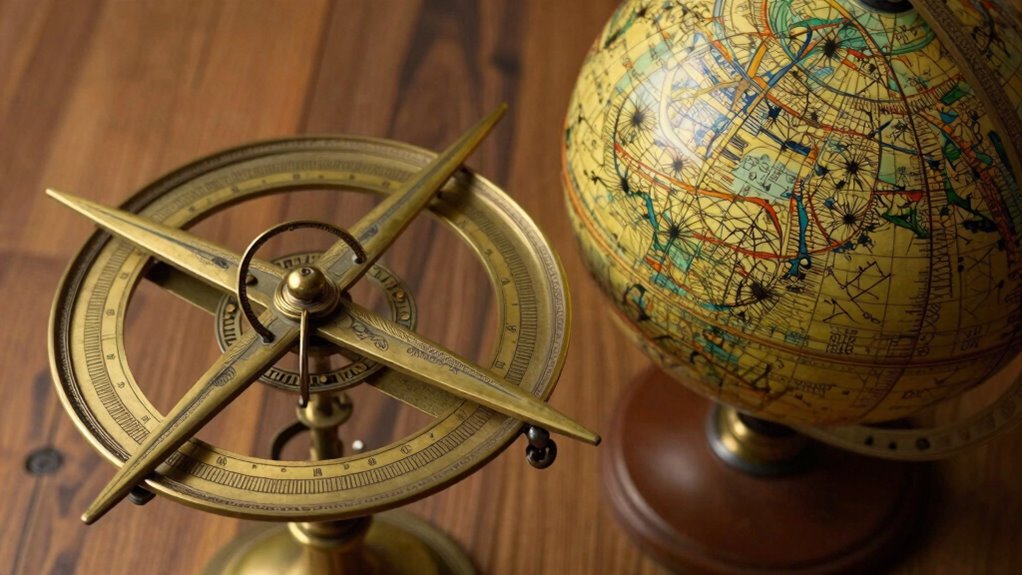
Over centuries, celestial instruments like astrolabes and globes have evolved from simple observation tools into complex devices that shape both science and culture. Their development reflects navigation history and the deep roots of celestial symbolism. You can see these changes through: 1. How early astrolabes aided explorers in navigation, expanding geographic knowledge. 2. The shift from practical instruments to symbols of power and knowledge in different cultures. 3. The influence of celestial globes on art and education, fostering a shared understanding of the cosmos. 4. The way these tools incorporated celestial symbolism, reinforcing spiritual and societal values. Additionally, the technological advancements in instrument design demonstrate humanity’s ongoing pursuit to understand the universe more precisely. These innovations also highlight the cultural significance of celestial mapping, illustrating how societies used these tools to express their worldview. Their evolution highlights humanity’s quest to understand the universe, blending scientific progress with cultural identity, and shaping how we view the sky today.
What Celestial Instruments Reveal About Humanity’s Cosmic Curiosity

Have you ever wondered what drives humanity to look up at the night sky and seek understanding? Celestial instruments like astrolabes and globes reveal our innate curiosity about the cosmos. They symbolize a desire for stellar navigation and a quest to decode celestial symbolism, showing how early societies sought to find their place in the universe. These tools demonstrate that understanding the stars wasn’t just practical—it was deeply spiritual. People used them to explore navigation routes, align religious practices, and interpret the universe’s mysteries. Additionally, the development of these instruments was influenced by the advancements in scientific curiosity, reflecting our ongoing pursuit of knowledge about the universe. Recognizing the importance of instrument design also highlights how technological innovation played a role in expanding our cosmic understanding.
The Legacy of Ancient Sky Mapping Tools in Art and Science
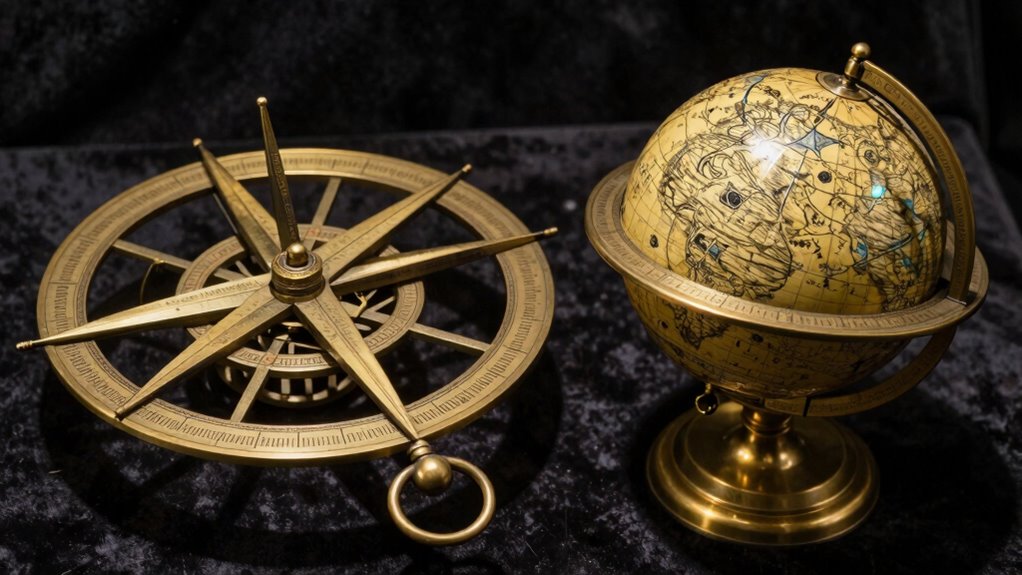
Ancient sky mapping tools like astrolabes and celestial globes have left a lasting impact on both art and science, bridging the gap between practical knowledge and creative expression. They influenced how we comprehend celestial symbolism and navigation, shaping perspectives across centuries. These tools inspired artworks that depict cosmic themes, blending scientific accuracy with artistic beauty. Their legacy persists in modern visual culture and scientific methods.
Consider these key points:
- They advanced ancient navigation techniques, guiding explorers across uncharted waters.
- They embedded celestial symbolism into religious and cultural art, reflecting divine order.
- They inspired Renaissance art, combining astronomy with visual storytelling.
- They laid groundwork for modern astronomical instruments, blending science and craftsmanship.
Your appreciation of these tools highlights their enduring influence on our view of the cosmos.
What Celestial Instruments Tell Us About Our Relationship With the Cosmos

Celestial instruments like astrolabes and globes reveal how humans have long sought to understand their place in the universe. They embody deep cosmic symbolism, reflecting our desire to connect with the vastness of space. These tools serve as physical representations of celestial symbolism, illustrating not only the stars and planets but also our quest for knowledge and meaning. By studying these instruments, you see how ancient cultures viewed the cosmos as a mirror of human existence, emphasizing harmony and order. They highlight our ongoing fascination with the universe, showing that our relationship with the cosmos is rooted in curiosity, wonder, and a quest for understanding. Ultimately, celestial instruments act as bridges, linking us to the broader universe and revealing our enduring quest to comprehend the sky’s mysteries.
Frequently Asked Questions
How Do Celestial Instruments Influence Modern Astronomy?
Celestial instruments influence modern astronomy by serving as essential navigation tools and enhancing astronomical observations. You use advanced telescopes and other devices inspired by ancient tools to explore the cosmos, improve accuracy, and gather data. These instruments help you understand celestial movements, map stars, and identify planets. By building on past innovations, you refine your knowledge of the universe, making modern astronomy more precise and insightful.
Are There Any Surviving Ancient Celestial Globes Still in Use Today?
Yes, some ancient celestial globes still exist and are kept as treasures of historical preservation. These globes hold deep cultural significance, showcasing how past civilizations visualized their universe. While they aren’t used for modern navigation, they serve as educational tools and symbols of our astronomical heritage. You might find them in museums or private collections, reminding us that old gems can still teach us new things.
What Materials Were Commonly Used to Craft Ancient Astrolabes?
Ancient astrolabes were commonly crafted using metal alloys like brass or bronze, which provided durability and a smooth surface for intricate engravings. You’ll also find oak or other hardwoods used in their construction, showcasing skilled wood craftsmanship. These materials allowed for precise measurements and detailed designs, reflecting the technological and artistic expertise of their creators. Combining metal and wood, they became both functional tools and beautiful artifacts.
How Accurate Were Ancient Sky Maps Compared to Today’s Technology?
Ancient sky maps had notable celestial inaccuracies because they relied on limited observations and primitive tools, making them less precise than today’s technology. You’ll find that ancient mapping often contained errors in star positions and constellations, which modern astronomy has corrected with advanced instruments. Despite these inaccuracies, their maps reflected impressive ingenuity and understanding for their time, laying the groundwork for our current precise celestial charts.
Can Celestial Globes and Astrolabes Be Considered Art as Well as Science?
Like a painting blending science and art, celestial globes and astrolabes are both. You see, their artistic craftsmanship transforms them into beautiful objects that symbolize the universe. They aren’t just tools for navigation or astronomy but also serve as symbolic representations of the cosmos. So, you can consider them as much art as science, reflecting human creativity, curiosity, and the desire to understand the sky’s mysteries.
Conclusion
By exploring these ancient sky-mapping tools, you open a universe of human curiosity and spiritual longing. Celestial globes and astrolabes aren’t just old instruments—they’re gateways to understanding our place in the cosmos. They reveal how our ancestors gazed at the night, dreaming of eternity. Remember, these symbols carry the weight of civilizations’ hopes and fears—showing that our connection to the stars is as timeless as the universe itself.