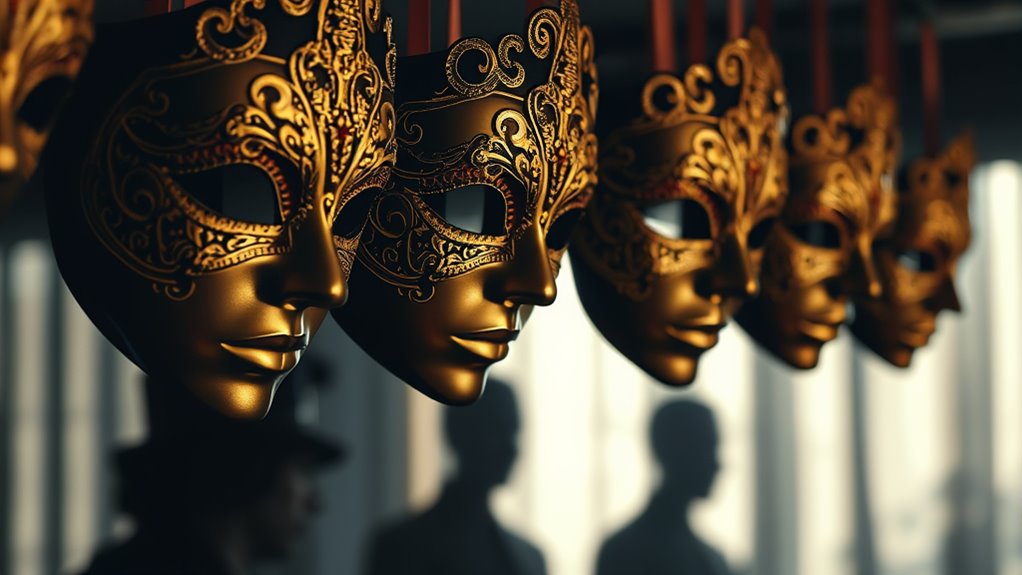

Masks symbolize who you are or wish to become, offering a way to hide your true self and explore different identities. They provide anonymity, helping you feel safe while expressing your emotions or third-party roles. Masks also mark moments of transformation, allowing you to shed old personas and embrace new ones. Across cultures, they connect you to spiritual beliefs and shared history. If you’re curious how masks reveal this complex interplay, there’s much more to discover.
Key Takeaways
- Masks symbolize the concealment of identity, allowing individuals to adopt new personas or remain anonymous.
- They serve as tools for transformation, enabling psychological shifts and exploration of different facets of self.
- Masks act as cultural symbols reflecting societal values, spiritual beliefs, and collective memory.
- Wearing masks creates a barrier that fosters emotional protection and facilitates social or ritualistic roles.
- They embody symbolic narratives that connect humans with divine or ancestral realms, emphasizing change and transcendence.
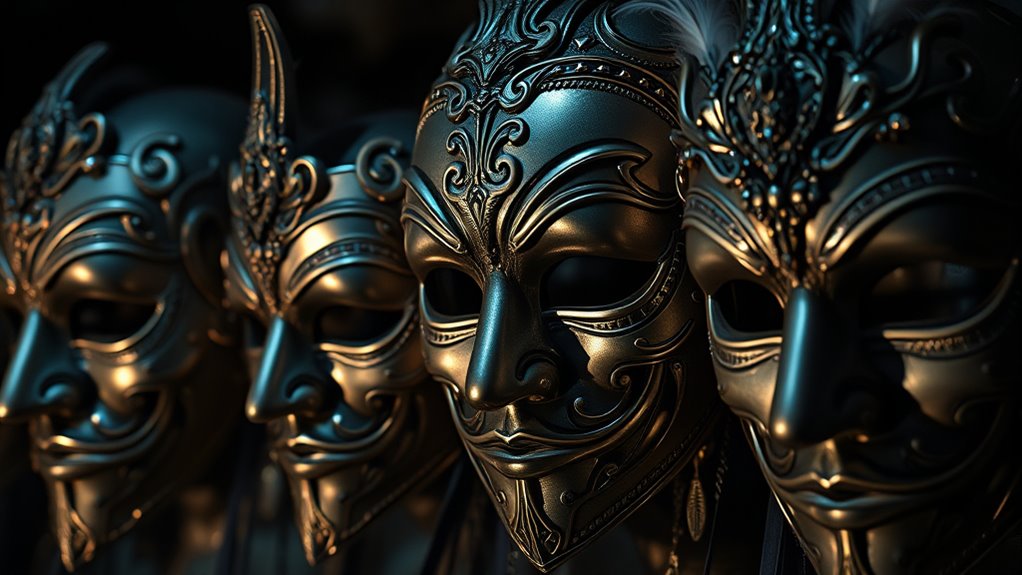
Masks have long served as powerful symbols across cultures, representing everything from identity and anonymity to transformation and concealment. Their cultural significance varies widely, often reflecting societal values, spiritual beliefs, and historical contexts. In many traditions, masks are used in rituals or ceremonies to connect with ancestors, spirits, or deities. They serve as a bridge between the human and the divine, allowing wearers to embody qualities or stories beyond their own. For example, in African tribes, masks symbolize ancestors or spirits, conveying important cultural narratives and social roles. Similarly, in Japanese Noh theater, masks embody specific characters, emphasizing their psychological depth and cultural resonance. These masks aren’t just costumes—they carry meanings embedded in history and spirituality, reinforcing community identity and collective memory.
Beyond their cultural importance, masks have profound psychological implications. Wearing a mask can alter your perception of self and influence how others perceive you. When you don a mask, you often feel a shift in identity, a step into a different persona or role. This can provide a sense of liberation, allowing you to express emotions or traits that might be suppressed otherwise. Masks can serve as a form of protection, creating emotional distance from the world or from personal vulnerabilities. They help you navigate complex social dynamics, offering anonymity that can foster honesty or bravery. Conversely, the act of hiding behind a mask may also evoke feelings of alienation or dissociation, highlighting the tension between the persona you project and your true self. Psychologically, masks can be a tool for self-exploration, enabling you to experiment with different facets of your identity in a safe space. They can also influence your mood or behavior, pushing you into roles that feel more authentic or empowering. Additionally, masks are often associated with cultural symbolism****, emphasizing their importance in social and spiritual contexts.
The transformative power of masks lies in their ability to facilitate change—whether in a ritual, performance, or personal exploration. When you wear a mask, you often feel a sense of transformation, as if stepping into a new role or identity. This sense of alter ego can help you confront fears, explore hidden desires, or gain new perspectives. Masks allow you to temporarily shed societal expectations, giving you permission to act differently. In this way, masks are not just coverings but gateways to understanding yourself and others better. They remind you that identity isn’t fixed, but fluid—shaped by context, emotion, and intention. Whether used in cultural rituals or personal moments of introspection, masks serve as powerful symbols that reveal the complex layers of human identity, bridging the internal and external worlds through their rich symbolism.
Top picks for "symbolism mask identity"
Open Amazon search results for this keyword.
As an affiliate, we earn on qualifying purchases.
Frequently Asked Questions
How Do Masks Influence Personal Identity Over Time?
Masks influence your personal identity by shaping your persona evolution and enabling identity concealment. Over time, wearing masks can blur the lines between your true self and the persona you project, leading to a deeper internal conflict or growth. You may find yourself adopting new behaviors or traits, which can either strengthen or obscure your authentic identity. Ultimately, masks give you the power to explore different facets of yourself while maintaining a sense of anonymity.
Are Masks More Symbolic in Certain Cultures Than Others?
Masks are like ancient keys, opening cultural significance in different societies. In some cultures, they hold deep ritual importance, representing gods, spirits, or ancestors. Their symbolic power often surpasses mere disguise, embodying traditions and beliefs. While masks hold universal meaning, they tend to be more symbolic in cultures where ritual practices and spiritual connections are central, making them essential icons of cultural identity and heritage.
Can Masks Be Used to Conceal True Emotions Effectively?
Yes, masks can effectively conceal true emotions through facial concealment, helping you hide feelings and maintain composure. They allow for emotional suppression, giving you control over how much of your inner state you reveal. By covering facial cues, masks create a barrier that prevents others from seeing your genuine emotions, which can be useful in social situations or performances where you want to keep your true feelings private.
What Psychological Effects Do Masks Have on Wearers?
Wearing a mask is like holding back a storm; it influences your psychological state. You might feel more detached, as facial expressions are hidden, leading to emotional suppression. This can cause feelings of loneliness or anxiety over time. Masks can also boost confidence temporarily but may deepen emotional disconnect. Ultimately, they shape your perception of yourself and how you interact with others, impacting your mental well-being in complex ways.
How Do Masks Facilitate Social or Political Activism?
You harness masks in social or political activism to amplify your message and protect your identity. They serve as powerful protest symbolism, allowing you to challenge authority or societal norms. Masks foster cultural resistance by uniting diverse groups under a shared visual identity. They also create anonymity, encouraging bold actions without fear of personal repercussions, and symbolize collective strength, inspiring others to join the cause and sustain momentum.
Conclusion
As you embrace the symbolism of masks, remember they’re like Pandora’s box—hiding mysteries and revealing hidden truths. You hold the power to transform, conceal, or disclose your true self, just as the gods once did with their disguises. Whether you wear a mask for protection or self-discovery, it’s your choice to step into the unknown, much like Orpheus venturing into the shadows. In masks, you find both freedom and mystery—an eternal dance of identity and disguise.