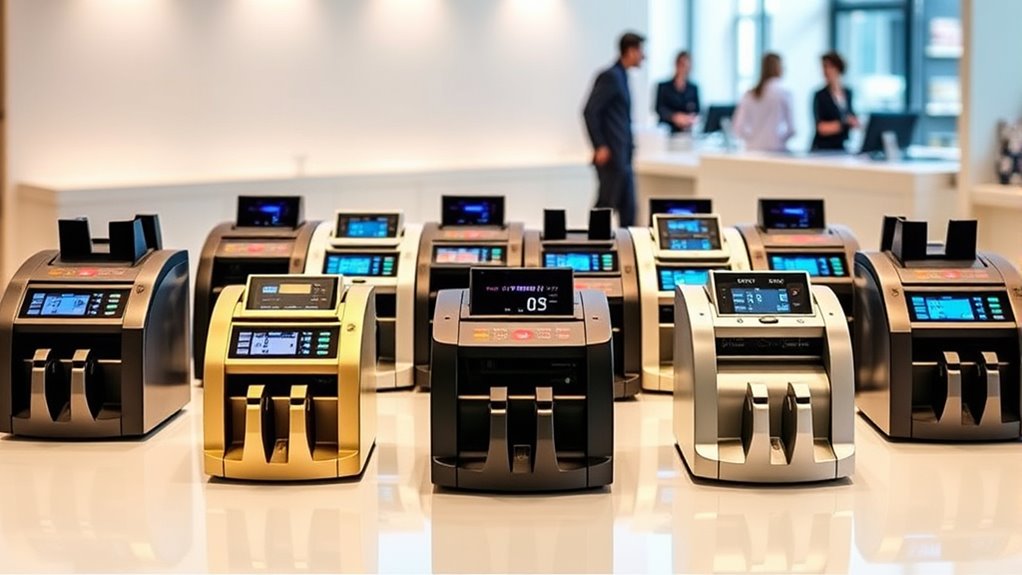

Cash counting machines range from fast bill counters that tally stacks of one denomination to mixed-denomination models that calculate a stack’s total value. I’d choose the MUNBYN IMC22 as the best overall pick because mixed-denomination counting and dual displays make it a strong fit for routine business cash handling. The Cassida 1,400-notes-per-minute counter stands out for speed, while the KOLIBRI pairs a clear TFT display with multiple detection features. The main tradeoff is whether to prioritize quick batch counts or value counting across denominations, alongside detection, ease of use, and currency support. Read on for the full breakdown and guidance on choosing the right type for your workflow.

Get art and craft supplies delivered free with Prime
- Fast, free delivery on millions of items
- Prime Video, Amazon Music and more included
- Member-only deals all year
Key Takeaways
- Mixed-denomination models such as the MUNBYN IMC22 and Aneken N60 are aimed at counting the total value of unsorted bills, while speed-focused counters are better suited to stacks already sorted by denomination.
- The Cassida 1,400-notes-per-minute model leads this lineup for stated counting speed, but speed alone does not replace value counting or counterfeit screening.
- Several models list multiple detection methods, including UV, magnetic, and infrared checks; buyers should compare the actual detection functions rather than treating a longer acronym list as a guarantee of accuracy.
- The MUNBYN IMC22 combines mixed-denomination handling with dual displays and multi-currency support, giving it a broader role than basic batch counters.
- The lineup includes multiple closely related PONNOR, Cassida, and Aneken options, so buyers should choose by workflow and stated functions rather than brand name alone.
| Cassida Money Bill Counter – Business Grade, 1,400 Notes/Min, UV/MG Counterfeit Detection |  | Best for High-Volume Single-Denomination Counting | Counting speed: Up to 1,400 bills per minute | Counterfeit detection: UV and magnetic sensors | Display: 2.8-inch TFT | VIEW ON AMAZON | See Our Full Breakdown |
| PONNOR Money Counter Machine with Value Count and Counterfeit Detection |  | Best for Quiet, Flexible Daily Counting | Counting speed: Up to 1,200 notes per minute | Detection technology: UV, MG, IR, MT, DD | Modes: Count, Add, Batch, Auto, Manual | VIEW ON AMAZON | See Our Full Breakdown |
| KOLIBRI Money Counter Machine with 4.5 TFT Display, Advanced Detection, and 1,200 Notes/Min |  | Best for Mixed-Denomination USD Counting | Display: 4.5-inch TFT | Counting speed: Up to 1,200 notes per minute | Detection methods: IR, UV, MG | VIEW ON AMAZON | See Our Full Breakdown |
| MUNBYN IMC22 Money Counter Machine Mixed Denomination, Dual-Display, Counterfeit Detection, Supports Multiple Currencies |  | Best for Multi-Currency Cash Desks | Model: IMC22 | Currency support: USD, MXN, EUR, CAD; over 120 currency upgrades listed | Counting speed: Up to 1,200 bills per minute | VIEW ON AMAZON | See Our Full Breakdown |
| PONNOR Money Counter Machine with Value Bill Count, Cash Counter for Dollar and Euro, UV/MG/IR/Counterfeit Detection, Add/Bat/Value Mode, Large LCD Display |  | Best for USD and EUR Value Counting | Currency handling: USD and EUR value counting | Detection methods: UV, IR, MG, DD | Display: 3.7-inch LCD | VIEW ON AMAZON | See Our Full Breakdown |
| NUCOUN VC-1 Money Counter Machine with Multi-Currency Detection and Counterfeit Protection |  | Best for Multi-Currency Mixed-Bill Counting | Currency support: Over 120 currencies | Counting speed: Up to 1,200 pieces per minute | Mixed denominations: Supported | VIEW ON AMAZON | See Our Full Breakdown |
| MUNBYN IMC51 Money Counter Machine |  | Best for Worn and Creased Bills | Model: IMC51 | Counting speed: Up to 1,100 bills per minute | Detection technology: UV, IR, MG, MT, dimensional, thickness, security line, variable ink, spectrum, and fluorescence | VIEW ON AMAZON | See Our Full Breakdown |
| Aneken Money Counter Machine with Value Count, Dollar, Euro, UV/MG/IR/DD/DBL/HLF/CHN Counterfeit Bill Detectors, Add and Batch Modes, LCD Display |  | Best for Straightforward Batch Counting | Counting speed: Up to 1,000 bills per minute | Detection modes: UV, MG, IR, DD, DBL, HLF, CHN | Display: LCD | VIEW ON AMAZON | See Our Full Breakdown |
| Aneken Money Counter with Value Count, 1300 Bills/Min for USD & EUR |  | Best for Fast USD and EUR Stacks | Counting speed: Up to 1,300 bills per minute | Supported currencies: USD and EUR | Bill capacity: 200 bills | VIEW ON AMAZON | See Our Full Breakdown |
| SVANTTO Money Counter Machine with Value Count |  | Best for Portable Shift Handoffs | Model: IMC28 | Counting speed: Up to 1,000 bills per minute | Hopper and stacker capacity: 200 bills each | VIEW ON AMAZON | See Our Full Breakdown |
| Cassida Money Bill Counter – Business Grade, 1,300 Notes/Min, UV/MG Counterfeit Detection |  | Best for Fast Single-Denomination Counting | Count speed: 1,300 notes per minute | Detection sensors: 5520 UV/MG; description also lists ultraviolet, magnetic, and infrared sensors | Hopper capacity: 100 bills | VIEW ON AMAZON | See Our Full Breakdown |
| AROHANI Money Counter Machine with Value Counting for Business |  | Best Lightweight Option for Pre-Sorted Bills | Counting speed: Over 1,000 bills per minute | Detection modes: MG, UV, IR, and MT | Display: 2.8-inch LED | VIEW ON AMAZON | See Our Full Breakdown |
| Aneken N60 Mixed Denomination Money Counter Machine with Counterfeit Detection and 3.5″ TFT Display |  | Best for Multi-Currency Mixed-Bill Counting | Working modes: Mixed denomination, single denomination, number count, batch, and accumulation | Counterfeit detection: Infrared, ultraviolet, magnetic, and dimensional detection | Display: 3.5-inch TFT screen; dual-screen display | VIEW ON AMAZON | See Our Full Breakdown |
| Aneken Mixed Denomination Money Counter with Counterfeit Detection |  | Best Premium Detection and Touchscreen Controls | Detection methods: 2CIS, UV, MG, IR, MT, and SN | Counting speed: 800, 1,000, or 1,200 notes per minute | Screen: 4.5-inch touchscreen | VIEW ON AMAZON | See Our Full Breakdown |
| Carnation Money Counter Machine – Cash Counting & Mixed Denomination Bill Counter, Portable Currency Detector, Counterfeit Bank Scanner, Dollar Sorter for Commercial Use |  | Best for High-Volume Mixed-Currency Workflows | Counting speed: Up to 1,200 notes per minute | Supported currencies: USD, CAD, BRL, MXN, ARS, and PEN | Hopper capacity: 300 notes | VIEW ON AMAZON | See Our Full Breakdown |
| cash counting machine | Counting speed | Display |
|---|---|---|
| Cassida Money Bill Counter | Up to 1,400 bills per minute | 2.8-inch TFT |
| PONNOR Money Counter Machine w | Up to 1,200 notes per minute | — |
| KOLIBRI Money Counter Machine | Up to 1,200 notes per minute | 4.5-inch TFT |
| MUNBYN IMC22 Money Counter Mac | Up to 1,200 bills per minute | Dual 3.5-inch TFT screens |
| PONNOR Money Counter Machine w | Over 1,300 bills per minute | 3.7-inch LCD |
| NUCOUN VC-1 Money Counter Mach | Up to 1,200 pieces per minute | 3.5-inch touchscreen |
| MUNBYN IMC51 Money Counter Mac | Up to 1,100 bills per minute | — |
| Aneken Money Counter Machine w | Up to 1,000 bills per minute | LCD |
| Aneken Money Counter with Valu | Up to 1,300 bills per minute | — |
| SVANTTO Money Counter Machine | Up to 1,000 bills per minute | External LED display |
| Cassida Money Bill Counter | — | — |
| AROHANI Money Counter Machine | Over 1,000 bills per minute | 2.8-inch LED |
| Aneken N60 Mixed Denomination | Over 1,200 bills per minute | 3.5-inch TFT screen; dual-screen display |
| Aneken Mixed Denomination Mone | 800, 1,000, or 1,200 notes per minute | — |
| Carnation Money Counter Machin | Up to 1,200 notes per minute | 3.5-inch TFT |
More Details on Our Top Picks
Cassida Money Bill Counter – Business Grade, 1,400 Notes/Min, UV/MG Counterfeit Detection
For businesses that mainly count stacks of one denomination, this Cassida stands out for its 1,400-bill-per-minute speed, the fastest listed here. UV and magnetic sensors add a basic counterfeit-screening layer while count, add, and batch modes cover routine till and deposit work. Its 2.8-inch TFT display and touch controls keep the main tasks accessible, though the feature set may feel less straightforward to occasional operators. The key limitation is that it does not recognize denominations automatically: users must enter the bill value to calculate a total, and it cannot replace a mixed-denomination value counter such as the KOLIBRI. Compared with the PONNOR B08Q3H2HQX, this Cassida is faster on paper, but its listed detection methods and display are less extensive. It suits repeatable, high-volume counting better than mixed cash reconciliation.
Pros:- Listed counting speed of up to 1,400 bills per minute
- UV and magnetic sensors provide counterfeit screening
- Count, add, batch, and add-with-batch modes support common cash routines
- Touch controls and a TFT display provide a clear operating interface
Cons:- Does not automatically recognize denominations
- Bill value must be entered manually to calculate a total
- Touch-panel controls may be more involved than needed for occasional users
Best for: Retail managers and cash offices that process large stacks of a single denomination and value speed over automatic denomination recognition.
Not ideal for: Businesses that regularly count mixed denominations or need the machine to calculate totals without manually entering bill values.
- Counting speed:Up to 1,400 bills per minute
- Counterfeit detection:UV and magnetic sensors
- Display:2.8-inch TFT
- Operational modes:Count, Add, Batch, Add with Batch
- Denomination recognition:Not automatic; manual bill-value input required for total calculation
Our verdict“Choose this Cassida for fast, repeatable counting of same-denomination stacks, but pick the KOLIBRI or another value-counting model for mixed cash.”
PONNOR Money Counter Machine with Value Count and Counterfeit Detection
The PONNOR is a practical fit for a back office where noise matters alongside routine counting. Its silent operation option gives it a distinct advantage over the faster Cassida when staff need to count near customers or in a shared workspace. It runs at up to 1,200 notes per minute and offers UV, magnetic, infrared, MT, and DD detection, plus count, add, batch, auto, and manual modes. That combination gives operators more ways to handle standard batches than the Cassida’s listed modes. However, the description says it cannot total mixed denominations in add mode, so the KOLIBRI is a better match for mixed-cash reconciliation. Proper bill orientation is also needed to avoid errors, and the 110V requirement limits where it can be plugged in without a converter.
Pros:- Silent mode supports counting in shared or customer-facing spaces
- UV, MG, IR, MT, and DD detection technologies are listed
- Count, add, batch, auto, and manual modes offer operating flexibility
- Handles both new and old banknotes according to the product description
Cons:- Cannot calculate mixed-denomination totals in add mode
- Bills must be oriented correctly to reduce counting errors
- 110V power specification may require a converter outside compatible locations
Best for: Small retailers, service counters, and office cash handlers who want multiple counting modes and quieter operation for regular US-banknote batches.
Not ideal for: Businesses that need automatic mixed-denomination totals or operators who cannot control bill orientation and power compatibility.
- Counting speed:Up to 1,200 notes per minute
- Detection technology:UV, MG, IR, MT, DD
- Modes:Count, Add, Batch, Auto, Manual
- Power:110V
- Weight:8.5 pounds
- Dimensions:13.89 x 11.3 x 7.4 inches
- Color:Black
Our verdict“Pick the PONNOR for quieter routine batch counting, but choose the KOLIBRI if mixed-denomination totals are central to your workflow.”
KOLIBRI Money Counter Machine with 4.5 TFT Display, Advanced Detection, and 1,200 Notes/Min
The KOLIBRI earns its place by counting and sorting mixed USD denominations, a more useful capability for reconciling tills than a fast counter that only totals a uniform stack. Its 1,200-note-per-minute speed is below the Cassida’s listed maximum, but automatic mixed-value handling can save more work when cash arrives in varied bills. The 4.5-inch TFT display gives results more room than the Cassida’s 2.8-inch screen, and IR, UV, and MG detection add screening beyond basic counting. Mix, sort, count, add, batch, and add-plus-batch modes make it adaptable, though the broader menu may take longer for occasional users to learn. Regular maintenance is also part of ownership. Unlike the MUNBYN IMC22, the listed currency support here is specifically USD, so international cash desks should compare that model instead.
Pros:- Counts and sorts mixed USD denominations
- 4.5-inch TFT display is larger than the Cassida’s listed display
- IR, UV, and MG detection methods are included
- Three-year warranty and lifetime support from California-based technicians are listed
Cons:- Advanced modes may take time for infrequent operators to learn
- Regular maintenance is needed for performance
- Listed denomination handling is mixed USD rather than multiple currencies
Best for: Retailers, event operators, and office cash teams that regularly reconcile mixed US denominations and want sorting as well as counting.
Not ideal for: Businesses handling multiple currencies or users who want a simple, low-maintenance counter for occasional same-denomination batches.
- Display:4.5-inch TFT
- Counting speed:Up to 1,200 notes per minute
- Detection methods:IR, UV, MG
- Denomination handling:Mixed USD denominations
- Modes:Mix, Sort, Count, Add, Batch, Add+BATCH
- Warranty:3 years
- Support:Lifetime support from California-based technicians
Our verdict“Choose the KOLIBRI for mixed-denomination USD reconciliation; select the MUNBYN IMC22 instead when multi-currency support matters more.”
MUNBYN IMC22 Money Counter Machine Mixed Denomination, Dual-Display, Counterfeit Detection, Supports Multiple Currencies
The MUNBYN IMC22 is the strongest fit in this group for operations that handle cash beyond USD. It supports USD, MXN, EUR, and CAD, with more than 120 currency upgrades listed, while the KOLIBRI’s stated mixed-denomination handling is limited to USD. Its dual 3.5-inch TFT screens make counts visible from both sides of a counter, a useful detail when customers or a second staff member need to follow the result. CIS, UV, IR, and MG sensors provide a broader listed detection set than the Cassida’s UV/MG combination. The tradeoff is a larger footprint and a more involved feature set; at 15.75 inches long, it may need dedicated counter space. Bill placement must also be correct to reduce jams. A two-year warranty is listed.
Pros:- Supports mixed denominations across USD, MXN, EUR, and CAD, with over 120 currency upgrades listed
- Dual displays make results visible from both sides of the counter
- CIS, UV, IR, and MG sensors provide multiple detection layers
- 100–240V input supports a wider voltage range than the 110V PONNOR models
Cons:- Larger dimensions may require dedicated workspace
- Correct bill placement is needed to avoid jams
- Multiple currency and detection functions may be more than infrequent users need
Best for: Banks, currency exchanges, and retailers that reconcile mixed denominations across USD, MXN, EUR, CAD, or supported upgrade currencies.
Not ideal for: Small shops with limited counter space or businesses that only count occasional stacks of one currency and do not need mixed-currency functions.
- Model:IMC22
- Currency support:USD, MXN, EUR, CAD; over 120 currency upgrades listed
- Counting speed:Up to 1,200 bills per minute
- Display:Dual 3.5-inch TFT screens
- Counterfeit detection:CIS, UV, IR, MG sensors
- Voltage:100–240V
- Weight:8.8 pounds
- Dimensions:15.75 x 9.25 x 13.39 inches
- Warranty:2 years
Our verdict“Choose the IMC22 when mixed-currency handling and customer-visible totals justify its larger footprint and more advanced operation.”
PONNOR Money Counter Machine with Value Bill Count, Cash Counter for Dollar and Euro, UV/MG/IR/Counterfeit Detection, Add/Bat/Value Mode, Large LCD Display
This PONNOR is aimed at operators who need more than a bill tally: it supports value counting for USD and EUR, making it a better match than the Cassida for stacks where denomination totals matter. Its listed speed of 1,300 bills per minute is also higher than the KOLIBRI’s 1,200, though the KOLIBRI is the clearer choice when mixed USD sorting and its larger 4.5-inch TFT display are priorities. Here, a 3.7-inch LCD, 200-bill hopper, and UV, IR, MG, and DD detection serve busy cash routines without the IMC22’s multi-currency breadth. The tradeoffs are a 110V power specification, a 12.54-pound weight, and support focused on US and Euro currency. Accessories include an external display and spare parts, but this is less suited to portable use than its compact dimensions might suggest.
Pros:- Value counting supports USD and EUR
- Listed speed reaches 1,300 bills per minute
- UV, IR, MG, and DD detection methods are included
- Includes an external display, power cord, and spare parts
Cons:- 110V specification may require a converter in other power regions
- At 12.54 pounds, it is less convenient to move frequently
- Currency support is primarily USD and EUR rather than the IMC22’s broader range
Best for: Cashiers and office teams that count USD or EUR by value and want a high-speed machine with an external display for shared viewing.
Not ideal for: Multi-currency businesses, international users without compatible 110V power, or staff who need a lightweight counter for frequent transport.
- Currency handling:USD and EUR value counting
- Detection methods:UV, IR, MG, DD
- Display:3.7-inch LCD
- Counting speed:Over 1,300 bills per minute
- Hopper capacity:200 bills
- Voltage:110V
- Weight:12.54 pounds
- Dimensions:9.5 x 11.5 x 5.5 inches
- Color and material:Silver; PP
Our verdict“Choose this PONNOR for fast USD or EUR value counting with useful included accessories, but pick the IMC22 for wider currency coverage.”
NUCOUN VC-1 Money Counter Machine with Multi-Currency Detection and Counterfeit Protection
The NUCOUN VC-1 is the clearest choice here for businesses that handle mixed denominations and more than one currency: it supports over 120 currencies and can process mixed bills, while the MUNBYN IMC51 requires you to sort denominations by hand. Its 1,200-bill-per-minute speed and full-color imaging for counterfeit detection target busy cash desks that need more than a basic stack counter. A 3.5-inch touchscreen also makes settings easier to access than a simple LCD-style interface. The tradeoff is its nearly 10-pound weight, which makes it less appealing for frequent station-to-station moves than the portable SVANTTO. The listed warranty includes 90-day replacement and two-year support, but buyers should note the short replacement period. This is a specialized pick for currency flexibility, not the simplest or lightest option.
Pros:- Counts mixed denominations and supports automatic detection across more than 120 currencies.
- Processes up to 1,200 bills per minute.
- Full-color imaging supports counterfeit screening.
- Touchscreen interface provides a more direct way to operate the machine.
Cons:- At 9.81 pounds, it is relatively heavy for frequent portable use.
- The listed replacement coverage is limited to 90 days, despite two years of support.
- Its mixed-currency features may be unnecessary for businesses handling only sorted, single-currency stacks.
Best for: Retailers and small-business offices that regularly count mixed denominations or handle multiple currencies, including USD, EUR, and GBP.
Not ideal for: Single-currency operations that count pre-sorted bills and prioritize a lighter, simpler machine over mixed-currency recognition.
- Currency support:Over 120 currencies
- Counting speed:Up to 1,200 pieces per minute
- Mixed denominations:Supported
- Display:3.5-inch touchscreen
- Counterfeit detection:Full-color imaging
- Dimensions:12.65 x 10.2 x 7.44 inches
- Weight:9.81 pounds
- Warranty and support:90-day replacement; 2-year support
Our verdict“Choose the VC-1 if mixed-bill and international-currency counting matter more than low weight or a basic setup.”
MUNBYN IMC51 Money Counter Machine
The MUNBYN IMC51 suits businesses that count large stacks of already-sorted bills, especially when notes are not in pristine condition. Its upgraded rollers are designed to handle worn or creased currency, while UV, infrared, magnetic, and other detection methods add a broad counterfeit-screening toolkit. At 1,100 bills per minute, it is a fast workhorse, though the Aneken USD/EUR model reaches a higher listed speed of 1,300 bills per minute. The key limitation is workflow: the IMC51 cannot count mixed denominations, so staff must sort bills before using Value mode; mixed piles are handled one stack at a time. Value, Add, and Batch modes help with organized cash routines, but they do not remove that sorting step. Its 110V requirement also narrows where it can be used.
Pros:- Upgraded rollers are intended to feed worn and creased bills more reliably.
- Uses multiple screening methods, including UV, IR, magnetic, and dimensional checks.
- Value, Add, and Batch modes support routine counting and bundling.
- Counts up to 1,100 bills per minute.
Cons:- Bills must be separated by denomination before counting.
- Value mode requires mixed piles to be added one stack at a time.
- 110V-only operation limits power compatibility.
Best for: Cash-heavy retailers and offices that process pre-sorted stacks, including older or creased notes, and want multiple counterfeit checks.
Not ideal for: Businesses that need totals from unsorted mixed denominations or need a counter compatible with power outside 110V.
- Model:IMC51
- Counting speed:Up to 1,100 bills per minute
- Detection technology:UV, IR, MG, MT, dimensional, thickness, security line, variable ink, spectrum, and fluorescence
- Counting modes:Value, Add, Batch
- Voltage:110V
- Bill handling:Upgraded rollers for worn and creased notes
- Technical support:24-hour support on weekdays
Our verdict“Pick the IMC51 for fast counting of sorted, less-than-perfect notes, but skip it if mixed-denomination totals are part of your daily workflow.”
Aneken Money Counter Machine with Value Count, Dollar, Euro, UV/MG/IR/DD/DBL/HLF/CHN Counterfeit Bill Detectors, Add and Batch Modes, LCD Display
This Aneken is a practical middle ground for operators who want counterfeit screening and batch functions without paying for mixed-denomination recognition they will not use. It counts up to 1,000 bills per minute and includes Add and Batch modes, so staff can build totals or prepare set-size bundles from sorted stacks. Its UV, magnetic, infrared, and other detection modes give it a broader screening list than the SVANTTO’s five named checks, though the SVANTTO adds a specified 200-bill hopper and stacker. The Aneken’s manual denomination setting is the main workflow constraint: it does not automatically identify each bill’s value, so the operator has to choose the denomination. A standard LCD keeps the interface simple, and low-noise operation may suit front counters, but it is limited to 110V.
Pros:- Offers Add and Batch functions for cash totals and prepared bundles.
- Includes UV, MG, IR, DD, DBL, HLF, and CHN detection modes.
- Low-noise operation is suited to customer-facing counters.
- Includes an external display, brush, spare parts, and currency straps.
Cons:- Does not automatically recognize bill denominations; operators must set them manually.
- Limited to 110V power.
- Its 1,000-bill-per-minute speed is lower than the MUNBYN IMC51 and the faster Aneken model in this lineup.
Best for: Small shops and office cashiers who count denomination-sorted USD or EUR stacks and want Add and Batch functions with multiple detection modes.
Not ideal for: Businesses that regularly receive mixed denominations and need automatic bill-value recognition or flexible voltage compatibility.
- Counting speed:Up to 1,000 bills per minute
- Detection modes:UV, MG, IR, DD, DBL, HLF, CHN
- Display:LCD
- Counting functions:Add and Batch
- Denomination recognition:Manual setting
- Power supply:110V
- Included accessories:Power cord, brush, external display, spare parts, user manual, currency straps
- Noise:Low-noise operation
Our verdict“Choose this Aneken for quiet, feature-rich batch counting of pre-sorted bills, not for automatic valuation of mixed piles.”
Aneken Money Counter with Value Count, 1300 Bills/Min for USD & EUR
For a business that mostly counts sorted USD or EUR, this Aneken prioritizes throughput: its stated 1,300 bills-per-minute speed is higher than the 1,000-bill Aneken model and the MUNBYN IMC51. Auto and Manual operation plus batching give operators some control over how a stack is processed, while UV, magnetic, infrared, thickness, dimension, and other listed checks support counterfeit screening. The speed does not make it a mixed-bill value counter, however. It cannot calculate totals for piles containing different denominations, so staff still need to sort notes or count each denomination separately. The 200-bill capacity helps reduce how often a stack must be split, but sensitivity settings may need adjustment to avoid errors. Its USD/EUR focus also makes it less suitable for broader currency needs than the NUCOUN VC-1.
Pros:- Listed speed of up to 1,300 bills per minute is the fastest among these five products.
- Supports both auto and manual operation.
- Offers batch counting and multiple counterfeit detection modes.
- 200-bill capacity reduces the need to split larger stacks into small feeds.
Cons:- Cannot calculate a total value for mixed-denomination piles.
- Currency support is listed for USD and EUR only.
- Sensitivity settings may need adjustment to reduce counting errors.
Best for: Retailers and offices that process high volumes of denomination-sorted USD or EUR and value speed over mixed-bill recognition.
Not ideal for: Businesses handling mixed denominations, currencies beyond USD and EUR, or bills that trigger frequent sensitivity adjustments.
- Counting speed:Up to 1,300 bills per minute
- Supported currencies:USD and EUR
- Bill capacity:200 bills
- Detection modes:UV, MG, IR, THK, DIM, CCH, FL, SL
- Operation modes:Auto and Manual
- Batching:Supported
- Included accessories:User manual, power cable, external display, cleaning brush, spare fuse
- Mixed-denomination value counting:Not supported
Our verdict“Choose this Aneken when you need fast counting of sorted USD or EUR bills, and choose the NUCOUN VC-1 instead if mixed-currency recognition is essential.”
SVANTTO Money Counter Machine with Value Count
The SVANTTO IMC28 is aimed at teams that move a counter between checkout points or use it for daily drawer reconciliations. A carry handle, 200-bill hopper and stacker, and external LED display make it easier to position and let a cashier and customer follow the count together. Its five-way counterfeit screening covers UV, magnetic, magnetic-thread, infrared, and dimensional checks, while Batch mode supports preparing set quantities. Compared with the faster 1,300-bill Aneken, it tops out at 1,000 bills per minute; its advantage is the specified capacity and portable design, not raw speed. It still requires manual sorting of mixed denominations, so its value totals apply to single-denomination counting rather than unsorted cash. The 110V limit may also rule it out for some setups.
Pros:- Carry handle supports moving the machine between work areas.
- 200-bill hopper and stacker suit routine daily counts.
- External LED display makes counts visible to both staff and customers.
- Five screening types cover UV, MG, MT, IR, and DD checks.
Cons:- Mixed denominations must be sorted manually before counting.
- Its 1,000-bill-per-minute speed is below the faster Aneken model.
- 110V operation limits power compatibility.
Best for: Small retailers and service businesses that move a counter between stations and need visible shift counts for sorted bills.
Not ideal for: High-throughput operations that prioritize maximum speed, or teams that need automatic mixed-denomination totals or non-110V operation.
- Model:IMC28
- Counting speed:Up to 1,000 bills per minute
- Hopper and stacker capacity:200 bills each
- Screening types:UV, MG, MT, IR, DD
- Voltage:110V
- Display:External LED display
- Color:Gray
- Warranty:2 years
Our verdict“Pick the SVANTTO for portable, shared-view counting at multiple stations, but not for mixed-pile valuation or maximum counting speed.”
Cassida Money Bill Counter – Business Grade, 1,300 Notes/Min, UV/MG Counterfeit Detection
The Cassida is the speed-focused choice here for businesses that mostly count bills in batches rather than tallying mixed denominations. Its 1,300-notes-per-minute rate and count, add, and batch modes suit repeated cash-room tasks, while UV, magnetic, and infrared sensing adds a layer of bill screening. Compared with the Aneken N60, it gives up mixed-denomination counting and the larger 200-bill hopper in favor of a more compact machine with a simpler core job. The tradeoff is its 100-bill hopper and stacker, which mean more frequent reloading and clearing during larger counts. At 11.9 pounds, it is compact in footprint but not especially light, and its batch presets and diagnostics may take some initial learning.
Pros:- Counts at up to 1,300 notes per minute
- UV, magnetic, and infrared sensors support counterfeit screening
- Count, add, batch, and programmable batch preset functions
- Compact footprint with an LCD display and self-diagnostic system
Cons:- The 100-bill hopper and stacker require frequent reloading and clearing
- At 11.9 pounds, it is less convenient to move than lighter options such as the AROHANI 7002
- Multiple settings and presets may take time to learn
Best for: Retail and office cash handlers who count pre-sorted bills quickly and want batching plus counterfeit screening.
Not ideal for: Businesses that need mixed-denomination totals, large uninterrupted batches, or a machine that is easy to carry between locations.
- Count speed:1,300 notes per minute
- Detection sensors:5520 UV/MG; description also lists ultraviolet, magnetic, and infrared sensors
- Hopper capacity:100 bills
- Stacker capacity:100 bills
- Dimensions:10.9 × 9.9 × 6.2 inches
- Weight:11.9 pounds
- Material:Plastic and steel
- Color:Black/Gray
Our verdict“Choose the Cassida if speed on pre-sorted cash matters more than mixed-denomination counting or larger batch capacity.”
AROHANI Money Counter Machine with Value Counting for Business
At 6.61 pounds, the AROHANI 7002 is the easiest pick in this group to move between a counter, office, or temporary cash station. It counts over 1,000 bills per minute and offers batch, add, value-counting, and MG/UV/IR/MT detection modes, giving small businesses more flexibility than the basic single-purpose Cassida. But its value-counting label should not be mistaken for mixed-denomination recognition: the supplied description says it cannot identify mixed banknotes or denominations, so bills still need to be sorted before counting. The 2.8-inch LED display keeps the controls straightforward, though it is smaller than the Aneken N60’s 3.5-inch screen. This is a practical, portable counter for routine prepared stacks, not a solution for totaling a mixed till in one pass.
Pros:- Lightweight 6.61-pound body is easier to relocate than the Cassida or Aneken N60
- Counts over 1,000 bills per minute
- Offers MG, UV, IR, and MT detection modes
- Includes batch, add, and value-counting functions
Cons:- Does not recognize denominations or count mixed banknotes
- The 2.8-inch display is smaller than the screens on the Aneken models
- Detection modes do not guarantee identification of every counterfeit bill
Best for: Small retailers, market vendors, and office teams that move their counter between work areas and count sorted bills.
Not ideal for: Cash offices that need mixed-denomination recognition, broad currency handling, or a larger display for frequent extended counting.
- Counting speed:Over 1,000 bills per minute
- Detection modes:MG, UV, IR, and MT
- Display:2.8-inch LED
- Weight:6.61 pounds
- Dimensions:12.20 × 10.63 × 6.89 inches
- Voltage:100–240 V
- Functions:Value counting, batch, add, and detection
- Included accessories:User manual, power cord, and cleaning brush
Our verdict“Pick the AROHANI for portable, fast counting of sorted cash, but skip it if you need mixed-bill value totals.”
Aneken N60 Mixed Denomination Money Counter Machine with Counterfeit Detection and 3.5″ TFT Display
The N60 earns its place through mixed-denomination counting across five listed currencies, a meaningful step up from machines such as the Cassida and AROHANI that are better suited to sorted stacks. It can also run single-denomination, number-count, batch, and accumulation modes, so one machine can handle both till reconciliation and routine bundle counts. Its 200-bill hopper reduces interruptions compared with the Cassida’s 100-bill capacity, and the 3.5-inch TFT plus dual-screen viewing makes results easier to check from different positions. The tradeoff is size and setup: at 11.41 pounds, it is not as portable as the AROHANI, and the range of currencies and modes may require time with the manual. Buyers should also distinguish its stated currency support from the Aneken 4.5-inch touchscreen model’s upgradable currency coverage.
Pros:- Counts mixed denominations and supports five listed currencies
- 200-bill hopper holds more than the Cassida’s 100-bill hopper
- Infrared, ultraviolet, magnetic, and dimensional detection
- Multiple modes and dual-screen viewing support varied cash workflows
Cons:- At 11.41 pounds, it is less portable than the AROHANI 7002
- Setup across currencies and modes may require consulting the manual
- The supplied data does not specify a stacker capacity
Best for: Retailers and cash offices that regularly total mixed USD, CAD, MXN, EUR, or GBP bills without sorting denominations first.
Not ideal for: Mobile cash handlers who prioritize low weight, or businesses that need a simple counter for one denomination only.
- Working modes:Mixed denomination, single denomination, number count, batch, and accumulation
- Counterfeit detection:Infrared, ultraviolet, magnetic, and dimensional detection
- Display:3.5-inch TFT screen; dual-screen display
- Supported currencies:USD, CAD, MXN, EUR, and GBP
- Counting speed:Over 1,200 bills per minute
- Hopper capacity:200 bills
- Dimensions:12.01 × 9.84 × 7.09 inches
- Weight:11.41 pounds
Our verdict“Choose the N60 when mixed-denomination totals across its listed currencies matter more than low weight or simpler operation.”
Aneken Mixed Denomination Money Counter with Counterfeit Detection
This Aneken is the feature-led option for buyers who want mixed-denomination counting paired with an extensive detection suite. Its 2CIS, UV, MG, IR, MT, and SN detection gives it a broader stated screening toolkit than the N60’s listed sensors, while the 4.5-inch touchscreen offers more room for controls than the N60’s 3.5-inch display. It also counts at selectable speeds of 800, 1,000, or 1,200 notes per minute, letting operators favor pace or a more measured workflow. The currency claim needs careful reading: support is upgradable to 120 currencies, not stated as included in the base setup. The optional printer is another add-on rather than a built-in reporting tool. Compared with the Carnation, the Aneken emphasizes touch control and sensor detail, while the Carnation specifies a larger hopper and included USB/RS232 connectivity.
Pros:- Mixed-denomination counting paired with six listed detection methods
- 4.5-inch touchscreen provides a larger control surface than the N60
- Selectable counting speeds of 800, 1,000, or 1,200 notes per minute
- Currency support can be upgraded to 120 currencies
Cons:- Additional currency recognition may require a software upgrade
- Compatible printer is optional and sold separately
- Hopper capacity, stacker capacity, weight, and dimensions are not specified in the supplied data
Best for: Cash offices that process mixed denominations and want touchscreen operation, multiple detection methods, and the option to expand currency support.
Not ideal for: Buyers who need a printer included, immediate support for a wide currency list, or clearly documented hopper and stacker capacities.
- Detection methods:2CIS, UV, MG, IR, MT, and SN
- Counting speed:800, 1,000, or 1,200 notes per minute
- Screen:4.5-inch touchscreen
- Counting capability:Mixed-denomination counting
- Currency support:Upgradeable to 120 currencies
- Printer compatibility:Optional Aneken P30 printer
Our verdict“Choose this Aneken for touchscreen-led mixed-cash handling and broad detection, provided you confirm which currency features and accessories are included.”
Carnation Money Counter Machine – Cash Counting & Mixed Denomination Bill Counter, Portable Currency Detector, Counterfeit Bank Scanner, Dollar Sorter for Commercial Use
The Carnation is the strongest capacity-focused choice in this batch for busy counters: its 300-note hopper and 200-note stacker are larger than the N60’s specified hopper and the Cassida’s 100-bill feed and output capacities. It counts mixed denominations in six listed currencies and combines UV, MG, MT, IR, and CIS sensors with a 3.5-inch TFT display. USB and RS232 connections also give it a clearer route to external reporting than the Aneken touchscreen model, whose printer is optional. The stated speed reaches 1,200 notes per minute, but the supplied information does not list the selectable speed steps or explain report formats. Its portability claim also needs context: no battery operation is specified, so moving it means relocating the machine, not using it untethered. Its breadth suits back-office work better than buyers seeking a minimal counter.
Pros:- 300-note hopper and 200-note stacker support longer counting runs than the Cassida
- Counts mixed denominations across six listed currencies
- UV, MG, MT, IR, and CIS sensors provide multiple detection methods
- USB and RS232 connectivity support connection to external equipment
Cons:- No battery operation is specified despite the portable positioning
- Durability details and the exact report outputs are not provided
- Complex functions may take time for staff to learn
Best for: Retail back offices and cash-handling teams that process mixed bills in several supported currencies and value larger feed and output capacities.
Not ideal for: Users who need battery-powered operation, detailed published durability information, or a very simple counter with few settings.
- Counting speed:Up to 1,200 notes per minute
- Supported currencies:USD, CAD, BRL, MXN, ARS, and PEN
- Hopper capacity:300 notes
- Stacker capacity:200 notes
- Display:3.5-inch TFT
- Detection sensors:UV, MG, MT, IR, and CIS
- Connectivity:USB and RS232
- Counting capability:Mixed-denomination bill counting
Our verdict“Pick the Carnation for larger mixed-currency counting runs and wired connectivity, not for untethered portability or a bare-bones workflow.”

How We Picked
I ranked these cash counting machines by how well their stated functions match common cash-handling jobs: counting sorted stacks quickly, calculating value across denominations, batching deposits, and flagging bills for a closer look. I gave more weight to useful workflow differences—such as mixed-denomination counting, currency support, detection features, display clarity, and add or batch modes—than to a high speed figure on its own. Build and usability details, including display design and portability where specified, also shaped how broadly suitable each model appears.
The order reflects versatility and practical fit, not a claim that every buyer needs the most feature-rich machine. Mixed-denomination models rank strongly for businesses that handle unsorted cash, while fast single-stack counters make more sense when bills are already separated. Where the supplied product details do not specify a feature, I do not treat it as present; buyers should verify supported currencies, detection functions, and service arrangements before purchase.
Factors to Consider When Choosing Cash Counting Machines
Before choosing among these cash counting machines, start with the way cash reaches your till or back office. A machine that excels at counting sorted bills may slow you down if your routine involves mixed denominations, while a value counter can be unnecessary if staff sort every stack before counting. These broader checks can help match the machine to the work rather than paying attention to headline specifications alone.
Choose Between Bill Counts and Total Value
A basic bill counter reports how many notes passed through it; a value counter also calculates the monetary total. That difference matters when a deposit contains mixed denominations, since a simple count cannot tell you whether the stack contains the expected amount. Before buying, map one real cash close from start to finish and note whether staff sort bills first. Mixed-denomination counting can shorten that workflow, but it may bring extra setup and currency requirements. If your process already sorts each denomination into separate stacks, a simpler counter may be easier to operate and maintain. Avoid paying for value counting unless your team can use it reliably.
Match Detection Features to Your Verification Process
UV, magnetic, infrared, and other detection labels describe different checks, not a universal guarantee that every counterfeit bill will be caught. Detection can prompt a manual inspection, but it should not replace your business’s cash-handling procedures or staff training. Check which currencies and bill types the machine supports, especially if you accept older notes or handle more than one currency. A broad list of detection acronyms is less useful if the machine’s settings do not match the notes you process. Ask how alerts appear and what the operator should do after a flagged note. Keep a separate method for resolving questionable bills rather than treating a machine alert as a final decision.
Treat Speed as One Part of Throughput
Advertised notes-per-minute figures describe counting speed under specified conditions; they do not account for sorting, loading, clearing jams, or recounting flagged notes. A fast counter can save time when staff feed large, prepared stacks, but it will not remove delays caused by mixed or damaged bills. Think about your busiest cash-counting period and how many times staff must handle each stack. For a small daily deposit, a clear display and simple controls may matter more than the highest speed figure. For repeated high-volume batches, compare speed with hopper handling and batch functions, then check how the machine responds to errors. A realistic workflow estimate is more useful than comparing speed figures alone.
Check Currency and Denomination Compatibility
Currency support is not interchangeable across all money counters, even when a listing mentions multiple currencies. Confirm that the exact currency, denominations, and note versions used by your business are supported by the selected model and its current settings. This matters for retailers near borders, exchange services, and businesses that accept dollars and euros. Do not assume that detecting a foreign note also means the machine can calculate its value correctly. If you handle mixed currencies, find out whether they must be separated before counting. These checks can prevent a machine from fitting the description but missing your actual cash routine.
Balance Display and Controls Against Staff Turnover
A machine used by several employees should make counts and alerts easy to read from the operator’s normal position. Larger or color displays can improve visibility, while dual displays can let another person check the result without leaning over the machine. Yet a feature-rich interface can add steps if staff only need a basic count. Consider who will use the machine, how often they change settings, and whether instructions are easy to access. Batch and add modes are valuable when the same count must be split or combined, but they are less helpful if employees rarely use them. Choose controls that fit your team’s routine, not just the longest feature list.
Plan for Placement, Upkeep, and Support
Cash counters need a stable place where staff can feed bills and retrieve counted stacks without crowding the checkout or cash office. Portable designs can help businesses move a machine between work areas, but portability matters less than convenient access if it stays on one counter. Paper dust and worn notes can affect feeding, so check the cleaning guidance and whether routine maintenance is manageable for your staff. Before committing, confirm the warranty, support route, and availability of instructions or replacement parts. A model with more detection features may call for more careful setup than a straightforward bill counter. Account for upkeep and service access as part of the ownership decision.
Frequently Asked Questions
Do I need a mixed-denomination cash counter or a basic bill counter?
Choose a mixed-denomination model if staff regularly count unsorted bills and need the machine to calculate their total value. A basic bill counter reports note quantity, so someone must sort denominations and work out the total separately. If your cash close already requires denomination sorting, a basic model may fit the routine without adding functions staff will not use. Compare the time spent sorting with the added setup needed for value counting. The right choice depends on your cash process, not simply the size of the machine’s feature list.
Can counterfeit detection replace checking bills by hand?
No; detection features are best treated as screening tools that flag notes for closer inspection. Different machines use different methods, and a list of detection acronyms does not establish how a model handles every currency or bill version. Confirm that the machine supports the notes you accept and follow the manufacturer’s operating instructions. Train staff on what to do when a note triggers an alert. Keep your existing verification procedures in place for questionable bills.
Is a higher notes-per-minute figure always worth prioritizing?
Not necessarily, because a speed figure does not capture sorting, loading, recounts, or interruptions from flagged notes. Fast models are most useful when staff process many prepared stacks and the rest of the workflow can keep pace. If bills arrive mixed, value counting may save more time than faster counting of sorted notes. For occasional cash handling, an easy-to-read display and straightforward controls may matter more. Compare the machine’s stated speed with the work employees actually perform.
What should I verify before using a machine for dollars and euros?
Confirm that the exact model supports both currencies for the functions you need, including denomination recognition and value counting where applicable. Multi-currency detection does not automatically mean the machine can add mixed currencies into one meaningful total. Check whether notes must be separated by currency, whether settings need to be changed, and which bill versions are supported. A business that accepts both currencies should test its real workflow against the manufacturer’s specifications before relying on a machine for daily reconciliation. Do not infer support from a broad product title alone.
Which features matter most for a small business counting cash once a day?
For a daily close, prioritize reliable feeding, readable results, simple operation, and a counting mode that matches whether bills are sorted. Add and batch modes can help when deposits need to be split or totals combined, but they may add little for a straightforward till count. Detection functions can support staff checks, provided the machine is configured for the accepted currency. Consider where the machine will sit and how easily employees can clean and operate it. A clear fit with the closing routine is usually more useful than buying extra capacity that the business will rarely use.
Conclusion
For the broadest mix of daily business needs, I’d start with the MUNBYN IMC22: its mixed-denomination counting, dual displays, and multi-currency support give it the strongest all-around role in this lineup. For best value, compare the simpler PONNOR or Aneken value-count options against the functions your workflow actually needs; choose the model whose stated currency and detection features match your bills. Buyers seeking a premium, feature-led choice can look at the MUNBYN IMC22 or Aneken N60, while confirming the precise functions and compatibility before purchase. For beginners who count sorted stacks, a straightforward Cassida counter is a more direct starting point than a mixed-value machine. If speed is the main need, the Cassida 1,400-notes-per-minute model is the standout; if mixed-denomination totals are the priority, favor the IMC22 or an Aneken mixed-denomination option instead.
Halloween Picks
halloween
As an affiliate, we earn on qualifying purchases.