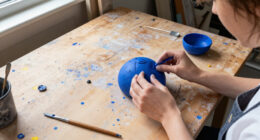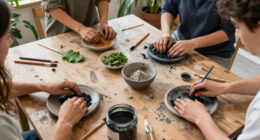
Shopping for handmade ceramic pottery sets often means choosing between two different kinds of craft. Wheel-thrown pieces are shaped individually on a potter’s wheel, so each bowl or mug can show subtle differences in profile, weight, and glaze. Slip-cast pieces are formed by pouring liquid clay into molds, a process that can still involve substantial hand-finishing but tends to produce more uniform shapes.

Get art and craft supplies delivered free — and shop member deals
- Fast, free delivery on millions of items
- Access to Prime Big Deal Days deals on October 6–7
- Prime Video, Amazon Music and more included

AmorArc 12-Piece Ceramic Dinnerware Set for 4
- ✔ Material: Ceramic
- ✔ Pieces: 12
- ✔ Service: For 4

Set of 4 Vintage Pottery Coffee Mugs, 8.5 oz Handmade Stoneware Cups
- ✔ Quantity: 4 mugs
- ✔ Capacity: 8.5 fl oz (250 ml) each
- ✔ Weight: 12.7 oz (360 g) per mug

AmorArc 24-Piece Ceramic Dinnerware Set for 8
- ✔ Material: Ceramic stoneware
- ✔ Pieces: 24
- ✔ Service: For 8
That difference matters most when deciding whether a set should feel individually made or look closely coordinated on the table. Wheel-thrown sets usually suit buyers who value visible variation and maker-specific character. Slip-cast sets suit people who want a handmade connection with more predictable sizing and a consistent place setting. Neither method guarantees quality: clay, glaze, firing, finishing, and the maker’s standards matter just as much.
This comparison looks at shape and character, consistency, function, durability, care, availability, and value. The practical choice is whether the individuality of wheel-thrown work is worth potential variation and a higher price, or whether a more uniform set better fits everyday use and replacement needs.
At a Glance
| Criteria | Wheel-thrown pottery sets | Slip-cast pottery sets | Winner |
|---|---|---|---|
| Shape and individuality | Each piece is shaped individually, so small differences are part of the appeal. | Molded forms tend to have a consistent profile, with character added through finishing and glaze. | A |
| Matching and consistency | Sizes and profiles can vary within the same set. | Usually easier to match in size and shape, though handmade finishing can still vary. | B |
| Everyday function | Can feel distinctive in hand; proportions depend on the potter. | Predictable dimensions can help with stacking, serving, and setting a coordinated table. | Depends |
| Durability and finish | Depends on clay, glaze, firing, and workmanship; hand-thrown does not automatically mean stronger. | Depends on materials and production quality; molds do not guarantee durability. | Tie |
| Care and kitchen compatibility | Check the maker’s care guidance; wheel-thrown construction alone says nothing about dishwasher or microwave safety. | Compatibility is product-specific; verify the maker’s instructions rather than infer it from the forming method. | Tie |
| Availability and replacement | Small-batch runs may sell out, and exact replacements can be difficult to find. | Repeat runs may be easier to coordinate, but small makers may still discontinue a design. | B |
| Price and value | Often costs more for labor-intensive shaping and an individual maker’s work. | May offer a more accessible route to coordinated handmade pieces; price varies by maker and finish. | Depends |
AmorArc 12-Piece Ceramic Dinnerware Set for 4
For a household that wants pottery character in a practical table setting, the 12-piece AmorArc set is our most balanced pick. It provides dinner plates, appetizer plates, and bowls for four, so it handles regular meals without requiring buyers to assemble matching pieces separately. Its naturally varied glaze gives the set visual texture; that variation is also a real tradeoff if you want every plate and bowl to look precisely alike.Compared with the four-piece mug set, this is the more complete purchase for meals, but it does not offer the same emphasis on individual rustic mug character. Compared with AmorArc’s 24-piece version, it covers the same stated assortment and sizes for half as many people, which keeps the choice simpler for smaller homes. Stackable storage and microwave, dishwasher, and freezer compatibility support routine use. The listing calls the glaze scratch-resistant and lead- and cadmium-free, though it does not specify piece dimensions beyond the plates or bowl capacity.Choose it when four settings are enough and a varied glaze is part of the appeal. Skip it if you routinely host larger groups, want a uniform factory-matched finish, or are primarily shopping for handcrafted coffee cups rather than tableware.
Pros:
- Provides dinner plates, appetizer plates, and bowls for four people
- Stackable pieces help limit cupboard space
- Microwave, dishwasher, and freezer safe
- Lead- and cadmium-free glaze is specified
Cons:
- Glaze color can shift with lighting and vary between pieces
- The set serves four, so larger households need additional place settings
Best for: Households of up to four who want plates and bowls with a naturally varied glaze and convenient everyday care.
Not ideal for: Frequent hosts serving more than four, or buyers who require a highly uniform finish from piece to piece.
Bottom line: We recommend this as the most practical handmade-look pottery set for everyday meals in a four-person household.
“We recommend this as the most practical handmade-look pottery set for everyday meals in a four-person household.”
Set of 4 Vintage Pottery Coffee Mugs, 8.5 oz Handmade Stoneware Cups
These four mugs bring the most explicitly handmade character in this lineup. Speckled glaze and rustic edges give each stoneware cup a vintage look, while the low, wide shape is intended to show off coffee crema. At 8.5 fl oz apiece, they suit cappuccino, tea, hot chocolate, or a smaller latte serving. Their solid 12.7 oz weight may feel reassuring to some drinkers, though it makes each cup less of a lightweight everyday mug.Unlike either AmorArc dinnerware set, this purchase is focused on drinks rather than a whole place setting. That narrow role is an advantage if your plates are already sorted and you want ceramic cups with more visible variation. It is a limitation if you are furnishing a table from scratch. The stated dishwasher, microwave, and sterilizer compatibility makes routine care straightforward, but the 8.5 oz capacity is modest beside oversized coffee servings. As with pottery generally, dropping a cup can cause chipping.We rank the mugs behind the four-person dinnerware set because they cover fewer dining needs, not because their craft aesthetic is less distinctive. Pick them for a compact coffee ritual or a small gift set; choose the 12-piece AmorArc option when plates and bowls matter more.
Pros:
- Speckled glaze and rustic edges give the cups a handmade look
- 8.5 fl oz capacity suits cappuccino, tea, and smaller coffee drinks
- Dishwasher, microwave, and sterilizer safe
- Low, wide shape is designed to highlight coffee crema
Cons:
- 8.5 fl oz may be too small for large coffee servings
- Stoneware can chip if dropped
Best for: Coffee, tea, and hot chocolate drinkers who want four weighty stoneware mugs with a speckled, rustic appearance.
Not ideal for: People who prefer large-capacity travel-style mugs, lightweight cups, or a complete dinnerware service.
Bottom line: Choose these when distinctive ceramic drinkware is the priority and a smaller cup capacity fits your routine.
“Choose these when distinctive ceramic drinkware is the priority and a smaller cup capacity fits your routine.”
AmorArc 24-Piece Ceramic Dinnerware Set for 8
When eight place settings are the point, this AmorArc set scales up the same basic assortment found in the smaller dinnerware option: dinner plates, appetizer plates, and bowls. Twenty-four pieces cover eight people, making it more suitable for a larger household or regular group meals than the 12-piece version. The reactive glaze adds visual variation across the table, and the dishes stack to make storage more manageable than a loose collection of bulky pieces.Its strengths track closely with the 12-piece set: the plates share the same listed sizes, bowls hold 24 oz, and the set is microwave, dishwasher, and freezer safe. The stated lead-free and cadmium-free finish and scratch-resistant glaze also make it a convenient everyday choice. But if you only serve four, doubling the service means storing and maintaining pieces you may rarely use. Color variation between pieces is part of the reactive-glaze look; those seeking a uniform coordinated finish should consider that carefully.Compared with the 12-piece set, this one adds the capacity for larger gatherings rather than a different assortment. Compared with the vintage mugs, it is far more useful for meals but lacks their drink-specific, rustic character. We place it third for broad appeal because its larger footprint only pays off when you need eight settings; for that buyer, it is the clear choice in this lineup.
Pros:
- Includes dinner plates, appetizer plates, and bowls for eight
- Stackable pieces help organize larger service sets
- Microwave, dishwasher, and freezer safe
- Scratch-resistant, lead-free, cadmium-free glaze is specified
Cons:
- Requires more cupboard room than the 12-piece set
- Reactive glaze color may vary with lighting and between pieces
Best for: Families of up to eight or hosts who want matching plate and bowl settings for larger meals.
Not ideal for: Small households with limited cupboard space or anyone seeking a small drinkware set rather than dinnerware.
Bottom line: This is the strongest match for buyers who need eight pottery-style settings and can accommodate the larger set.
“This is the strongest match for buyers who need eight pottery-style settings and can accommodate the larger set.”
As an Amazon Associate we earn from qualifying purchases.
Key Differences
The clearest difference is the way the forms are made. A potter throws each piece separately on a wheel, shaping the clay by hand. That process often leaves variations in rim, curve, and balance that make a set feel personal. Slip-casting starts with a mold, so pieces can share a closer profile and dimensions. Makers may still trim, glaze, decorate, and finish each one by hand; “cast” does not mean factory-made or mass-produced.
Those methods create different strengths, not a simple quality ranking. Wheel-thrown sets are a stronger fit when individual character is part of the pleasure of owning the pieces. Slip-cast sets are often more practical when coordinated proportions, repeatable sizing, or an orderly stack matter more. Either can be beautiful and well-made, and either can disappoint if the glaze, finish, or construction is poor.
Price deserves the same care in interpretation. A wheel-thrown set may cost more because shaping every piece individually takes time, but the premium only makes sense if that variation matters to you. A slip-cast set can offer better value for buyers who want a coordinated table without paying extra for individually thrown forms. Compare the actual set size, finish, care instructions, and replacement policy before deciding.
Detailed Comparison
Shape and individuality (Wheel-thrown pottery sets wins — moderate)
Wheel-thrown wins by a moderate margin for visible character. Because each item is shaped separately, a mug handle, bowl curve, or foot may differ slightly from its neighbors. Those small variations give the set an individual feel, though they can also make a full place setting look less exact.
Slip-cast pieces tend to repeat a shared silhouette. That is useful if you prefer clean coordination, while decoration and hand-finishing can still give them personality. Choose by how much variation you want to see and feel at the table.
Matching and consistency (Slip-cast pottery sets wins — moderate)
Slip-cast wins by a moderate margin when close matching is the goal. A shared mold usually makes it easier for plates or bowls to have similar profiles and dimensions. That can help with stacking, serving, and replacing one piece with another from the same run.
Wheel-thrown work gives up some uniformity in return for individually shaped forms. Variations are usually subtle, but buyers who want every setting to look nearly identical should ask the maker how much size and shape variation to expect.
Everyday function (minor difference)
This is a close, product-specific comparison. Wheel-thrown pieces can have a satisfying balance and a distinct feel in the hand, but comfort depends on actual proportions, handle clearance, weight, and capacity. Slip-cast forms offer more predictable dimensions, which can make a coordinated cupboard or table easier to arrange.
Neither method guarantees a more useful mug or bowl. Check measurements and capacities, and consider whether pieces nest or stack if storage space matters. Try a sample or inspect detailed photographs when buying online.
Durability and finish (moderate difference)
There is no reliable winner by forming method alone. Durability depends on the clay body, firing, glaze fit, thickness, and finishing. A well-made wheel-thrown plate can serve reliably for years; a carefully made slip-cast bowl can do the same. A rough foot, sharp rim, glaze defect, or hairline crack deserves attention regardless of how the shape began.
Ask the maker about intended use, and inspect the foot and rim where possible. Treat claims about strength as specific to the piece rather than assuming handmade or molded construction predicts it.
Care and kitchen compatibility (minor difference)
Neither option wins based on production method. Dishwasher, microwave, and oven guidance depends on the clay, glaze, decoration, and the maker’s testing and recommendations. Handmade does not automatically mean hand-wash only, and slip-cast does not automatically mean appliance-safe.
For daily-use sets, check the care instructions before purchase. If you rely on a dishwasher or microwave, choose a maker who clearly states whether those uses are suitable for that particular collection.
Availability and replacement (Slip-cast pottery sets wins — moderate)
Slip-cast often has a moderate practical advantage because a repeatable mold can make it easier for a maker to produce pieces with similar dimensions again. This can help if you want to add to a set over time. It is not a promise of ongoing stock: independent potters may retire a mold or stop making a glaze.
Small batches of wheel-thrown work can be harder to match exactly. If replacing a broken favorite matters, ask how long the design is expected to be available and whether the maker sells individual pieces.
Price and value (moderate difference)
The better value depends on what you want to pay for. Wheel-thrown sets may command a higher price because each form requires individual shaping. That premium is worthwhile for buyers who value the potter’s hand and appreciate variation. If matching pieces and straightforward daily use matter more, a slip-cast set may be the more sensible purchase.
Compare complete set contents and per-piece prices before judging either as cheaper. Glaze complexity, decoration, firing, and the maker’s labor can change the price as much as forming method.
Wheel-thrown pottery sets: Pros and Cons
Pros:
- Individual shaping gives each piece a distinct profile and feel.
- Visible variation can make a table feel collected and personal.
- The work often highlights the potter’s shaping skill.
Cons:
- Pieces may vary more in size, weight, and shape.
- Coordinating or replacing an exact match can be difficult.
- The labor involved can make sets more expensive.
Slip-cast pottery sets: Pros and Cons
Pros:
- Shared molds tend to produce coordinated shapes and predictable dimensions.
- Consistent profiles can make stacking and setting a table easier.
- Repeat production may help buyers add similar pieces later.
Cons:
- The forms may feel less individually shaped than wheel-thrown work.
- Molded construction does not by itself guarantee quality or durability.
- Future availability still depends on the maker and collection.
Who Should Choose What
Choose Wheel-thrown pottery sets if:
- You enjoy subtle differences between pieces and want visible evidence of individual shaping.
- You are buying a meaningful gift or centerpiece set where maker-specific character matters more than exact uniformity.
- You have seen the actual forms or measurements and are comfortable paying more for individually thrown work.
Choose Slip-cast pottery sets if:
- You want a coordinated place setting with similar profiles and dimensions.
- You value predictable stacking, storage, or adding matching pieces later.
- You want handmade finishing and glaze character without making individual wheel-thrown variation the main reason for the purchase.
Skip both if: Choose neither until you find a set with clear care guidance, suitable dimensions, and a replacement policy that fits your needs; the forming method cannot compensate for poor finishing or unsuitable use.
Value for Money
Pay more for wheel-thrown pottery only if the individual shaping is something you will notice and enjoy every day, or if the set’s maker and specific forms carry special meaning. The added cost is not a general guarantee of stronger ceramics, better glaze, or longer life. Judge the finished work and the maker’s information on its own merits.
Slip-cast sets can be better value for buyers who prioritize a coordinated table, consistent sizing, and a potentially easier path to adding pieces. Their price still depends on hand-finishing, decoration, clay, and firing, so compare what is included rather than assuming all cast sets are inexpensive. For most practical everyday buyers, a well-made slip-cast set is the more economical fit; for buyers who prize visible individuality, wheel-thrown work can justify its premium.
Final Verdict
Choose wheel-thrown pottery if you want the individuality of separately shaped pieces and accept that a set may not be perfectly uniform. Choose slip-cast pottery if coordinated proportions, predictable stacking, and the prospect of matching additions matter more. The biggest deciding factor is your preference for variation versus consistency, not an assumed difference in durability.
For most households seeking an attractive, coordinated set for regular use, a well-made slip-cast collection is the more practical value. Buyers who see the potter’s hand in each curve as central to the purchase should spend more on wheel-thrown work, after confirming care instructions and dimensions.
Frequently Asked Questions
Is wheel-thrown pottery better quality than slip-cast pottery?
No forming method guarantees better quality. Clay, glaze, firing, finishing, and the maker’s skill determine how well a piece is made. Wheel-thrown pottery tends to show more variation; slip-casting tends to create more consistent forms.
Are slip-cast pottery sets handmade?
They can be. Slip-casting uses a mold to shape liquid clay, while makers may handle pouring, trimming, glazing, decorating, and finishing by hand. Ask the maker which parts of the process are done by hand.
Which kind is easier to replace if a piece breaks?
Slip-cast pieces may be easier to match because molds can repeat a form, but ongoing availability depends on the maker and collection. Ask whether individual pieces are sold and how long the design is expected to remain in production.
Can handmade ceramic pottery go in the dishwasher or microwave?
It depends on the specific clay, glaze, decoration, and maker guidance, not simply on whether it is wheel-thrown or slip-cast. Check the care instructions for the exact set before using appliances.
Fall Picks
fall essentials
As an affiliate, we earn on qualifying purchases.