
TL;DR

Get art and craft supplies delivered free with Prime
- Fast, free delivery on millions of items
- Prime Video, Amazon Music and more included
- Member-only deals all year
Paul Ramírez Jonas’s participatory artwork “Public Trust” invited people in Toronto to make promises to strangers, display them on a marquee and take home a printed contract. First commissioned in Boston in 2016, the project returns as Toronto approaches a municipal election, prompting reflection on public commitments and democratic participation.
Artist Paul Ramírez Jonas’s participatory artwork “Public Trust” invited people in Toronto last month to make promises to strangers, display the vows on a large marquee and take home individual contracts recording them. Presented by The Bentway as Toronto’s municipal election approaches, the project puts personal commitments alongside the public promises made by politicians and other authorities.
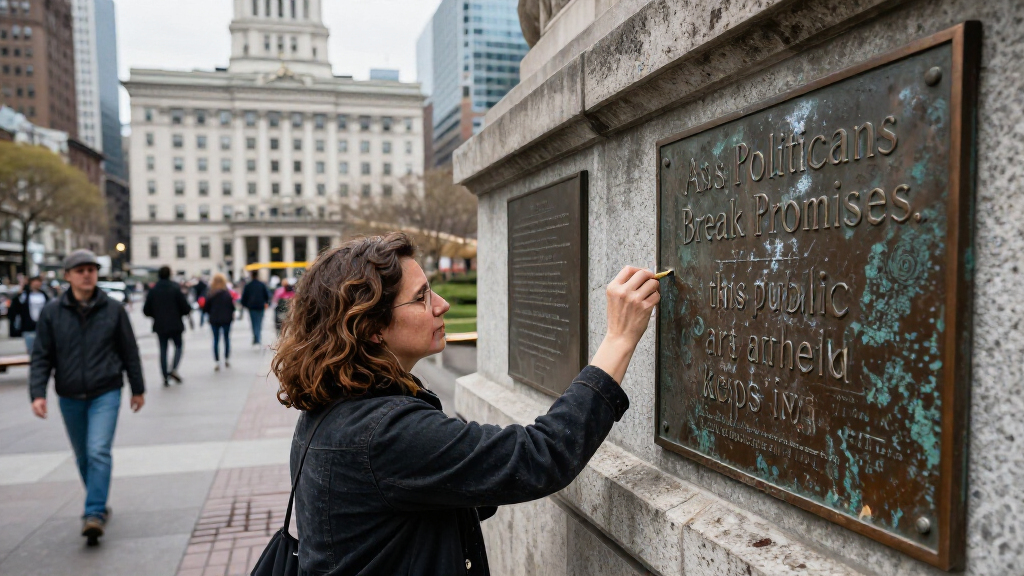
At the Toronto event, participants sat across from someone they did not know, made a promise and swore to keep it. The vow was then displayed on a large-scale marquee and memorialized in a one-of-a-kind contract for the participant to take home. One of the promises recorded was, “I promise to disagree better.” The original report describes hundreds of vows, but does not give a precise attendance or promise count.
The Bentway presented the work, with programming directed by Anna Gallagher-Ross. “Public Trust” was commissioned and first presented by Now + There in Boston in 2016. The organization was later renamed the Boston Public Art Triennial. The Toronto presentation brings the project back a decade after its first appearance, connecting an individual act of promise-making with questions about public participation and political accountability.
In Boston, promises made by local residents were set alongside daily headlines containing commitments from politicians, corporations, weather forecasters and others. The contrast put everyday vows and statements from influential institutions in the same frame. The report does not specify whether the Toronto presentation reproduced that headline display or provide further details about its format and duration.
Personal Vows Meet Public Promises
“Public Trust” asks audiences to compare what people pledge to one another with what public figures and institutions promise to do. Its format does not determine whether any commitment will be kept; instead, it makes the words visible and gives participants a record to take home. That distinction matters as Toronto’s municipal election approaches, when voters are likely to hear commitments from candidates seeking public support.
The work also makes participation tangible. Rather than treating public trust only as an abstract political idea, it gives people a direct role: they speak, listen to a stranger and place their words in a shared public setting. The reported Toronto vow to “disagree better” points to a personal practice of civic life, though it should not be read as evidence of broader public opinion. The artwork’s relevance comes from the contrast it creates, not from a claim that its participants represent the city.
Popular right now

Bose QuietComfort True Wireless Earbuds with Active Noise Cancellation, Black

LG 85-Inch QNED84B Mini LED 4K Smart TV (2026)

De'Longhi Magnifica Duo Fully Automatic Espresso Machine with Milk Frother, Silver
As an affiliate, we earn on qualifying purchases.
From Boston Commission to Toronto
Now + There commissioned “Public Trust” as its first project, presenting it in Boston in 2016, months before Donald Trump was first elected president. The original report says the project helped set a standard for the organization’s later commissions. It describes residents’ promises as often focused on family or self-improvement, even as participants came from different backgrounds.
The Toronto presentation gives the project a new setting and timing: it arrives as the city’s municipal election approaches. The report frames the return as an opportunity for residents to reflect on words and participation. It does not name a specific election date, identify particular candidates or connect the artwork to a campaign or party.
The Toronto Presentation’s Open Questions
The source report does not give the Toronto event’s exact dates, attendance, full list of promises or the number of contracts produced. It also does not state how long the marquee was displayed, whether the vows remain available to the public, or what follow-up participants may have with one another. No evidence is provided about whether the project changed political attitudes or affected voter behavior.
The report’s title and framing refer to politicians breaking promises, but it does not document specific broken pledges or assess the record of any named official. The artwork presents commitments for reflection; the report does not establish that every political promise fails or that participants’ vows will be kept.
Election Season and the Work’s Return
The immediate point of reference is Toronto’s approaching municipal election, which the original report identifies as the setting for the project’s renewed relevance. The source does not provide a schedule for another presentation, say whether “Public Trust” will return to Toronto or announce a related public program. Any further exhibition dates or details about access to the collected vows remain unconfirmed.
For now, the work leaves participants with written records of their promises and gives the public a shared display of their words. Whether those commitments endure is outside what the report establishes; the next milestone identified is the election itself, where candidates’ public promises will again be part of the civic conversation.
Key Questions
What is “Public Trust”?
It is a participatory artwork by Paul Ramírez Jonas in which strangers make promises to each other. The promises are displayed publicly, and each participant can take home a printed contract.
Where and when was the Toronto presentation?
The Bentway presented the work in Toronto last month, according to the original report. The report does not provide exact event dates or a more specific venue description.
When did the project begin?
“Public Trust” was commissioned and first presented in Boston in 2016 by Now + There, an organization later renamed the Boston Public Art Triennial.
Does the artwork verify whether promises are kept?
No. The work records and displays commitments, but the source does not describe a system for tracking whether participants or public figures fulfil them.
Why is the Toronto presentation tied to an election?
The original report says Toronto’s municipal election is approaching and presents the project as a prompt to reflect on public words and participation. It does not identify a specific election date or connect the artwork to any candidate or party.
Source: hyperallergic.com