
TL;DR

Get art and craft supplies delivered free with Prime
- Fast, free delivery on millions of items
- Prime Video, Amazon Music and more included
- Member-only deals all year
India’s pavilion at the 61st Venice Biennale presents Geographies of Distance: Remembering Home, an exhibition exploring how home can be shaped by place, memory and belonging. Curator Amin Jaffer says the show reflects on identity during accelerated change in India; the source does not provide its opening date or a full list of participating artists.
India’s pavilion at the 61st Venice Biennale is presenting Geographies of Distance: Remembering Home, an exhibition by five artists that considers how home is shaped by place, memory and belonging amid rapid change. Curator Amin Jaffer frames the show as a response to the Biennale’s theme, “In Minor Keys,” drawing on the varied landscapes and experiences associated with India.
The exhibition brings together references to places across the country, from the sun-baked earth of Tamil Nadu in the south to the stepped architecture of Ladakh in the north, as well as homes near the Himalayas and a Delhi threatened by demolition. The presentation links these distinct settings through questions of distance, memory and what makes a place feel like home.
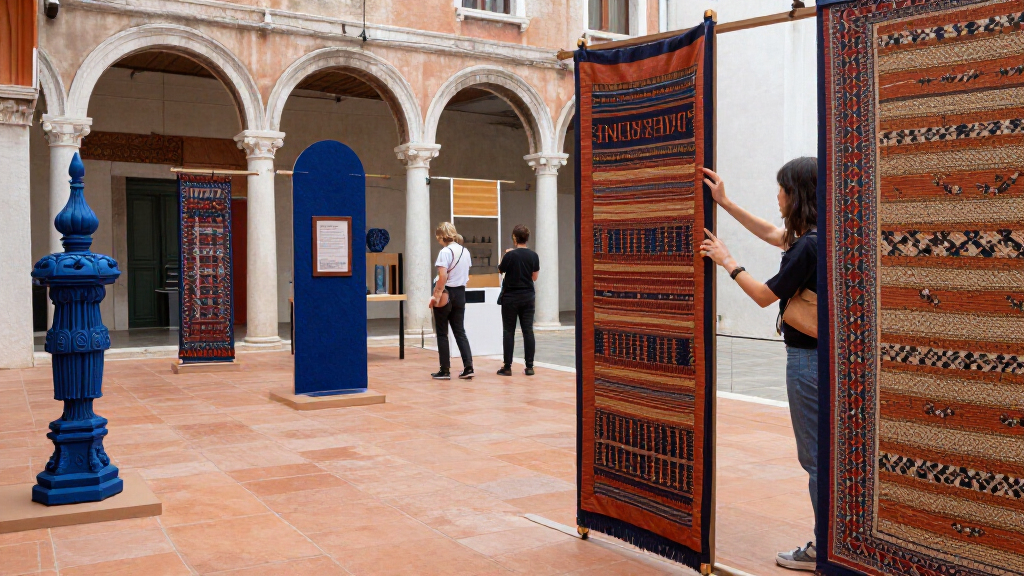
Its installations use materials and forms to evoke those ideas. Enormous hanging flowers stand in for gardens and their inhabitants, reflecting the importance of flowers in private, public and sacred life. A mesh of bamboo canes recalls a construction technique widespread in eastern India and suggests new cities rising over older urban landscapes.
Works identified in the source include Skarma Sonam Tashi’s Echoes of Home (2026) and Sumakshi Singh’s Permanent Address (2026), made with silk, cotton and nylon thread stretched on steel frames. The report names five artists collectively but does not provide the complete list or detailed descriptions of every work.
Home Across Changing Landscapes
The pavilion uses the idea of home to connect regional differences with larger questions about identity and belonging. Its geographic span matters: it brings distant environments and architectural histories into one exhibition without treating home as a single, uniform Indian experience.
The work also places those ideas against accelerated urbanization. Bamboo construction and the reference to Delhi’s demolitions point to change in the built environment, while the exhibition’s focus on memory asks what people carry with them when familiar places are altered or lost. These are the curator’s framing and the exhibition’s artistic propositions, not evidence of a single shared experience among all Indians.
Popular right now

Breville BES870BTR Barista Express Espresso Machine, Black Truffle

Apple AirPods Max 2 Wireless Over-Ear Headphones – Midnight

Vitamix 5200 Professional-Grade Blender, 64 oz. Container, Black
As an affiliate, we earn on qualifying purchases.
India at the Venice Biennale
The exhibition is India’s presentation at the 61st Venice Biennale, whose stated theme is “In Minor Keys.” The pavilion interprets that theme through what its report describes as India’s diversity, using quieter, reflective approaches to consider place and belonging.
The title, Geographies of Distance: Remembering Home, signals the show’s emphasis on movement between places and on memory. The available report focuses on the exhibition’s concepts, materials and selected works; it does not give a fuller account of the pavilion’s selection process or how the presentation relates to earlier Indian participation in Venice.
“I would characterize the pavilion and the work of the five artists as a reflection on identity and belonging in a period of accelerated change.”
— Amin Jaffer, curator of Geographies of Distance
Details Still Missing from the Report
The source does not specify the exhibition’s opening and closing dates, provide the names of all five artists, or describe every work in detail. It also does not identify specific demolition projects in Delhi or give figures for urbanization; those references should be understood as part of the exhibition’s framing rather than quantified findings.
The report presents the curator’s interpretation and descriptions of selected installations, but it does not include responses from visitors, participating artists beyond the cited work titles, or other assessments of the pavilion. The available material does not establish how the exhibition will be received or what impact it may have beyond the Biennale.
The Pavilion During the Biennale
The confirmed development is the pavilion’s presentation at the 61st Venice Biennale. The source provides no schedule for talks, public programs or changes to the installation, and it does not state when the exhibition will close. Any further reporting should verify those dates and program details with the pavilion or Biennale organizers.
Key Questions
What is India showing at the 61st Venice Biennale?
India’s pavilion is presenting Geographies of Distance: Remembering Home, an exhibition by five artists about place, memory and belonging.
Who is curating the exhibition?
Amin Jaffer is identified as the curator. He describes the pavilion as a reflection on identity and belonging during accelerated change.
Which artists and works are named in the report?
The report identifies Skarma Sonam Tashi and his 2026 work Echoes of Home, as well as Sumakshi Singh and her 2026 work Permanent Address. It does not list all five artists.
What does the exhibition mean by home?
The exhibition considers home through place, memory, distance and belonging. Jaffer says it can be more than a physical location: it can also be a condition people carry with them.
How long will the pavilion be open?
The source does not provide the exhibition’s opening or closing dates. Readers should check with the Indian Pavilion or Biennale organizers for current visiting information.
Source: hyperallergic.com