TL;DR

Get art and craft supplies delivered free with Prime
- Fast, free delivery on millions of items
- Prime Video, Amazon Music and more included
- Member-only deals all year
Gemini G.E.L., the Los Angeles print workshop founded in 1966, is marking its 60th anniversary with an exhibition drawn from its archive. Curated by Susan Dackerman and Helen Molesworth, the show traces how artists used the workshop to collaborate and test printmaking beyond conventional formats.
Los Angeles print workshop Gemini G.E.L. is marking its 60th anniversary with (Almost) Every Year: Sixty Years of Printmaking at Gemini G.E.L., an exhibition drawn from its archive and curated by Susan Dackerman and Helen Molesworth. The exhibition looks at how the studio became a site for dialogue and experimentation, as artists worked outside their usual approaches to printmaking.
Founded in 1966 by Sydney B. Felsen and Stanley Grinstein, Gemini invited artists from New York and Los Angeles from its early years. Its initial roster included Josef Albers, Man Ray, Robert Rauschenberg, Jasper Johns, Claes Oldenburg, Frank Stella and Ellsworth Kelly, alongside Los Angeles artists such as David Hockney, Ed Ruscha, Ron Davis and Bruce Nauman. The anniversary exhibition uses works across the archive to show how the workshop brought varied practices into contact.
Rather than treating the collection only as a chronological record, the curators emphasize shared concerns and unexpected departures. The exhibition places artists together around interests such as shape and color, found imagery, black, and linear structures. It also highlights artists working against expectations: Joel Shapiro and Richard Tuttle, both associated with minimalist sculpture, made screenprinted geometric abstractions in bright palettes and complex configurations.
Other works test what can count as a print. Oldenburg’s 1969 Profile Airflow combines a two-color lithograph with molded polyurethane relief. Jasper Johns printed a light-bulb image on lead, while Edward and Nancy Kienholz made sculptures from gasoline containers, adding Fresnel lens systems to suggest television sets. Allen Ruppersberg later made a 20-foot perforated piano-player roll into a multicolored screenprint, divided into four sections.
How the Workshop Expanded Printmaking
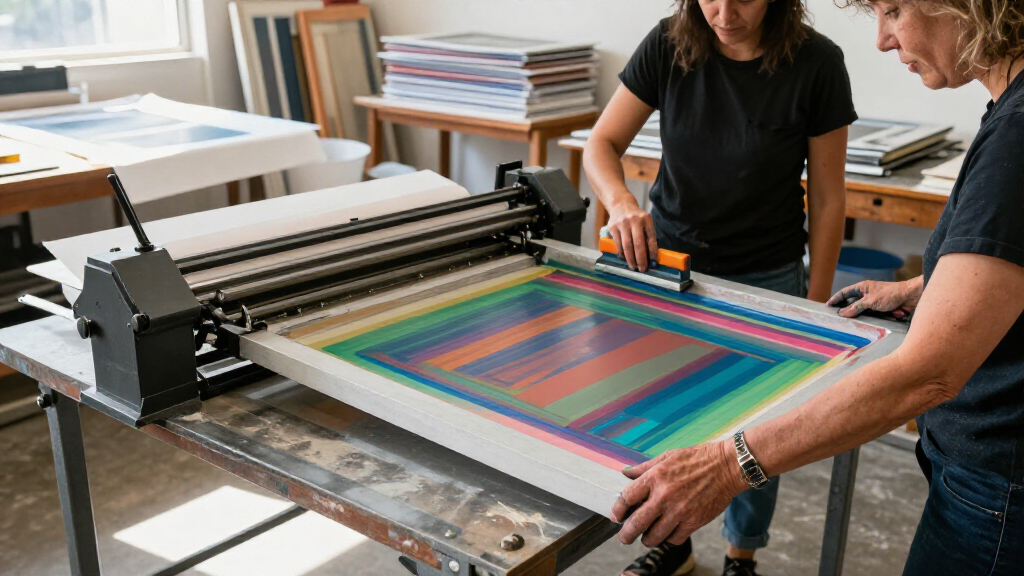
The exhibition presents Gemini G.E.L. not just as a production studio but as a place where artists could work with unfamiliar processes and materials. That history matters because it shows printmaking as more than an image transferred to paper: across the works on view, it can take the form of relief, printed metal, sculptural objects or an extended roll. The range makes visible how collaboration between artists and workshop practitioners can alter the boundaries of a medium.
The anniversary survey also connects the workshop’s history to changes in the artists it welcomed. Women began working at Gemini in the 1980s, starting with Dorothea Rockburne and Vija Celmins, followed by Susan Rothenberg and Elizabeth Murray. The source report says the curators described the current roster as notable for its gender equality. The exhibition thus offers a way to consider both artistic experimentation and who has been represented in the workshop’s history, while the available account does not provide a full roster analysis or figures.
Popular right now

Ninja DualZone Smart Air Fryer, 10 Qt, 6-in-1, DZ950

Bose QuietComfort Ultra Earbuds (2nd Gen), Deep Plum

Dyson Big Ball Multi Floor Canister Vacuum, Yellow
As an affiliate, we earn on qualifying purchases.
From 1966 to the Anniversary Survey
Gemini opened in Los Angeles in 1966, during a period when the city’s art community was growing. Its early invitations brought prominent artists from elsewhere in the United States into the same workshop as local figures. The exhibition’s chronology follows that activity across nearly six decades, with the title signaling that it covers almost every year, rather than claiming an unbroken annual record.
The archive includes artists from different generations and practices, from Rauschenberg and Albers to Vija Celmins and Julie Mehretu. The review also points to connections across the collection: Frank Stella and Ellsworth Kelly exploring shape and color, Rauschenberg and Johns using found-object imagery, and Toba Khedoori, Mehretu and Analia Saban engaging with linear matrices. These groupings frame the exhibition as an account of exchanges as well as individual careers.
“The workshop served as a place for dialogue among visiting artists and for experimenting beyond their usual routines or comfort zones.”
— Hyperallergic’s report on the exhibition
What the Exhibition Record Leaves Open
The available report does not state the exhibition’s closing date, provide a complete checklist of works, or describe how many objects are included. It also does not give quantitative information about the workshop’s current artist roster, so the curators’ observation about gender equality cannot be assessed from the report alone. The title indicates coverage of almost every year, but the specific gaps in the chronology are not detailed.
Some interpretations remain the curators’ or reviewer’s readings rather than documented statements of artist intent. For example, the report says Oldenburg’s molded automobile profile may have been influenced by Southern California’s Finish Fetish movement; it presents this as a possibility, not a confirmed account of his motivation.
The Anniversary Exhibition’s Record
The immediate development is the anniversary presentation of (Almost) Every Year, which brings Gemini G.E.L.’s archive into view through works selected by Dackerman and Molesworth. Readers seeking practical details such as dates, visiting information and a complete object list will need to consult the gallery or exhibition’s own current materials; those details are not included in the source report.
As the exhibition’s chronology and juxtapositions invite comparison across artists and decades, the next point of interest is how audiences encounter the workshop’s changing definitions of printmaking—and the artists included in that history. The source material does not specify further anniversary programming or whether the exhibition will travel.
Key Questions
What is Gemini G.E.L.?
Gemini G.E.L. is a Los Angeles print workshop founded in 1966 by Sydney B. Felsen and Stanley Grinstein. It has worked with artists across generations and media.
What is the anniversary exhibition called?
The exhibition is titled (Almost) Every Year: Sixty Years of Printmaking at Gemini G.E.L. It was curated by Susan Dackerman and Helen Molesworth using the workshop’s archive.
What is the exhibition’s main focus?
It examines Gemini as a place for artist exchange and experimentation, including work that challenged conventional ideas of a print through unusual materials, formats and processes.
Which artists are represented?
The report names artists including Josef Albers, Man Ray, Robert Rauschenberg, Jasper Johns, Claes Oldenburg, Ellsworth Kelly, David Hockney, Ed Ruscha, Vija Celmins and Julie Mehretu. It does not give a complete list.
Is the exhibition open for a specific period?
The source report does not state opening or closing dates or other visiting details. Those should be checked with the gallery’s current information.
Source: hyperallergic.com