TL;DR

Get art and craft supplies delivered free — and shop member deals
- Fast, free delivery on millions of items
- Access to Prime Big Deal Days deals on October 6–7
- Prime Video, Amazon Music and more included
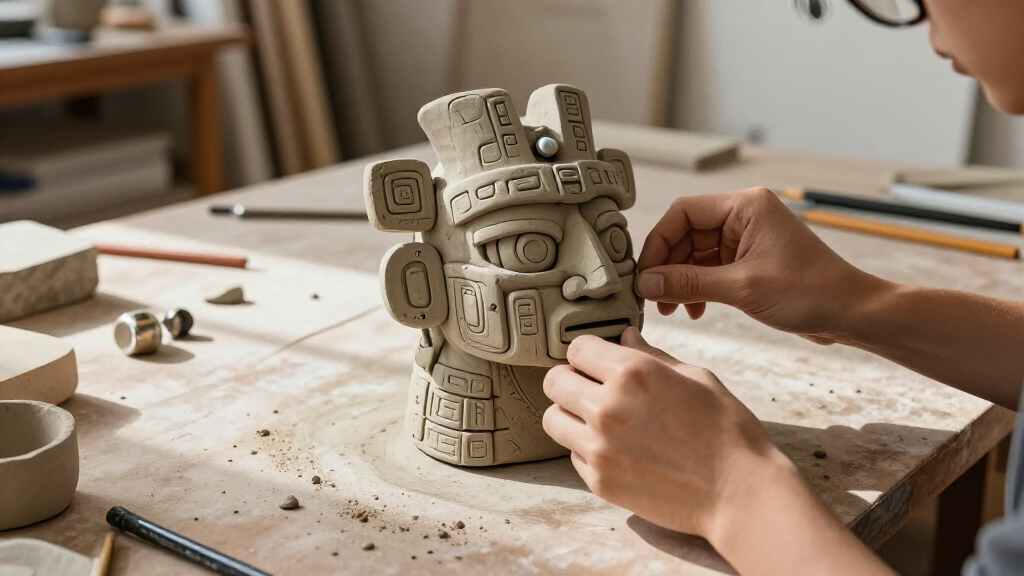
New Mexico-based artist Max Lehman is showing ceramic sculptures in “Ancestral Androids” at Hecho a Mano in Santa Fe through Nov. 1, 2026. The works combine references to Pre-Columbian visual culture with science-fiction figures and technology, while imagining how future archaeologists might interpret objects whose origins have been lost.
New Mexico-based artist Max Lehman is presenting ceramic sculptures that combine references to Pre-Columbian visual culture with science-fiction technology in “Ancestral Androids,” an exhibition at Hecho a Mano in Santa Fe running through November 1, 2026. The show imagines how objects made today might look to archaeologists in a distant future, when their original uses and stories are no longer known.
The sculptures use ceramic, acrylic and metallic paint, with some works identified as glazed ceramic. Their bright, often cartoon-like figures carry titles including “The Mother of Machines,” “The Malachite Mage,” “The Duchess of Digital Data” and “Fiery Phineas and His Tablet of Doom.” Colossal’s report describes figures with expressions that can seem unsettling, as well as faces placed on foreheads or bellies, motifs Lehman uses to suggest collectivity and shared consciousness.
The work draws on ancient art and on the possibility that technology could become part of a future civilization’s material record. One sculpture, “Mayan Max and His Pre-Colo iPad,” explicitly joins a reference to the Maya with a contemporary digital device. The supplied report identifies the works as pieces from 2026; it does not give full exhibition dates beyond the stated end date or a complete list of works in the show.
Lehman says he wants viewers to sit with uncertainty rather than receive a definitive guide to what each figure represents. “I resist providing complete explanations because archaeology rarely offers certainty,” he said in a statement quoted by Colossal. He describes the sculptures as imagined finds whose precise origin and purpose could become difficult to recover over time.
Imagining Archaeology’s Future Ruins
The exhibition connects two ways of thinking about the past and future: archaeologists infer how people lived from surviving objects, while Lehman asks how future people might interpret objects from our own technological era. Its central idea is that meaning can become uncertain when context disappears, even if an object itself survives.
That question resonates with contemporary debates about digital archives and artificial intelligence. Lehman’s work does not offer a factual forecast about which records or stories will last. Instead, it uses handmade objects to make the uncertainty visible: future viewers might mistake a device, a fictional character or a cultural reference for something sacred or practical. The sculptures invite interpretation without claiming to settle it.
The show also places emphasis on physical making amid rapid technological change. Lehman argues that working clay preserves traces of a maker’s experience and decisions. That is his perspective as an artist, rather than an independently established claim about the limits of machine technology.
As an affiliate, we earn on qualifying purchases.
Ancient Forms Meet Imagined Technology
Colossal’s report situates Lehman’s approach in his study of Pre-Columbian art history and points to carved stone imagery associated with ancient Maya temples and the Mexica Sun Stone, also called the Aztec calendar stone. These are distinct historical traditions, and the report presents them as examples of the ancient visual culture informing the broad frame of Lehman’s work, not as evidence that every sculpture refers to a specific artifact.
Lehman’s fictional setting moves far beyond the present, to a time when today’s developments in robotics, machine learning and digital data may themselves be distant history. He imagines archaeologists encountering his sculptures after their original context has vanished. The exhibition therefore combines historical reference and speculative storytelling, rather than presenting the figures as archaeological reconstructions or depictions of actual ancient beliefs.
Among the named works are “Petro who is Predicting the Unpredictable,” made in 2026 from ceramic with acrylic and metallic paint, and “The Sapphire Sage,” also dated 2026. Colossal lists the former at 12 by 11 by 8 inches and the latter at 16 by 12.5 by 7 inches. These details describe individual works; they do not establish the dimensions or materials of every sculpture in the exhibition.
““I resist providing complete explanations because archaeology rarely offers certainty. We reconstruct civilizations from fragments, projecting ourselves into the spaces left empty by time.””
— Max Lehman, in a statement quoted by Colossal
What the Exhibition Leaves Open
The supplied report gives the exhibition’s title, venue, city and closing date, but does not state when “Ancestral Androids” opened, provide ticketing or visiting information, or say whether additional events are planned. It also does not provide a gallery statement or independent commentary beyond Colossal’s account and Lehman’s quoted statements.
The intended meanings of individual figures are not fully explained, consistent with Lehman’s stated preference for ambiguity. References to ancient cultures and imagined future technologies are part of the artist’s framework; the report does not claim that the sculptures reproduce historically documented objects, rituals or beliefs. Any reading of their faces or symbols as having a single, fixed meaning remains interpretation rather than confirmed fact.
Santa Fe Show Runs Through November
“Ancestral Androids” is scheduled to remain at Hecho a Mano in Santa Fe through November 1, 2026. The source report does not identify a subsequent venue or announce plans for the exhibition after that date. Colossal directs readers to Lehman’s Instagram for more of his work, but the supplied material does not list a specific future project or event.
For visitors, the confirmed next milestone is the exhibition’s closing date. Further details about gallery hours, access and any programming would need to be checked with Hecho a Mano; those details are not included in the report.
Key Questions
Where can visitors see Max Lehman’s “Ancestral Androids”?
The exhibition is at Hecho a Mano in Santa Fe, according to Colossal’s report. The report does not include gallery hours or ticket information.
How long is the exhibition on view?
“Ancestral Androids” is scheduled to continue through November 1, 2026. The source does not give its opening date.
What are Lehman’s sculptures made from?
The works described in the report use ceramic, often with acrylic and metallic paint; some are identified as glazed ceramic. Materials differ by piece.
Are the sculptures historical archaeological objects?
No. The report describes them as Lehman’s contemporary artworks, inspired by Pre-Columbian visual culture and science fiction. Their imagined future archaeological interpretation is a concept behind the show, not a claim that the works are ancient artifacts.
Does Lehman explain what each sculpture means?
Not completely. Lehman says he resists providing full explanations because archaeological evidence can leave uncertainty. The report gives titles and some broad themes but does not assign a definitive meaning to every figure.
Source: rss
Fall Picks
fall essentials
As an affiliate, we earn on qualifying purchases.