TL;DR

Get art and craft supplies delivered free with Prime
- Fast, free delivery on millions of items
- Prime Video, Amazon Music and more included
- Member-only deals all year
Chapter 1 of John Berger’s 1972 book Ways of Seeing sets out an argument about how vision is shaped by knowledge, belief and the act of looking. Berger also says images record a maker’s way of seeing, while learned ideas about art can distance viewers from the past. The supplied source is the chapter text, not a new announcement or report of a recent event.
Chapter 1 of John Berger’s 1972 book Ways of Seeing argues that looking is an active, situated process, not simply the passive receipt of visual information. In the text supplied from the book’s chapter page, Berger connects what people see to what they know and believe, then applies that idea to images, photography and the way art is interpreted. The material concerns a foundational argument in a published work, not a new event or announcement.
Berger opens with the claim that seeing comes before words: people encounter the visible world before they can explain it in language. But words and knowledge do not settle what sight means. His example is a sunset: people see the sun disappear below the horizon while knowing that the Earth is turning. The scientific explanation and the immediate appearance coexist without becoming identical. Berger uses that gap to show that perception is not reducible to a verbal account.
What people see is also affected by belief and experience. Berger compares contemporary understandings of fire with medieval beliefs in a physically existing Hell, arguing that the same visible phenomenon can carry different meanings in different periods. He then stresses that looking involves selection: “We only see what we look at,” he writes, describing attention as an act that brings a chosen subject into relation with the viewer. Vision, in this account, is active and shaped by a person’s position in the world.
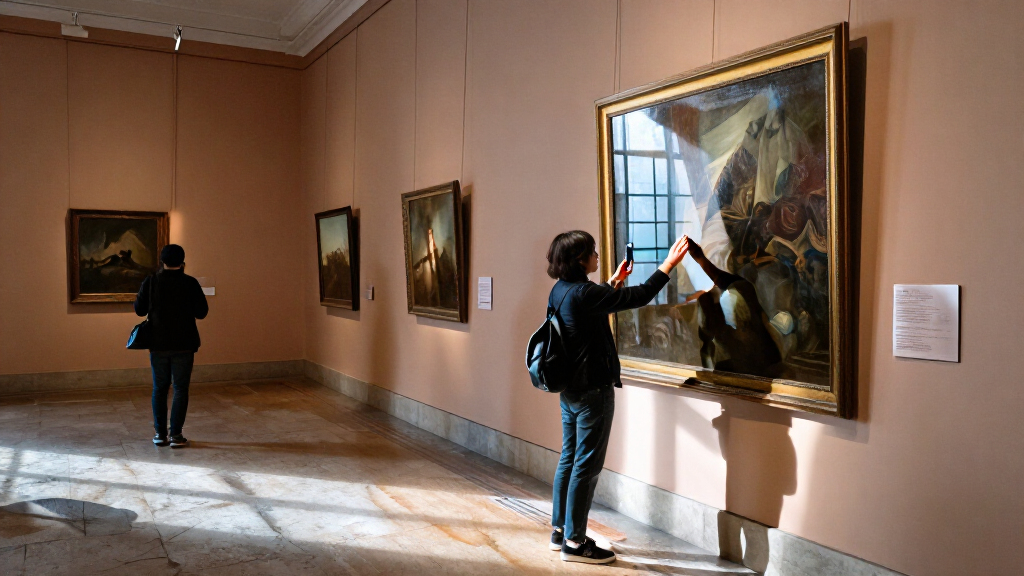
The chapter extends that account to images. Berger defines an image as a sight that has been recreated or reproduced and detached from its original place and time. Photographs, he argues, are not neutral mechanical records because a photographer chooses one view from many possible views. Paintings similarly retain evidence of the maker’s way of seeing. At the same time, what viewers notice depends on their own interests and perspective.
How Berger Reframes Looking at Images
The chapter matters because it asks readers to treat images as acts of selection, rather than transparent windows onto reality. That distinction applies to a family snapshot as well as a painting: a maker chose what to include, and a viewer brings their own attention and assumptions to what remains visible. Berger’s point does not make images useless as records; it changes the questions readers can ask of them.
His argument also connects visual interpretation to powerful inherited ideas about art. Berger lists concepts such as beauty, truth, genius, civilization, form, status and taste as assumptions that influence how works are presented and viewed. If those ideas no longer fit the present, he argues, they can mystify the past—making artworks seem remote rather than helping viewers understand the conditions in which they were made.
That approach remains useful for readers considering how pictures shape public understanding. A photograph can preserve an appearance, but it also reflects a choice of subject and viewpoint. A museum label, a reproduction or a familiar category of “great art” can guide attention in turn. Berger’s chapter supplies a method for noticing these layers, while leaving any particular image open to close examination.
As an affiliate, we earn on qualifying purchases.
The Chapter’s Argument About Art and History
Berger’s chapter moves from everyday perception toward the interpretation of art. It first considers the gap between sight and explanation, then describes looking as relational: people see objects from a position and are also aware that others can see them. From there, Berger turns to images as preserved appearances and to the changes in how people understand their value.
He says images initially served to evoke absent things. Once an image could outlast its subject, it also became evidence of how that person or object had appeared in the past—and, by implication, of how others had seen it. Berger links the later recognition of the image-maker’s individual vision to a growing consciousness of individuality and history. He avoids assigning a precise date to that development, but says it has existed in Europe since the beginning of the Renaissance.
Berger presents images as a form of historical testimony, while cautioning that their meaning is not self-evident. Art is viewed through present-day assumptions, he says, and history is shaped by the relationship between the present and the past. The chapter therefore treats looking at art as both a visual experience and an interpretation affected by time.
““Seeing comes before words.””
— John Berger, Ways of Seeing, Chapter 1
Limits of the Supplied Chapter Text
The material provided is the text of Chapter 1 and does not establish a current publication, exhibition, anniversary event or new scholarly finding. Accordingly, there is no recent development to report. The chapter itself also does not supply a detailed case study of a particular photograph or artwork against which to test its claims; its examples are used to lay out a general argument.
Berger’s statements about art, historical consciousness and the effects of learned assumptions are arguments made in the book, not independently verified findings presented by the supplied source. Readers should distinguish those interpretations from the chapter’s directly observable structure and wording. The provided excerpt ends mid-sentence, so it does not establish how the chapter’s discussion concludes.
Reading Beyond the Opening Chapter
There is no reported next event or scheduled milestone in the supplied material. For readers following Berger’s argument, the next step is to continue with the remainder of Chapter 1 and the book, where the opening claims can be considered alongside the images and examples used in the wider work. The excerpt supplied here ends before the chapter is complete, so its final development cannot be summarized from this source alone.
Readers can also apply Berger’s questions to a specific image: who made or selected it, what has been left outside the frame, what assumptions guide its presentation, and how a viewer’s own perspective affects what stands out. Those are extensions of the chapter’s argument, not new claims about a current event.
Key Questions
What is Chapter 1 of Ways of Seeing about?
It argues that vision is active and shaped by knowledge, belief and attention. Berger then applies that idea to the way people make and interpret images.
Why does Berger say photographs are not neutral records?
He argues that a photographer selects one view from many possibilities. That choice means a photograph reflects the photographer’s way of seeing, even when it appears casual.
What does Berger mean by saying every image embodies a way of seeing?
He means an image preserves an appearance while also reflecting the maker’s choices. Its meaning depends in part on how viewers look at it and what they bring to it.
Does the supplied material describe a new event?
No. It provides the text and arguments of a chapter from a book published in 1972; it does not report a recent announcement or development.
Source: hn
Columbus Day / Indigenous Peoples' Day Picks
long weekend sales
As an affiliate, we earn on qualifying purchases.